


2025 CSR Investment Snapshot: GTCO, FirstBank, TotalEnergies, MTN and Others Drive Social Impact at Scale
 csrreporters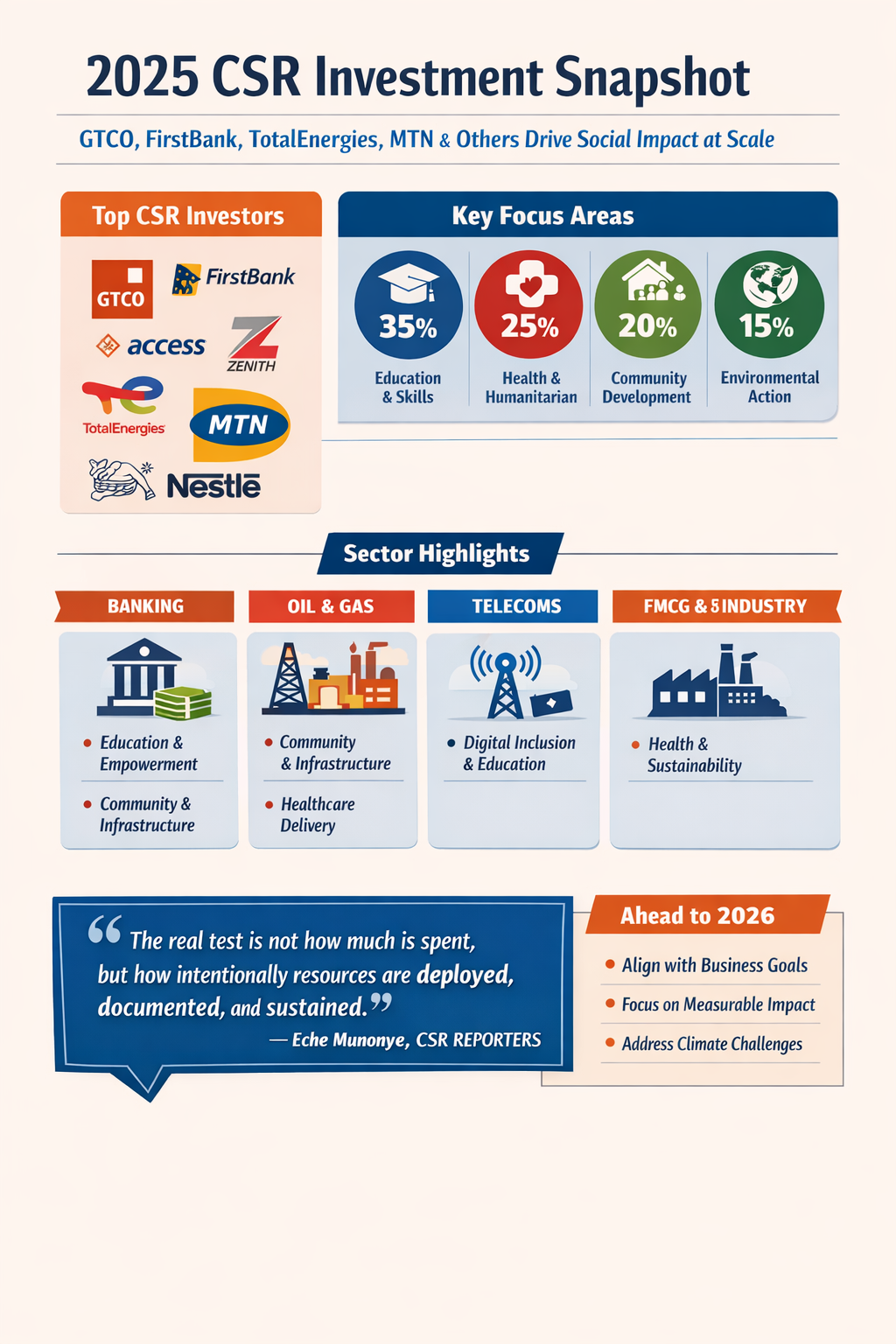
2025 CSR Investment Snapshot GTCO, FirstBank, TotalEnergies, MTN and Others Drive Social Impact at Scale
In a year shaped by inflation, foreign exchange volatility, rising operating costs, and broader economic uncertainty, Corporate Social Responsibility (CSR) spending in 2025 offers insight into how organisations prioritise social investment under pressure. While cost controls tightened and discretionary spending came under review for many businesses, several organisations continued to commit significant financial resources to CSR and sustainability initiatives.
This snapshot examines CSR investment trends in 2025, drawing from publicly available disclosures, sustainability and annual reports, foundation activities, and verified announcements. It is not a ranking, nor does it equate spending with impact. Instead, it highlights where large-scale CSR investments were concentrated, the themes they supported, and what this signals as organisations look toward 2026.
Banking Sector CSR in 2025: Institutionalised Social Investment
The banking and financial services sector remained one of the most prominent contributors to CSR spending in 2025. Institutions such as GTCO Plc, Access Bank Group, First Bank, Zenith Bank Plc, and United Bank for Africa (UBA) sustained significant investments, largely channelled through structured foundations.
CSR spending in the sector focused primarily on:
- Education and skills development
- Health interventions and outreach
- Youth and women empowerment
- Entrepreneurship support and financial inclusion
The presence of dedicated foundations has enabled continuity and scale, allowing banks to maintain national reach even in challenging conditions. Expectations around outcome measurement, transparency, and long-term impact tracking continue to grow.
Oil, Gas and Energy: Large-Scale CSR with Evolving Expectations
The oil and gas sector continued to account for some of the largest CSR budgets in 2025. TotalEnergies Nigeria, Shell Nigeria, and Chevron Nigeria Limited sustained multi-year investments in host community development.
Key focus areas included:
- Education scholarships and infrastructure
- Healthcare delivery and facilities
- Livelihood and economic development programmes
- Community infrastructure projects
These investments are often governed by established frameworks such as Global Memoranda of Understanding (GMoUs), which provide structure and community engagement mechanisms. As global energy transition debates intensify, stakeholders increasingly expect CSR investments from the sector to address environmental remediation, climate resilience, and sustainable livelihoods beyond fossil fuel dependency.
Telecommunications: Linking CSR Investment to Digital Inclusion
Telecommunications companies remained strong CSR investors in 2025, with MTN Nigeria and Airtel Nigeria sustaining significant funding through their foundations.
CSR initiatives in the sector focused on:
- Education and digital learning
- Youth skills development
- Health interventions
- Digital inclusion and access
By aligning CSR spending with their core business strengths, telecoms companies have enhanced relevance and scalability.
Manufacturing, FMCG and Conglomerates: Broad-Based Social Investment
Large FMCG and industrial groups such as Nestlé Nigeria Plc, Dangote Group, BUA Group, Lafarge Africa Plc, and Unilever Nigeria Plc maintained notable CSR investments in 2025.
These investments cut across:
- Nutrition and food security
- Water stewardship and sanitation
- Education and youth development
- Environmental sustainability
- Community infrastructure
For many organisations, CSR spending is increasingly viewed as part of supply-chain resilience and social licence to operate.
Where the Money Went: Key CSR Themes in 2025
Across sectors, CSR spending in 2025 clustered around a few dominant themes:
- Education and Skills Development – continued to attract the largest share of CSR funding.
- Health and Humanitarian Support – remained a priority amid ongoing social needs.
- Community Development and Infrastructure – particularly in host communities of large operations.
- Environmental Sustainability and Climate Action – growing, but still underfunded relative to climate risk.
This distribution highlights both progress and gaps. Climate adaptation and resilience remain areas where CSR investment lags behind urgency.
Beyond Spending: The Accountability and Transparency Gap
Despite significant financial commitments, documentation and impact reporting remained uneven in 2025. Stakeholders are increasingly focused on what changes CSR investments deliver rather than simply how much is spent. Transparency, independent documentation, and credible reporting are becoming essential components of responsible CSR practice.
A CSR REPORTERS Perspective
Eche Munonye, Publisher of CSR REPORTERS, observed that scale alone is no longer sufficient. CSR spending at scale is commendable, especially in a challenging economic year, but the real test is how intentionally resources are deployed, documented, and sustained. Leadership in CSR will increasingly be defined by clarity of impact rather than the size of budgets.
Looking Ahead to 2026: From Big Budgets to Strategic Impact
As organisations prepare for 2026, expectations around CSR will continue to rise. Those best positioned for leadership are likely to:
- Align CSR investments with core business strengths
- Prioritise measurable, long-term outcomes
- Expand focus to climate resilience and systems change
- Strengthen transparency and independent verification
The organisations that will stand out are those treating CSR as a long-term investment in trust, not a short-term reputational tool.
[give_form id="20698"]