Building a Sustainable CSR Strategy for SMEs in Lagos: A 2026 Blueprint
 csrreporters
What if the 3.2 million small businesses currently operating across Lagos State are actually better positioned to drive the United Nations Sustainable Development Goals than the multinational corporations they often envy? While over 75% of local entrepreneurs assume that meaningful social impact requires a massive treasury, the reality is that a focused csr strategy for sme lagos can transform a modest enterprise into a champion of community development. You’ve likely felt the frustration of being unable to match the philanthropic spending of tier-one banks, yet you know that your stakeholders expect more than just profit-driven motives.
It’s a common sentiment that the line between simple charity and strategic sustainability is blurry, often leaving Lagosian business leaders feeling paralyzed. This article provides a clear, actionable roadmap to help you bridge that gap, ensuring your brand earns the reputation it deserves while preparing your organization for the 2026 SISA Awards. We’ll examine how to measure the ROI of your social investments and align your local impact with global ESG standards to ensure your business doesn’t just survive, it leads.
Key Takeaways
- Transition from sporadic philanthropy to a structured, ESG-aligned framework that addresses the unique socio-economic landscape of Lagos in 2026.
- Discover how to spearhead high-impact initiatives through skill-based volunteering, proving that impactful social stewardship does not require a multinational budget.
- Follow a rigorous 5-step blueprint to build a sustainable csr strategy for sme lagos that aligns local community needs with global Sustainable Development Goals.
- Learn to position your business for prestigious recognition through the SISA Awards, leveraging corporate responsibility as a catalyst for growth and investment.
The Evolution of CSR for Lagos SMEs in 2026
The commercial heartbeat of Nigeria, Lagos State, has witnessed a profound transformation in how its 3.2 million small and medium enterprises perceive their role within the broader community. By 2026, the traditional model of erratic, seasonal philanthropy has been replaced by a sophisticated framework that aligns local business objectives with the global 2030 Agenda for Sustainable Development. This shift isn’t merely cosmetic; it’s a fundamental reimagining of the Corporate Social Responsibility mandate to suit the specific socio-economic pressures of a city with over 20 million residents. SMEs are no longer peripheral actors in social change. They’ve become the primary architects of localized impact, spearheading initiatives that address infrastructure gaps, youth unemployment, and environmental degradation across the 20 Local Government Areas.
Implementing a forward-thinking csr strategy for sme lagos entities is now a core requirement for accessing capital and attracting elite talent. In the Yaba tech hub, 2025 data from the Lagos State Employment Trust Fund indicated that firms with documented social impact programs enjoyed a 40% higher retention rate among software engineers compared to their peers. These professionals prioritize purpose. They seek organizations that don’t just generate profit but actively facilitate the achievement of the UN Sustainable Development Goals (SDGs), particularly Goal 8, which focuses on Decent Work and Economic Growth, and Goal 11, centered on Sustainable Cities and Communities. This demand for ethical leadership has turned social stewardship into a powerful tool for competitive differentiation in a crowded marketplace.
Beyond Philanthropy: The ESG Mandate
The transition from corporate gifting to rigorous Environmental, Social, and Governance (ESG) standards marks the maturity of the Lagosian business ecosystem. SME CSR is the strategic integration of social and environmental concerns into business operations and interactions with stakeholders to ensure long-term viability and ethical relevance. Modern consumers in Lagos demand transparency. A January 2026 consumer report revealed that 76% of residents in high-density areas like Mushin and Alimosho verify a company’s social claims before making repeat purchases. This scrutiny forces SMEs to move beyond performative gestures toward measurable, auditable governance structures that build lasting trust with their local customer base.
The Lagos Advantage: Agility in Impact
Lagos SMEs possess a unique agility that allows them to pivot and respond to local crises far faster than bureaucratic multinationals. While large corporations may take months to approve a budget for community intervention, a localized business can deploy resources within days to solve immediate challenges. For instance, EcoClean Lagos, a small recycling firm based in Surulere, successfully diverted 150 metric tons of plastic from the Lagos Lagoon in 2025 by partnering directly with local street sweepers. This hyper-local approach fosters deep brand loyalty in neighborhoods like Surulere and Lekki, where residents see the tangible benefits of a company’s presence in their daily lives. By solving the problems right outside their front doors, these businesses transform from mere service providers into essential community pillars. Developing a robust csr strategy for sme lagos organizations ensures that every naira spent on social impact also strengthens the company’s local market position.
Designing Your CSR Framework: The Three Pillars of Local Impact
Small and medium enterprises in Lagos operate within a complex socio-economic ecosystem that demands more than superficial philanthropy. To build a robust csr strategy for sme lagos, owners must move beyond ad-hoc donations toward a structured framework that mirrors the 2026 Lagos State Development Plan. This blueprint centers on three non-negotiable pillars: Community Investment, Environmental Stewardship, and Workplace Ethics. By championing these values, an SME transitions from a mere market participant to a pioneering force for regional progress.
Community Investment and Youth Empowerment
Lagos faces a youth unemployment challenge that requires urgent, private-sector intervention. SMEs located in industrial and commercial hubs like Ikeja or Mushin possess a unique opportunity to spearhead skill acquisition programs that provide tangible pathways to employment. Rather than generic outreach, successful firms are facilitating STEM education initiatives by partnering with local public schools to donate laboratory equipment or sponsor coding bootcamps. Effective community engagement requires formal stakeholder dialogue with local Baales and community leaders. These traditional authorities act as the bridge between corporate objectives and grassroots needs. Research into CSR strategies for small businesses indicates that local relevance is the primary driver of program longevity. By aligning with the aspirations of the local populace, a Lagos SME ensures its social license to operate remains secure through 2026 and beyond.
Sustainable Operations in a Mega-City
The environmental pillar focuses on mitigating the ecological footprint of business activities within the specific constraints of the Lagos landscape. Grid instability often forces SMEs to rely on diesel generators; however, the shift toward solar energy solutions represents a critical step in reducing carbon emissions while stabilizing operational costs. Forward-thinking enterprises are now pioneering waste-to-wealth programs in collaboration with the Lagos State Waste Management Authority (LAWMA). This partnership is essential as the state accelerates its 2024 ban on single-use plastics and non-biodegradable materials. By 2026, the Lagos government expects a 50% reduction in plastic waste entering the drainage systems. SMEs that proactively remove plastics from their supply chains today aren’t just following regulations; they’re demonstrating visionary leadership. This commitment to sustainability reflects a deeper understanding of the United Nations Sustainable Development Goal 11, which advocates for making cities inclusive, safe, and resilient.
The final pillar involves the dignity of the Nigerian workforce. Ethical corporate governance starts with ensuring that every employee, from entry-level staff to senior management, operates in an environment that respects their fundamental rights. This includes implementing fair wage structures that account for the 2024 inflation rates and providing comprehensive health insurance. When an SME prioritizes the well-being of its people, it fosters a culture of integrity that radiates outward to its clients and partners. This internal transformation is a core component of a holistic csr strategy for sme lagos. Organizations that excel in these areas are often those celebrated by the CSR Reporters awards committee for their dedication to social impact. By integrating these three pillars, Lagos-based SMEs can transform local challenges into opportunities for enduring corporate excellence.
Low-Budget, High-Impact: CSR Strategies for Resource-Constrained SMEs
The prevailing myth that a robust csr strategy for sme lagos requires a multi-million Naira treasury often prevents smaller enterprises from embarking on their sustainability journeys. This misconception ignores the reality that social impact is driven by intentionality rather than just financial volume. According to the 2023 Nigerian SME Report, 62% of small business owners believe they’re too small to make a difference. However, the most successful organizations realize that purpose-driven leadership yields high returns through enhanced brand equity and employee retention. It’s about shifting the perspective from “spending” to “investing” in the social fabric of Lagos.
Skill-based volunteering represents a high-leverage opportunity for SMEs to champion social change without depleting cash reserves. A boutique law firm in Lekki might dedicate 10 hours monthly to providing legal aid for small-scale traders; a tech startup in Yaba could spearhead weekend coding bootcamps for underprivileged youth. These actions align directly with UN Sustainable Development Goal 8, promoting decent work and economic growth. By leveraging the existing expertise of their workforce, businesses provide invaluable services that would otherwise be inaccessible to marginalized communities, all while boosting staff morale and professional development.
Micro-philanthropy offers another sustainable path for growth. Instead of a one-time, massive donation, an SME can commit to small, consistent contributions that build long-term trust. A bakery in Surulere that donates 3% of its weekly bread production to a local food bank creates a reliable support system. When paired with digital storytelling, these modest projects gain significant reach. Using platforms like LinkedIn to document these efforts allows a business to share its journey of giving back. This transparency builds a narrative of accountability that resonates with 85% of modern consumers who prefer ethical brands.
Strategic Partnerships over Solo Ventures
SMEs shouldn’t operate in isolation when they can pool resources for a larger footprint. By 2025, collaborative “Impact Clusters” in industrial areas like Agbara or Apapa are expected to facilitate a 20% increase in localized environmental projects. Working with established local NGOs helps SMEs navigate complex social issues without needing in-house experts. CSR Reporters plays a vital role in this ecosystem, acting as a bridge that connects corporate entities with reputable social partners to ensure every initiative is pioneering and impactful.
Measuring What Matters: SME Metrics
Effective reporting must move beyond the “Naira spent” metric to focus on tangible human and environmental outcomes. SMEs can track progress using simple tools like Google Sheets to record data such as the 450kg of waste diverted from Lagos Lagoon or the 15 students who completed a vocational program. These metrics are essential for any organization aspiring to be recognized at the CSR Reporters Awards. Impact documentation serves as the foundational architecture for scaling social influence; it transforms a quiet act of kindness into a public record of corporate excellence. This data-driven approach ensures that even the smallest SME can demonstrate its commitment to global ESG standards and a long-term csr strategy for sme lagos.
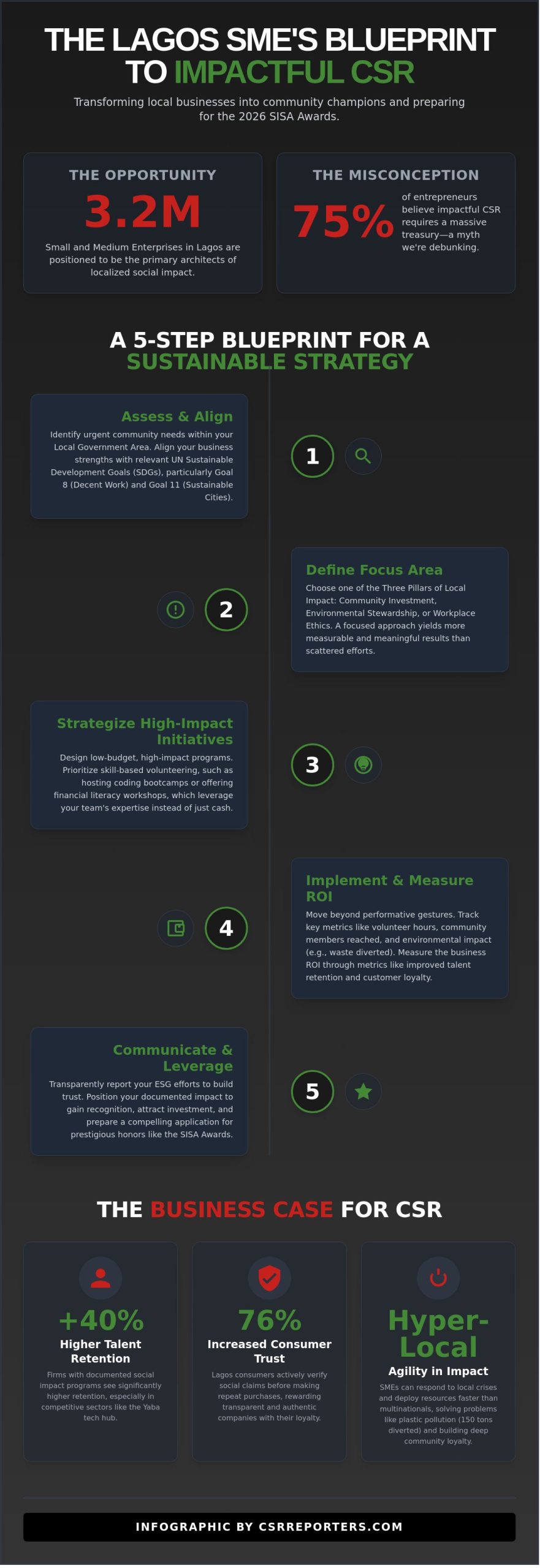
A 5-Step Blueprint for Implementing Your Lagos CSR Strategy
Developing a robust csr strategy for sme lagos requires more than just goodwill; it demands a structured approach that aligns with the city’s unique socio-economic pulse. Lagos is a high-energy environment where stakeholders value tangible results over vague promises. To succeed, SMEs must transition from ad-hoc donations to a methodical framework that mirrors global standards while addressing local realities.
Step 1: Conduct a Materiality Assessment. You can’t solve every problem in Lagos. Identify the issues that intersect with your business operations and matter most to your local customers. A 2023 survey of Lagos consumers indicated that 68% prefer brands that address local infrastructure or youth unemployment. Focus your resources where they generate the most significant community resonance.
Step 2: Define Clear, SDG-Linked Objectives. Align your initiatives with the United Nations Sustainable Development Goals (SDGs) to provide a universal language for your impact. Set measurable targets for 2026, such as providing vocational training to 100 youth in Yaba or reducing your plastic waste by 40%. These benchmarks transform your vision into a trackable corporate roadmap.
Step 3: Internal Alignment. Your Lagos-based team is your greatest asset. Ensure every employee, from the front desk to the boardroom, understands the “why” behind your mission. When staff members see their employer spearheading change in their own neighborhoods, it fosters a deep sense of institutional pride and loyalty.
Step 4: Execution and Documentation. Adopt the “Show, Don’t Tell” principle. If your SME funds a borehole in an underserved community like Makoko, don’t just write a caption; document the installation process. High-quality evidence serves as the bedrock of your corporate integrity and prevents accusations of “greenwashing.”
Step 5: Reporting and Visibility. Sharing your story isn’t bragging; it’s an act of transparency that inspires the wider business community. Use formal reporting structures to communicate your successes and lessons learned to your stakeholders, ensuring your brand is recognized as a leader in ethical business practices.
Engaging the Lagos Workforce
Building a culture of “Giving Back” starts with empowering your employees to lead. Many successful Lagos SMEs now incentivize staff to spearhead community projects within their specific Local Government Areas (LGAs), such as Ikeja or Alimosho. By allowing teams to nominate local causes, you’ll see a 25% increase in internal engagement rates. Create a narrative-driven internal report every quarter to celebrate these employee-led victories. This practice doesn’t just boost morale; it reinforces the idea that your company is a collective force for good in Nigeria.
Professional Documentation and Storytelling
High-quality visual storytelling is essential for any csr strategy for sme lagos aiming for national recognition. Short documentaries that capture the human element of your projects provide the emotional weight that data alone cannot convey. To gain broader visibility, organizations should leverage specialized platforms like CSR Reporters Magazine to showcase their initiatives to a wider audience of policy makers and industry peers. Preparing your first “Sustainability Report” using simplified GRI standards will further solidify your status as a transparent and accountable entity. This level of professionalism is what distinguishes a visionary SME from its competitors and prepares the brand for the prestigious CSR Reporters Awards.
Ready to elevate your brand’s reputation? You can feature your sustainability journey with us to inspire the next generation of ethical leaders in Africa.
From Strategy to Recognition: Positioning for the SISA Awards
The Social Impact and Sustainability Awards (SISA) represent the definitive benchmark for corporate excellence within the Nigerian business ecosystem. These awards aren’t mere ceremonies; they provide a rigorous audit of how organizations integrate the United Nations Sustainable Development Goals (SDGs) into their daily operations. For a local enterprise, developing a comprehensive csr strategy for sme lagos is the essential first step toward this prestigious recognition. When a business moves beyond sporadic philanthropy to structured stakeholder engagement, it builds the data-backed narrative that the SISA evaluation committee requires. This process forces a company to look at its environmental footprint and social equity with a level of scrutiny that mirrors international ESG standards.
Winning or even being nominated for a CSR award acts as a powerful catalyst for SME growth and institutional investment. Venture capital firms operating in the Yaba tech hub or the Victoria Island financial district increasingly prioritize ESG-compliant firms. A 2023 survey of Nigerian institutional investors revealed that 68% are more likely to fund SMEs with verified social impact credentials. This recognition validates the business model as sustainable, resilient, and low-risk. It tells the world that your company is built for the long term. This structured approach prepares you for the rigorous SISA evaluation, where documentation of impact is as important as the impact itself.
The future of ethical business in Africa is being written in the boardrooms of Lagos. As the city-state positions itself as a global financial hub by 2030, the leadership of SMEs in the sustainability space becomes critical. By pioneering ethical practices now, Lagos-based SMEs are not just following global trends; they’re leading the charge for a more equitable continent. This commitment to purpose-driven business ensures that growth is inclusive and that the benefits of commerce reach the deepest parts of our local communities.
The Benefits of Third-Party Validation
The CSR Reporters Awards function as a “Seal of Integrity” that differentiates an SME in a crowded marketplace. This validation provides a distinct competitive edge during government procurement processes, especially with agencies like the Lagos State Public Procurement Agency that value corporate responsibility. Winners gain extensive media coverage through the CSR Reporters platform, reaching a network of over 50,000 corporate leaders and policy makers. This visibility transforms a local brand into a recognized leader in ethical governance, facilitating smoother entries into international trade agreements where ESG compliance is mandatory.
Continuing the Journey with CSR Reporters
Sustaining impact requires constant evolution and expert guidance. CSR Reporters offers specialized advisory services that help management teams refine their csr strategy for sme lagos to meet evolving international standards. Through dedicated CSR training workshops, SME leaders learn to track specific metrics that matter to global partners. You don’t have to navigate this complex path alone. Join the movement for a more sustainable Lagos: Partner with CSR Reporters today and begin your journey toward institutional excellence.
Pioneering the Future of Purpose-Driven Business in Lagos
Transitioning from a profit-only model to a purpose-driven enterprise isn’t just a trend; it’s a strategic necessity for the 2,000+ small businesses navigating Nigeria’s commercial landscape. By adopting our 5-step blueprint, your organization can champion social change while maintaining fiscal health through resource-efficient initiatives. Implementing a robust csr strategy for sme lagos ensures your brand aligns with the 17 United Nations Sustainable Development Goals, bridging the gap between global standards and local community needs. These efforts don’t require massive capital outlays; they demand consistent stakeholder engagement and a commitment to transparent, ethical leadership.
As you position your brand for recognition at the 2026 Social Impact and Sustainability Awards (SISA), remember that your journey toward corporate excellence deserves expert guidance. CSR Reporters, the organizers of SISA and the leading African authority on ESG storytelling, provides specialized advisory for GRI-aligned sustainability reporting. We’ve documented over 500 corporate success stories, helping organizations shift from simple philanthropy to impactful governance. Develop Your Winning ESG Strategy with CSR Reporters Advisory and begin your journey as a visionary steward of the African continent. It’s time to give back and secure your legacy.
Frequently Asked Questions
What is the most effective CSR strategy for a small business in Lagos?
The most effective csr strategy for sme lagos centers on hyper-local community engagement that addresses specific neighborhood challenges like the 2023 Lagos State environmental initiatives. SMEs that commit 2% of their annual staff hours to local vocational training often experience stronger brand loyalty. Focusing on your immediate surroundings ensures that social impact remains visible and manageable for stakeholders within the local business ecosystem.
Do I need a large budget to start a CSR program in Nigeria?
You don’t need a multi-million Naira budget to launch a meaningful CSR program in Nigeria. Many successful small businesses begin by allocating just 1% of their annual net profit or providing pro-bono professional services to local schools. The 2022 Nigerian Code of Corporate Governance highlights that real impact stems from consistent value creation rather than the size of the financial donation.
How does CSR help an SME in Lagos gain a competitive edge?
CSR provides a vital competitive edge by building trust among the 70% of Nigerian consumers who, according to 2021 market data, prefer brands with clear social missions. A documented csr strategy for sme lagos serves as a powerful differentiator when bidding for contracts with global corporations. This ethical alignment often results in a 15% increase in staff retention rates among younger professionals.
What are the most relevant SDGs for businesses operating in Lagos?
The most relevant goals for businesses in Lagos include SDG 8, Decent Work and Economic Growth, and SDG 11, Sustainable Cities and Communities. These targets mirror the Lagos State Government’s T.H.E.M.E.S. Plus agenda which focuses on youth empowerment and infrastructure. Aligning your business operations with these specific goals ensures your social investments support the broader 2030 Agenda for Sustainable Development.
How can I document my company’s social impact effectively?
Documenting social impact requires the use of standardized frameworks like the Global Reporting Initiative to ensure transparency and credibility. Your 2024 impact report should feature specific metrics, such as the 50 students mentored or 1,000 kilograms of waste recycled, alongside stakeholder testimonials. Proper documentation simplifies the auditing process and provides the evidence needed to apply for prestigious industry awards.
What is the SISA Award, and how can my SME apply?
The Social Impact and Sustainability Awards, or SISA, is a prestigious annual event organized by CSR Reporters to celebrate organizations spearheading ethical business practices. SMEs can submit their applications through the CSR Reporters digital portal during the nomination period which usually starts in July. This platform acts as a credible validator of your firm’s dedication to the socio-economic growth of the African continent.
Can CSR initiatives help with tax incentives in Nigeria?
Yes, Nigerian legislation offers tax incentives via Section 25 of the Companies Income Tax Act, which permits deductions for donations to recognized public institutions. These allowable deductions are limited to 15% of the company’s total profit for the specific assessment year. Engaging a tax consultant ensures your 2024 financial records correctly document these philanthropic efforts to optimize your corporate tax position.
How do I choose the right NGO to partner with for my CSR projects?
Selecting the right NGO involves verifying their registration with the Corporate Affairs Commission and analyzing their project reports from the last 3 years. You should partner with organizations that maintain a 90% transparency rating and possess deep expertise in your chosen focus area. Successful collaborations thrive when both parties share a commitment to the long-term stewardship of the Nigerian community.
[give_form id="20698"]