csrreporters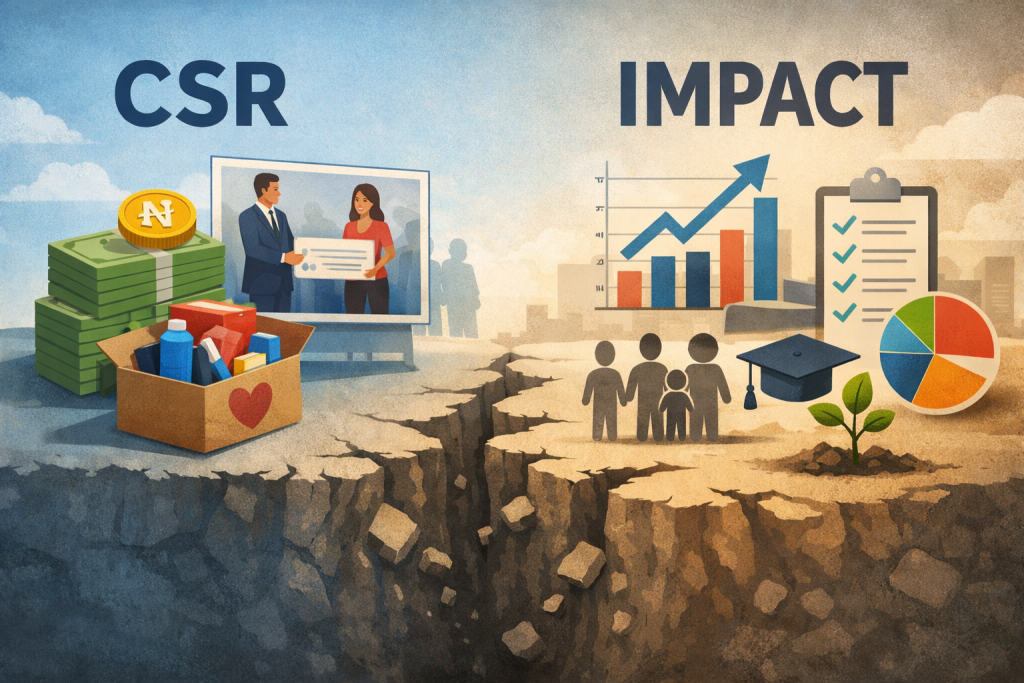
CSR in Nigeria must move from visibility to verifiable impact
Introduction: The Trust Deficit Is Real
In boardrooms across Lagos, Abuja, and Port Harcourt, Corporate Social Responsibility has long been framed as a communications asset. Press conferences with oversized cheques. Branded relief materials after floods. School renovations that make the annual report look good. The formula is familiar, and increasingly, it is failing.
Nigerian consumers, employees, and communities have grown more discerning. With the rise of social media scrutiny, civil society accountability networks, and a younger generation demanding authenticity, performative CSR no longer delivers reputational return. What it does deliver is cynicism.
According to the Edelman Trust Barometer Africa Report, trust in business institutions across sub-Saharan Africa remains fragile, with companies frequently cited as prioritising profit over community wellbeing. Nigeria is not exempt from this trend. Given the country’s deep infrastructural gaps, regional inequalities, and governance deficits, the stakes are higher, and the opportunity for genuine impact is more profound.
This article offers a clear-eyed framework for Nigerian companies ready to close the gap between CSR as public relations and CSR as a verifiable driver of social value. The question is not whether your organisation can afford to invest in impact. The question is whether it can afford not to.
The Problem with CSR as It Is Practised in Nigeria
1. Optics Over Outcomes
The dominant CSR model in Nigeria is event-driven. Companies mobilise resources around World Environment Day, International Women’s Day, or the dry-season hunger season, then retreat until the next calendar trigger. However, these initiatives generate photographs, not progress. They build brand recall, not community resilience.
The most damaging consequence is not wasted money, rather, it is the erosion of legitimacy. Consequently, communities that have received ‘support’ for a decade with no discernible change in their livelihoods begin to read CSR gestures as transactional rather than transformational.
2. Misalignment Between Business and Social Investment
There is a persistent disconnect between what companies do commercially and what they fund through CSR. An oil and gas firm funds arts scholarships. A fast-moving consumer goods company builds football pitches. While these may address real needs, they reflect no strategic logic, and therefore cannot be sustained or scaled.
Therefore, effective CSR demands that companies invest in areas where their operational presence, expertise, and supply chains create natural leverage. This is not a limitation; it is a multiplier.
3. The Accountability Void
Perhaps the most critical structural failure is the near-total absence of public accountability in Nigerian CSR reporting. Few organisations publish disaggregated data on their social investments. Fewer still subject those reports to independent verification. Consequently, we get an environment where it is impossible to distinguish genuinely impactful programmes from well-packaged optics.
A Framework for Effective CSR: The Five Pillars of Verified Impact
The following framework is designed for Nigerian companies operating at the intersection of commercial ambition and social obligation. It draws from global best practice, adapted for the Nigerian operating environment.
| Pillar | What It Means | Nigerian Context Example |
|---|---|---|
| 1. Strategic Alignment | CSR goals tied to core business operations and sector challenges | A telecoms company funding digital literacy schools in underserved LGAs |
| 2. Stakeholder Co-design | Communities participate in designing programmes, not just receiving them | Niger Delta communities co-creating environmental remediation timelines |
| 3. Measurable Outcomes | Clear KPIs, baselines, and third-party verification | Annual SDG-aligned impact reports with independent auditors |
| 4. Long-term Commitment | Multi-year programmes, not one-off cheques | 5-year agriculture empowerment programmes with milestone reviews |
| 5. Public Accountability | Publishing results that include what failed and inviting scrutiny | Open-access CSR dashboards updated quarterly |
Global Best Practices and What Nigeria Can Learn
Unilever: Embedding Sustainability in Commercial Strategy
Unilever’s Sustainable Living Plan directly tied social and environmental targets to business growth metrics. Rather than treating CSR as a separate department, Unilever integrated sustainability into its supply chain, product development, and sales targets. The lesson for Nigerian companies is integration: CSR must not live in a separate silo from operations, sales, and strategy.
🇳🇬 Nigeria Application
A Nigerian consumer goods company could tie CSR investment to its distribution network, funding entrepreneur training for market women who sell its products in rural areas, thereby advancing both gender empowerment and commercial reach.
PS: We recently analyzed the sustainability aspect of Unilever Nigeria’s 2025 Annual Report
Safaricom (Kenya): Community Infrastructure as Competitive Differentiation
Safaricom’s M-PESA not only transformed financial inclusion across East Africa but demonstrated that solving a community problem at scale can be the company’s most powerful commercial offering. Their CSR was inseparable from their product. Nigerian telecoms and fintech companies have a nearly identical opportunity with financial access, health data, and digital literacy.
🇳🇬 Nigeria Application
MTN Foundation and similar bodies should consider co-developing programmes with state ministries of education and community development, creating data-sharing frameworks that allow outcomes to be measured over five-year periods and shared publicly.
Patagonia (USA): Radical Transparency and Advocacy
Patagonia built one of the world’s most trusted brand identities not by doing more CSR, but by being brutally honest about the environmental cost of its own products and advocating loudly for policy change. Its ‘Don’t Buy This Jacket’ campaign, urging customers to consume less, earned more trust than any product launch.
For Nigeria, the equivalent would be companies that publicly acknowledge the environmental or social costs of their operations, commit to measurable remediation, and report on both progress and setbacks without spin.
The Nigerian CSR Landscape: Where Are the Gaps?
The Niger Delta: Decades of Missed Opportunity
The oil-producing communities of the Niger Delta represent the starkest illustration of CSR failure in Nigeria. Despite decades of mandated community development contributions by international and indigenous operators, poverty rates, unemployment, and environmental degradation remain among the highest in the country. The Global Memoranda of Understanding (GMoUs) introduced by Shell and Chevron in the early 2000s were celebrated as a new model, but implementation failures, governance gaps within community institutions, and inadequate monitoring have produced mixed results at best.
The lesson here is not that companies cannot make a difference. Rather, it is that extractive investments in communities require extraordinary accountability structures, independent oversight, and a genuine commitment to community agency.
Emerging Sectors: Tech, Fintech, and Agriculture
Nigeria’s rapidly growing tech and fintech sectors represent a new generation of CSR opportunity, and responsibility. These companies touch the daily economic lives of millions of Nigerians, yet their formal CSR investment remains nascent. Meanwhile, studies by CSR Reporters show that the agricultural sector, which employs over 35% of Nigeria’s working population, is chronically underserved by corporate social investment.
These gaps are not failures of goodwill. Rather, they are failures of imagination and strategy.
Practical Recommendations for Nigerian Corporate Leaders
For Boards and C-Suite Executives
- Mandate that the same board committees that oversee financial risk and regulatory compliance review your CSR strategy.
- Tie at least one executive performance indicator to measurable social outcomes. Not spend, but impact.
- Require annual independent third-party verification of CSR claims before they appear in public communications.
- Engage with Nigeria’s emerging ESG disclosure frameworks and align with UN SDG reporting standards proactively, not reactively.
For CSR and Sustainability Teams
- Design every new programme with a Theory of Change: define the problem, the intervention, the expected outcome, and the measurement approach before the first naira is spent.
- Build community advisory structures that have genuine power to redirect programmes that are not working, not rubber-stamp consultation forums.
- Create multi-year budgeting cycles for CSR investment. Impact does not operate on annual financial calendars.
- Publish failures because the companies that report honestly on what did not work are the ones that earn durable credibility.
For Communications and Brand Teams
- Shift the narrative from activities to outcomes. For example, replace “We donated ₦50m to education” with “School completion rates in our partner communities increased by 18% over three years.”
- Resist the temptation to over-communicate early-stage programmes. Let results lead, not launches.
- Build relationships with civil society organisations, journalists, and community voices who can provide independent validation of your claims.
The Policy Dimension: Regulation as an Accelerant
Voluntary CSR will not be sufficient to close Nigeria’s trust gap. Therefore, there is a growing case for policy intervention, not to mandate specific activities, but to require disclosure, verification, and community consent.
The Securities and Exchange Commission (SEC) Nigeria and the Nigerian Stock Exchange (NGX) have begun integrating ESG disclosure requirements for listed companies. This is a welcome development. However, disclosure requirements must be accompanied by a standardised reporting framework developed in consultation with civil society, communities, and international accountability bodies.
The Companies and Allied Matters Act (CAMA) 2020 introduced provisions for large companies to disclose social and environmental impact. Enforcement and standardisation of this requirement would be a transformative step, and one that Nigerian business leadership should champion, not resist.
Conclusion: The Credibility Dividend
There is a compelling business case for verified CSR, one that goes beyond reputation management. Companies that build genuine trust with communities, regulators, and civil society gain a social license to operate that no amount of marketing spend can manufacture. They attract purpose-driven talent and reduce the frequency and severity of community-related operational disruptions. They are better positioned to navigate regulatory change.
In Nigeria’s increasingly complex operating environment, shaped by infrastructure deficits, economic volatility, and a restive, connected citizenry, the companies that will lead the next decade are not those with the largest CSR budgets. They are those that can demonstrate, with data and with humility, that their presence in communities creates more than it extracts.
The shift from PR to impact is not a moral luxury. It is a strategic necessity.