Drilling for Profit, Donating for Optics: How Corporate Nigeria Profits from Poverty It Helps Sustain
 csrreporters
Drilling for Profit, Donating for Optics: How Corporate Nigeria Profits from Poverty It Helps Sustain
Picture the scene. A canopy is erected at the edge of a community. Plastic chairs arranged in neat rows. A banner — corporate colours, bold logo, the word ’empowerment’ prominently displayed. Officials take the podium. There are speeches about shared value, about giving back, about the company’s deep commitment to the people it serves. A borehole is commissioned. Photographs are taken. A press release is drafted before the event ends.
Two kilometres away, a pipeline belonging to the same company runs through farmland it contaminated a decade ago. The compensation case is still in court. The soil has not recovered. The farmers whose livelihoods it destroyed were not invited to the canopy event. They would not have recognised the community being described in those speeches.
This is not a single incident from a single company. It is a pattern. Across Nigeria’s oil-producing south, its urban commercial centres, its agricultural belts, and its underserved northern communities, a version of this scene repeats itself with remarkable consistency. Companies extract value, generate profit, and then allocate a fraction of those gains to visible, photographable acts of giving — while the structural conditions that make the giving seem necessary remain firmly in place.
The question this article asks is not whether companies should engage their communities. Of course they should. The question is harder: what does it mean when the same companies that profit from Nigeria’s broken governance environment present themselves as part of the solution to it?
CSR in Nigeria has become a sophisticated exercise in narrative management. The story it tells about corporate responsibility and the reality it obscures about corporate conduct are rarely the same story.
THE CSR INDUSTRIAL COMPLEX
Nigeria has one of the most active CSR landscapes on the African continent — measured, at least, by activity. There are annual awards ceremonies, sustainability reports running to dozens of pages, community investment programmes with dedicated teams and communication budgets, and a growing industry of consultants, NGOs, and media platforms built around the business of corporate social responsibility.
What this ecosystem has not produced is a credible, independently verified record of impact.
CSR reporting in Nigeria is almost entirely voluntary. Companies report what they choose to disclose, in formats they design, to audiences that lack the data to challenge their claims. There is no national framework mandating what must be reported. There is no independent body tasked with verifying whether the borehole was actually built, whether the scholarship actually reached students, whether the health outreach actually produced health outcomes. The market for CSR stories in Nigeria is a market without quality control.
Into this vacuum, appearance has become the primary currency. A well-produced sustainability report earns more reputational capital than a poorly communicated genuine intervention. A branded community project with good photography outperforms a structural policy commitment with no photo opportunity. The incentive system, from awards to media coverage to investor relations, rewards visibility. It does not reward verifiable outcome.
The result is an industry that is very good at generating evidence of effort and very poor at generating evidence of change. Corporate Nigeria spends significantly on CSR communications. It spends far less on asking whether any of it works.
PROFITING FROM THE CONDITIONS YOU HELP CREATE
To understand the deeper problem, it is necessary to look not just at what companies give, but at how they earn.
Consider the oil and gas sector — the most visible and most scrutinised corner of corporate Nigeria. International and local oil companies have operated in the Niger Delta for over six decades. In that time, they have extracted hundreds of billions of dollars in value. They have also, in that same time, polluted waterways, flared gas at volumes that contribute to respiratory illness and environmental degradation, displaced communities, and contested compensation claims in courts for years, sometimes decades.
The CSR programmes of these companies — clinics, classrooms, skill centres — are real. The money spent on them is real. But set against the scale of extraction, and set against the environmental and social damage that extraction has produced, the arithmetic is uncomfortable. The giving does not come close to offsetting the taking. And in many cases, what is being given addresses the symptoms of damage the company itself inflicted.
When you pollute the river and donate water filters, you have not become responsible. You have become efficient at managing the consequences of your irresponsibility.
The pattern is not exclusive to extractives. The banking sector earns significant revenue from a financial system that excludes the majority of Nigerians and charges punishing fees to those it does include. Its financial literacy CSR programmes reach thousands. Its interest rate structures affect millions. The telecommunications sector profits from data pricing that keeps internet access unaffordable for most Nigerians while running digital inclusion campaigns. The fast-moving consumer goods sector benefits from a retail ecosystem built on informal labour with no job security, no benefits, and no voice — and funds youth empowerment programmes.
In each case, the CSR investment addresses a condition that the company’s own business model perpetuates. This is not coincidence. It is the structural logic of CSR in an environment where the rules of business are weak enough to be shaped by those with the power to shape them.
STRUCTURAL COMPLICITY: BEYOND INDIVIDUAL BAD ACTORS
It would be convenient if this were a story about a few bad companies. It is not. It is a story about a corporate culture — across sectors, across company sizes, across Nigerian and multinational ownership structures — that has made a collective accommodation with a broken system.
That accommodation takes several forms.
Tax behaviour is perhaps the most consequential and least discussed. Nigeria’s tax-to-GDP ratio is among the lowest in the world. A significant share of that gap is attributable not to individual citizens evading taxes, but to corporations — through transfer pricing, through the use of tax incentives that are negotiated rather than earned, through the informal arrangements that reduce effective tax rates well below statutory ones. Every naira not paid in tax is a naira the state cannot spend on the infrastructure that would make CSR unnecessary. Corporate tax behaviour in Nigeria is, functionally, a policy decision about who funds public services.
Regulatory capture is the second form. Nigerian regulatory agencies are persistently underfunded, understaffed, and in some cases structurally compromised by the industries they are meant to oversee. This does not happen by accident. Industries with the resources to influence the shape of their regulatory environment often do so — through lobbying, through the revolving door between industry and regulatory appointments, through the quiet cultivation of relationships that make enforcement a negotiation rather than a consequence. Companies that benefit from weak regulation have an interest in keeping it weak. Some exercise that interest actively.
Labour practices constitute the third dimension. Informal employment, casualisation, and the use of contractors to avoid obligations to permanent staff are endemic across Nigerian industries. The workers who deliver the profits from which CSR budgets are drawn are, in many cases, denied the wages, security, and dignity that genuine corporate responsibility would require. A company cannot be considered socially responsible if it funds a scholarship programme while paying its cleaning staff poverty wages through a third-party contractor.
Structural complicity is not about intent. It is about the cumulative effect of choices — on taxes, on regulation, on labour — that maintain the conditions from which the business benefits and from which its CSR programmes derive their justification.
None of this is unique to Nigeria. Corporate capture of regulatory environments, aggressive tax minimisation, and labour casualisation are global phenomena. What makes Nigeria distinctive is the scale of the gap between the rhetoric and the reality — and the sophistication of the CSR infrastructure that has been built to bridge that gap perceptually, without bridging it materially.
THE VERIFICATION PROBLEM
At the heart of this entire arrangement is a simple, devastating fact: nobody is checking.
Impact claims in Nigerian CSR go almost entirely unverified. A company announces that it has trained 10,000 youth in digital skills. Who counted? A company reports that it has provided clean water to 50,000 community members. Who visited? A company states that its environmental remediation programme has restored degraded land to productive use. Who measured the soil?
The answers, in the overwhelming majority of cases, are: nobody independent, nobody with the mandate to publish a contrary finding, nobody with any consequence attached to discovering that the claim does not hold up.
This is not a minor technical problem. It is a fundamental corruption of the accountability function that CSR is supposed to serve. When impact claims cannot be verified, the entire enterprise becomes a communication exercise. Resources flow to projects that photograph well rather than projects that work. Communities learn to perform beneficiary status rather than report genuine outcomes, because honest reporting produces no reward and may produce retaliation. The feedback loop between investment and impact is severed.
For investors and international partners applying ESG frameworks to Nigerian corporate actors, this verification gap should be a serious concern. ESG scores built on unverified self-reported data are not ESG scores. They are brand assessments dressed in sustainability language. The capital allocation decisions made on the basis of those scores are therefore operating on incomplete — and in some cases, deliberately curated — information.
The communities that paid the highest price for this verification failure are those that believed the promises. The village that was told remediation was complete and planted crops on contaminated soil. The youth cohort that enrolled in a skills programme that had no pathway to employment. The women’s cooperative that received seed funding with no follow-up support and watched it fail. These are not hypothetical cases. They are the documented, recurring reality of unverified CSR in environments where accountability infrastructure does not exist.
WHAT GENUINE RESPONSIBILITY ACTUALLY LOOKS LIKE
This article is not an argument against corporate community engagement. It is an argument for making that engagement mean something.
Genuine corporate responsibility in Nigeria’s context begins not with what a company gives, but with how it earns. A company that pays its taxes honestly, in full, on time, contributes more to Nigeria’s development than one that donates ten times its tax savings to branded community projects. A company that pays fair wages to every worker in its value chain — including the contracted and casual workers it pretends are not its responsibility — does more for human welfare than one that sponsors a skills acquisition programme. A company that complies with environmental regulations without waiting to be sued preserves more community wellbeing than one that rehabilitates damage it should never have caused.
This is not idealism. It is a definition of the baseline. Everything called CSR that falls below this baseline is not responsibility — it is PR with a development vocabulary.
Above that baseline, genuine engagement looks different from what currently dominates the landscape. It is long-term rather than episodic. It is co-designed with communities rather than delivered to them. It is independently monitored and publicly reported against measurable outcomes. It is connected to the company’s core business in ways that address structural conditions rather than surface symptoms. And it is honest about what it cannot fix — because some of what needs fixing requires government action, policy reform, and institutional change that no company, however well-intentioned, can substitute for.
The most valuable thing corporate Nigeria could do for the communities it operates in is to advocate loudly, publicly, and persistently for the accountability systems that would hold everyone — including itself — to a higher standard. Mandatory CSR disclosure. Independent impact verification. Transparent tax reporting. Credible environmental enforcement. These are not threats to responsible business. They are the infrastructure that makes responsible business legible, credible, and rewarded.
Companies that resist these systems do so because they benefit from their absence. That is the most honest statement about corporate responsibility in Nigeria that can be made.
The gap between what corporate Nigeria says about responsibility and what it does about the conditions that make responsibility necessary is not a communications problem. It is a conduct problem. Addressing it requires honesty from every actor in the ecosystem.
To corporate boards and CSR teams:
The era of unverified impact claims, unaudited community investment figures, and sustainability reports that say everything except what matters most — is ending. Not because regulators have demanded it. Because the credibility of your entire ESG narrative depends on whether independent scrutiny would confirm what your reports assert. Commission genuine third-party verification of your impact. Publish the findings, including the ones that are unflattering. Audit your own tax behaviour, your labour practices, and your regulatory relationships before you publish another sustainability report. Responsibility that cannot survive scrutiny is not responsibility.
To institutional investors and ESG rating agencies:
ESG frameworks applied to Nigerian corporate actors using self-reported, unverified data are producing scores that do not reflect reality. If your due diligence does not include independent community-level verification, on-the-ground environmental assessment, and transparent tax analysis, you are rating stories, not performance. The capital you allocate on the basis of those ratings is either rewarding genuine responsibility or subsidising its imitation. The difference matters — to the communities involved, and eventually to your own risk exposure.
To civil society, independent media, and accountability institutions:
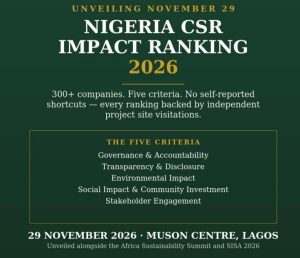
The verification gap in Nigerian CSR will not close itself. It requires organisations with the independence, the mandate, and the methodological credibility to go where the claims are made and ask whether they hold up. That means community-level reporting, beneficiary interviews, environmental monitoring, and the willingness to publish findings that powerful companies would prefer to remain unpublished. This is not adversarial journalism for its own sake. It is the accountability function that the market, left to itself, will never perform.
The canopy will be erected again next quarter. The banner will be different. The speeches will sound familiar. The pipeline will still be there. The question is whether, the next time, anyone will be watching closely enough to notice the distance between the two.
[give_form id="20698"]