csrreporters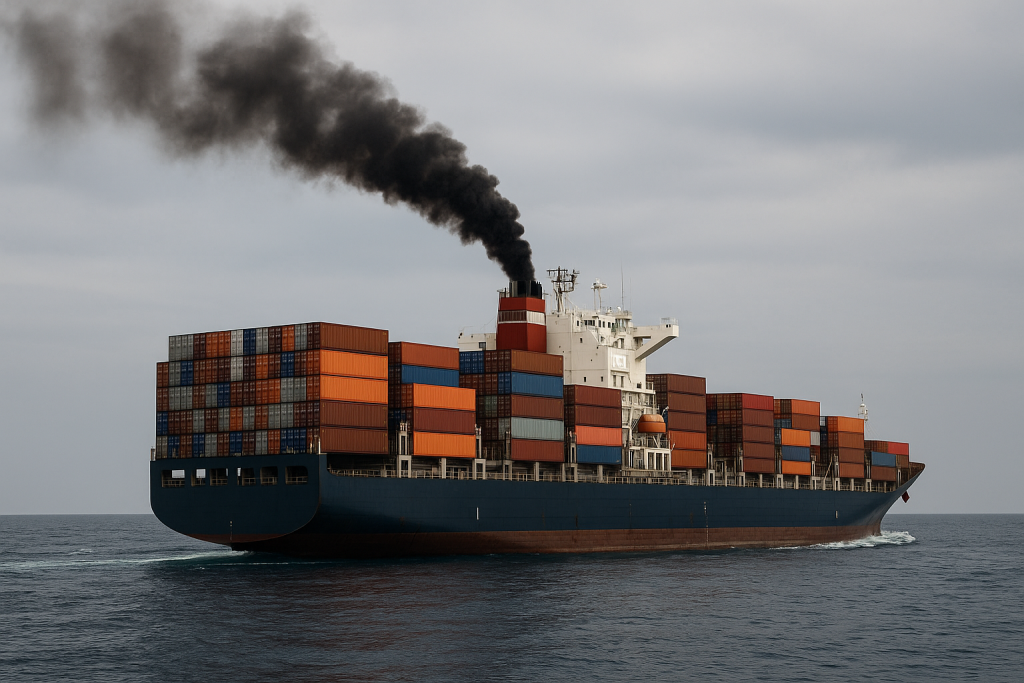
As the global race toward net zero accelerates, Nigeria is raising a critical question that sits at the heart of climate action: who really pays the price for sustainability?
At the center of this debate is global shipping, an industry responsible for moving nearly 90% of world trade and contributing about 2–3% of global greenhouse gas emissions. With mounting pressure to decarbonize, regulators are pushing for stricter environmental standards. But for countries like Nigeria, the transition presents a complex dilemma: how to support climate ambition without undermining economic survival.
In recent high-level engagements with the International Maritime Organization and bilateral discussions with Saudi Arabia, Nigeria’s Minister of Marine and Blue Economy, Adegboyega Oyetola, made the country’s position clear climate action must be fair, inclusive, and grounded in economic reality.
A Push for Equity in Climate Action
Nigeria is not resisting decarbonization. Rather, it is calling attention to how it is implemented.
The concern is straightforward: the financial and technological demands of transitioning to low-carbon shipping—cleaner fuels, upgraded fleets, and new compliance systems—are significant. For many developing countries, these costs are not easily absorbed.
This is why Nigeria is aligning its argument with the long-established principle of common but differentiated responsibilities, which recognises that while all nations must act on climate change, they do not share equal capacity or historical responsibility. Developed economies, having contributed more to global emissions and possessing stronger financial systems, are expected to support others through funding, technology transfer, and capacity building.
Without this balance, Nigeria warns that climate policies risk becoming uneven in their impact, placing heavier burdens on those least equipped to manage them.
Shipping as an Economic Lifeline
For Nigeria, shipping is not an abstract global system—it is deeply tied to everyday life and economic stability.
The country relies heavily on maritime trade for crude oil exports and the importation of essential goods, from food items to industrial materials. Ports and shipping-related activities sustain thousands of jobs, while the cost of moving goods across seas directly affects prices in local markets.
If decarbonisation measures lead to higher shipping costs, the effects will not remain at the industry level. They will filter down to businesses and consumers. A rise in logistics expenses could mean more expensive goods on store shelves, tighter margins for small businesses, and increased pressure on households already dealing with rising living costs.
For many Nigerians, the implications of global shipping reforms could show up not in policy papers, but in everyday expenses.
The Broader Net Zero Conversation
Nigeria’s position on shipping reflects a wider concern about the global push toward net zero emissions by 2050.
While the goal is widely supported, the path to achieving it is far from uniform. Developed nations are advancing rapidly, backed by access to capital, technology, and infrastructure. Developing countries, on the other hand, are still addressing fundamental challenges such as energy access, industrial growth, and job creation.
Nigeria’s argument is not against climate ambition, it is against a one-size-fits-all approach.
A transition that does not account for different starting points risks slowing development in countries that are still building their economic foundations. For these nations, climate action must be integrated with growth, not imposed in a way that disrupts it.
Avoiding a New Layer of Inequality
A key concern raised by Nigeria is the possibility that global climate policies, if not carefully designed, could unintentionally create new inequalities.
Higher compliance costs in shipping could make it more difficult for developing countries to compete in international trade. Businesses in these economies may struggle to keep up with new standards, while companies in wealthier nations adapt more easily.
The result could be a widening gap:
- Increased costs for imports and exports
- Pressure on jobs within maritime and port sectors
- Reduced competitiveness for local industries
- Greater economic imbalance between developed and developing regions
In this context, climate action becomes not just an environmental issue, but a question of fairness in the global economic system.
Building Through Partnerships and the Blue Economy
Nigeria is also looking beyond the challenges toward potential opportunities.
Discussions with Saudi Arabia have highlighted areas of cooperation, including maritime security, training, and investment in the blue economy, the sustainable use of ocean resources to drive economic growth.
For Nigeria, the blue economy presents a pathway to diversification. With its coastline and marine resources, the country has the potential to expand into sectors such as fisheries, marine transport, tourism, and renewable ocean energy.
However, turning this potential into reality depends on access—access to financing, technology, and fair participation in global markets. Without these, the benefits of the blue economy may remain limited.
What This Means for Business and CSR
Nigeria’s stance is not only relevant to policymakers, it also carries weight for businesses and corporate responsibility leaders.
For companies operating in shipping and logistics, the message is clear: sustainability strategies must consider both environmental and economic impact. Reducing emissions is essential, but how that transition is managed matters just as much.
Investors are increasingly focused on environmental, social, and governance (ESG) standards, pushing companies to be transparent about their operations. This includes not only emissions data, but also how business decisions affect communities, markets, and economic stability. Read Purpose 2035
For local companies, there is an opportunity to engage with emerging frameworks that prioritizes fairness in decarbonization. Partnerships, innovation, and alignment with inclusive sustainability goals could open new pathways for growth.
From a CSR perspective, this moment highlights an important shift. Responsibility is no longer limited to environmental performance; it extends to ensuring that sustainability efforts do not unintentionally harm vulnerable economies or populations.
The Global Policy Landscape
The International Maritime Organization has set ambitious targets to reduce emissions from international shipping, including a significant cut by 2050 compared to 2008 levels.
Meeting these targets will require major changes, from the adoption of alternative fuels such as hydrogen and ammonia to improvements in energy efficiency and potential carbon pricing systems.
While these measures are necessary, they also come with high costs. For developed economies, these costs may be manageable within existing systems. For developing nations, they can pose serious challenges without external support.
This is why Nigeria’s call for fairness is gaining attention, it reflects a broader need to ensure that global solutions are designed to work across different economic realities.
Nigeria’s Voice on the Global Stage
As Africa’s largest economy and a key player in maritime trade, Nigeria is in a position to influence conversations around climate policy.
By advocating for equity in shipping reforms, the country is contributing to a larger effort to ensure that developing nations are not sidelined in global decision-making processes. Its position resonates with many countries facing similar challenges, strengthening a collective call for more inclusive frameworks.
This role is not just about representation; it is about shaping outcomes that reflect diverse realities and shared goals.
A Defining Test for Climate Justice
The transition to low-carbon shipping is often framed as a technical challenge, but it is equally a test of global fairness.
Nigeria’s position brings attention to a critical balance: the need to act decisively on climate change while ensuring that the path forward does not disadvantage those with fewer resources.
For CSR leaders, policymakers, and businesses, this is a moment that calls for thoughtful action. Sustainability must go beyond targets and timelines it must consider people, economies, and the systems that connect them.
In the end, the success of global climate efforts will not be measured by emissions reductions alone. It will also be defined by how inclusive and equitable those efforts are.
Because the future of global shipping will not just depend on how green it becomes—but on how fair it is to everyone navigating the journey.
[give_form id="20698"]