CHUKS OLUIGBO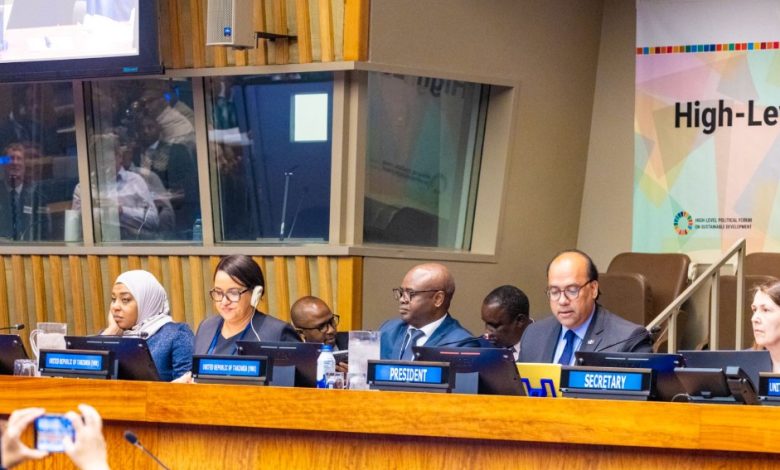
Image credit: Daily News
Tanzania showcased its progress on the Sustainaable Development Goals (SDGs) on Wednesday, 15 July 2026, at the United Nations High-Level Political Forum (HLPF) on Sustainable Development in New York, United States.
The progress report was contained in Tanzania’s Third Voluntary National Review (VNR) on the implementation of the Sustainable Development Goals presented by Minister of State in the President’s Office for Planning and Investment, Prof Kitila Mkumbo.
Prof Mkumbo had earlier addressed the General Debate of the Forum on Monday, 13 July, stating that his country had continued to make steady progress towards achieving the SDGs despite global challenges, including climate change, economic shocks and regional conflicts.
Key Areas of Achievement
Prof Mkumbo’s presentation on Monday showed Tanzania has recorded remarkable progress across a number of the SDGs, The Citizen said in a post on Instagram. The areas of progress include expanded access to clean water and sanitation, strengthened healthcare services, improved access to quality education, wider electricity coverage, accelerated digital transformation, increased investment in strategic infrastructure, stronger domestic resource mobilisation, and enhanced capacity of public institutions.
On Wednesday, he told the United Nations High-Level Political Forum (HLPF) on Sustainable Development that Tanzania has increased access to clean water (SDG 6) in rural areas from 72.3 per cent in 2020 to 85.3 per cent in 2025.
Highlighting progress in the energy sector (SDG 7), he noted that 86.2 per cent of Tanzanians now have access to electricity, even as the country’s electricity generation capacity has more than doubled.
Prof Mkumbo’s report further showed that Tanzania has made significant progress in SDG 9 on industry, innovation and infrastructure, contributing to an increase in railway passengers from 1.2 million to 4.1 million.
Speaking on SDG 17, which focuses on partnerships for sustainable development, he said the implementation of the goals has been driven by strong collaboration among all stakeholders, including the private sector, civil society organisations, and development partners.
“More than 824 civil society organisations and 1,000 private sector institutions participated in the preparation of this report,” he said.
The Path to Progress
In a 2020 paper “Localizing the Sustainable Development Goals: The case of Tanzania”, two scholars, Kristina Jönsson and Magdalena Bexell, highlighted how localizing the 2030 Agenda in Tanzania was helping the country’s progress in the SDGs. The scholars found that the government, civil society organizations, the UN, members of parliament and demands for review at the UN High-level Political Forum were the major drivers of localization.
Tanzania localized the 2030 Agenda within its National Five-Year Development Plan (2021/2022–2025/2026).
On Monday, Prof Mkumbo said Tanzania views the 2030 Agenda as an integral part of its long-term development journey, explaining that the agenda has been aligned with the National Development Vision 2050 through the Fourth Five-Year Development Plan (FYDP IV), providing a framework for sustaining progress on the SDGs beyond 2030.
According to him, the implementation of the country’s National Development Vision 2050 would accelerate the achievement of the SDGs by fully integrating them into the country’s short-, medium- and long-term development plans.
What’s Left Undone
Despite the steady progress it has made, Tanzania still lags in some of the SDGs, dogged by persistent gaps between policy and implementation.
A January 2020 Health Policy Plus report said Tanzania was making progress across eight goals but nine additional goals—including ending poverty—required further effort.
Beyond ending extreme poverty and economic inequalities, Tanzania needs to accelerate progress in the area of Gender Equality, where Equal Measures 2030 SDG Gender Index said progress remains very slow, as well as Universal Health Coverage (SDG 3) and Financing & Data (SDG 17).
The Road Ahead
Going by Prof Mkumbo’s presentations, Tanzania has not only demonstrated progress towards achieving the SDGs but also shown commitment to accelerating the implementation of the 2030 Agenda for Sustainable Development in the four years remaining before the global deadline.
As part of the commitment, he outlined seven priority areas for his country in the coming years to include modernising agriculture, advancing industrial development, expanding the blue economy, strengthening resilience to climate change, accelerating digital reforms, investing in human capital, and increasing domestic resource mobilisation to drive inclusive and sustainable economic growth.
What now remains is to stay the course. The year 2030 is around the corner.
[give_form id="20698"]