ONYINYECHI NWAIGBA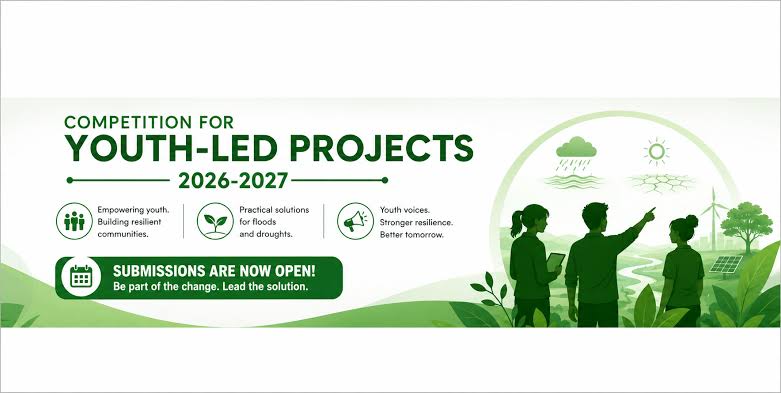
What if the next practical solution to Nigeria’s flood and drought challenges comes from a young person with an idea that simply needs the right support?
A global competition is giving young innovators an opportunity to turn such ideas into action.
The World Meteorological Organization (WMO), through its Associated Programme on Flood Management and Integrated Drought Management Programme, has opened applications for the 2026–2027 Global Integrated Flood and Drought Management Competition for Youth-Led Projects.
The competition is looking to support youth-led initiatives that can help vulnerable communities prepare for, respond to and become more resilient to floods and droughts.
Two selected projects will each receive CHF 3,000 to support implementation, alongside expert guidance on flood and drought management.
The projects will have up to nine months to implement their initiatives.
Why this matters
For communities facing recurring flooding, drought, water insecurity and other climate-related risks, resilience is not simply an environmental conversation.
It is also about livelihoods, education, health, infrastructure and community safety.
The WMO says extreme weather events are increasingly disrupting lives, threatening food and water security and exposing weaknesses in disaster preparedness.
Young people are often among those most affected. Yet they are also capable of developing solutions that respond directly to the realities of their communities.
That is the thinking behind the competition.
Rather than simply encouraging young people to talk about climate change, the initiative is designed to help them develop and implement practical solutions.
Projects could explore areas such as community preparedness, early warning systems, low-cost adaptation methods, waste management, nature-based solutions, disaster-risk reduction and approaches that combine indigenous knowledge with scientific methods.
The competition also encourages strong youth participation and innovative approaches that can be sustained or scaled beyond the initial project period.
Nigeria has already shown what is possible
There is a particularly important Nigerian example behind this year’s call.
In the 2025 edition, GreenQuest: Flood Resilience through Gamification and Community Action, led by Grace James, was selected as one of the winning projects.
The initiative focused on strengthening flood resilience in vulnerable Lagos communities, using gamification, storytelling and community engagement to improve flood preparedness.
The project has engaged young people and communities around issues including flood preparedness, waste management and early warning systems.
One of its approaches was the development of an educational game, GreenQuest: Rescue Tides, designed to help young people learn about flood risks in a more interactive way.
The project also included practical activities around low-cost flood mitigation techniques and community engagement.
This is significant because it demonstrates that youth-led climate solutions do not necessarily have to begin with massive infrastructure projects.
Sometimes, innovation can start with education, technology, community participation and a better understanding of local problems.
The WMO says the 2025 competition received 334 project proposals from around the world, highlighting the growing interest among young people in tackling water-related challenges.
Who can apply?
The competition is open to students and young professionals aged 18 to 35.
Applicants must propose projects that are genuinely youth-led and actively involve young people in their implementation.
According to the WMO, proposed projects should:
- Have clear objectives, timelines and scope.
- Provide a tangible contribution to flood or drought resilience.
- Be practical and results-oriented.
- Be implemented within a maximum of nine months.
- Have potential to be sustained or scaled.
- Include a feasible innovative element.
Projects may be submitted in English or Spanish, and each proposal can only be submitted once.
The deadline for applications is August 31, 2026.
More than funding
The CHF 3,000 prize is useful, but the opportunity goes beyond the money.
Selected project leaders will also receive guidance and support from experts working in flood and drought management.
For a young climate innovator, that access can be just as valuable as the funding itself.
An idea may be promising, but turning it into a project that can demonstrate measurable results, engage communities and potentially scale requires knowledge, mentorship and implementation support.
That is where opportunities like this can make a difference.
Nigeria continues to face significant climate and environmental challenges, from flooding in urban communities to pressures on water resources and livelihoods.
Addressing these challenges will require government action, private-sector investment and institutional support.
But it will also require young people who understand the problems in their communities and are willing to build solutions.
The next big climate solution may not come from a large institution.
It could come from a young innovator with an idea, a community that needs it and an opportunity to make it work.
How to Apply
Interested young people can review the submission guidelines and apply through the official programme page
[give_form id="20698"]