When Climate Risk Becomes an Investment Question: Nigeria’s Push for Resilient Infrastructure
 ONYINYECHI NWAIGBA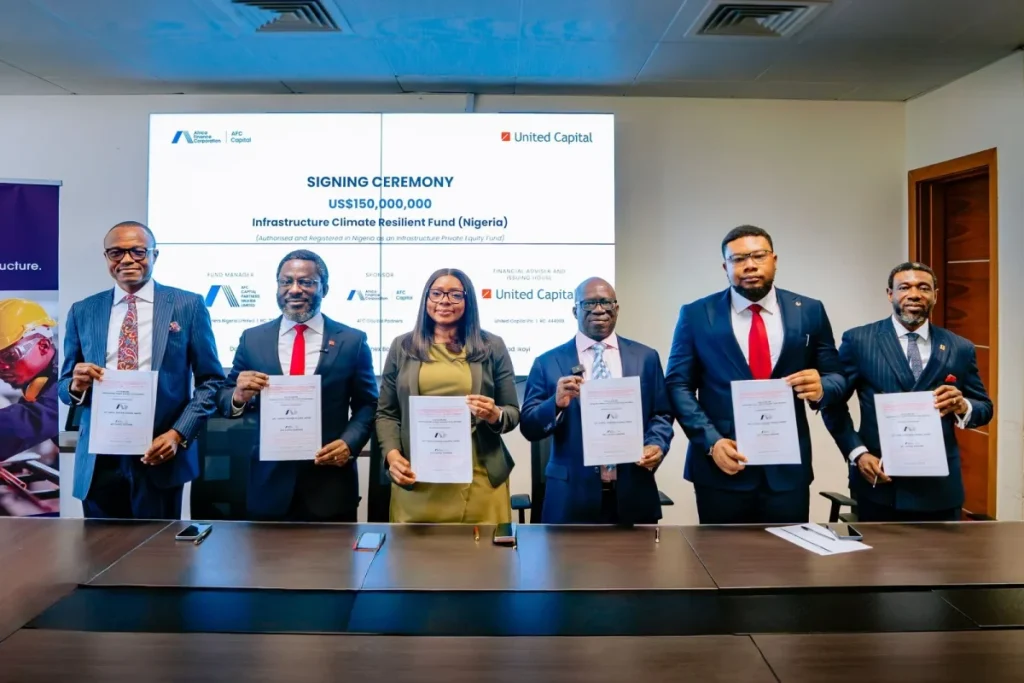
As flooding, extreme heat and other climate risks increasingly threaten infrastructure and raise the cost of doing business, Nigeria is looking to institutional capital to help finance infrastructure that can withstand a changing climate.
For years, conversations about climate change in Nigeria have largely focused on emissions, renewable energy and the country’s vulnerability to extreme weather.
But there is another part of the climate conversation that is becoming increasingly difficult to ignore.
Infrastructure.
A road damaged by flooding is not simply an environmental problem.
It can become a transportation problem.
A disrupted transport route can become a logistics problem.
A damaged power facility can become a business problem.
And when infrastructure repeatedly fails under climate pressure, the economic consequences can eventually reach households and consumers.
This is why climate resilience is increasingly moving from the margins of environmental discussions into the center of investment decisions.
A new $150 million infrastructure fund launched in Nigeria is putting that question directly on the table.
AFC Capital Partners, the asset management subsidiary of Africa Finance Corporation, has launched the Infrastructure Climate-Resilient Fund Nigeria, a Securities and Exchange Commission-registered vehicle designed to mobilize domestic institutional capital for climate-resilient infrastructure projects. The Nigerian fund forms part of a broader $750 million pan-African Infrastructure Climate-Resilient Fund.
At first glance, it is an investment story.
From a CSR and ESG perspective, however, there is a bigger question underneath it:
What happens when climate resilience becomes part of the way infrastructure is financed?
Climate Resilience Is Becoming an Economic Necessity
Climate change is often discussed in terms of future risks.
For infrastructure, many of those risks are already here.
Flooding can damage roads and disrupt transportation.
Extreme temperatures can accelerate the deterioration of infrastructure.
Heavy rainfall can affect drainage systems, bridges and other critical assets.
For businesses, these disruptions can mean delayed deliveries, higher logistics costs, damaged goods and lost productive time.
For communities, they can mean reduced access to markets, schools, healthcare and employment opportunities.
The result is that climate vulnerability can translate directly into economic vulnerability.
Africa Finance Corporation’s Chief Risk Officer, David Johnson, said Africa loses an estimated $200 billion annually because of climate-related disruptions. He also pointed to flooding and rising temperatures as specific threats to Nigerian transport infrastructure.
That puts climate resilience in a different context.
It is not simply about protecting infrastructure from environmental damage.
It is also about protecting the economic activity that depends on that infrastructure.
The Infrastructure Financing Problem
Nigeria’s infrastructure needs have long exceeded the capacity of public financing alone.
Roads, transport systems, energy infrastructure, digital networks and industrial facilities require significant long-term investment.
At the same time, climate change means that simply building more infrastructure is no longer enough.
The infrastructure has to be designed to withstand the conditions it is likely to face.
That can make projects more expensive at the beginning, but potentially less costly over their lifetime.
A road designed without adequate consideration for flooding, for example, may require repeated repairs.
A transport system that does not account for rising temperatures may experience faster deterioration.
A power project exposed to climate risks without adequate resilience measures can face disruptions that affect both operators and customers.
This creates a difficult financing question.
Who pays for resilience before the damage occurs?
The new fund is attempting to address part of that challenge by connecting institutional capital with infrastructure projects that incorporate climate resilience from the beginning.
Turning Institutional Savings Into Infrastructure
One of the most interesting aspects of the initiative is where the money is expected to come from.
The fund is designed to attract capital from Nigerian institutional investors, including pension fund administrators, insurers, asset managers and other long-term investors.
That matters because Nigeria has a substantial pool of domestic savings.
According to figures cited at the fund’s launch, Nigeria’s pension assets alone are estimated at between ₦31 trillion and ₦32 trillion.
The challenge is not simply having capital.
It is directing enough of that capital towards productive, long-term investments that can also address pressing development needs.
This is where climate finance becomes particularly interesting.
Institutional investors need returns.
Infrastructure needs capital.
Communities need resilient systems.
And governments need development that can withstand environmental and economic shocks.
A well-structured climate investment vehicle attempts to bring those interests together.
Beyond the $150 Million
The $150 million target is significant, but the potential impact of the initiative goes beyond the fund itself.
The Nigerian vehicle is part of a wider $750 million pan-African climate-resilient infrastructure initiative, with the broader programme targeting a project financing pool of about $3.7 billion.
That structure is important because infrastructure projects often require substantially more capital than one fund can provide.
The objective is therefore not simply to spend $150 million.
It is to use institutional and blended capital to unlock additional investment.
The Green Climate Fund is supporting the vehicle through first-loss capital and technical assistance, mechanisms designed to reduce investment risks and attract additional private-sector financing.
This is an important part of the climate-finance equation.
Some infrastructure projects may be socially or economically valuable but difficult for investors to finance because of perceived risks.
Blended finance can help absorb part of those risks, making it easier for commercial capital to participate.
In other words, the objective is not only to provide money.
It is to make more money available for projects that matter.
Transport and Renewable Energy Are Critical
The first sectors expected to receive attention from the Nigerian fund include transport and renewable energy.
That combination makes sense.
Transport infrastructure sits at the centre of Nigeria’s economic activity.
Roads, logistics networks and other transport systems determine how efficiently people and goods move around the country.
When climate events disrupt these systems, the consequences can spread across supply chains.
A resilient transport system can therefore have benefits far beyond the physical infrastructure itself.
It can help businesses move goods more reliably.
It can reduce disruption for commuters.
It can support access to markets.
And it can potentially reduce some of the costs associated with repeated infrastructure damage.
Renewable energy presents another opportunity.
Nigeria’s energy challenges are closely connected to its development challenges.
Investments that expand cleaner energy while also strengthening resilience could contribute to both environmental and economic objectives.
The fund’s broader strategy also covers areas such as digital infrastructure and industrial development.
Climate Resilience Is Also a Social Issue
There is a tendency to think of climate resilience as something that belongs to engineers, investors and environmental experts.
But infrastructure ultimately serves people.
When a road becomes impassable because of flooding, the people affected are commuters, traders, farmers, students and businesses.
When power infrastructure fails, households and companies bear the consequences.
When logistics networks are disrupted, the effects can eventually show up in the prices consumers pay.
That makes resilient infrastructure part of social sustainability.
A climate-resilient road is not simply a stronger road.
It can mean a farmer has a better chance of getting produce to market.
It can mean a business is less likely to lose inventory because of transportation delays.
It can mean workers are able to reach their workplaces more reliably.
The social value of infrastructure is therefore closely connected to its resilience.
But Financing Is Not the Same as Impact
There is, however, an important distinction that should remain at the centre of the conversation.
Launching a climate fund is an output.
It is not yet an impact.
The $150 million target tells us about the scale of the investment vehicle.
It does not tell us how many kilometres of roads will become more resilient.
It does not tell us how many communities will experience fewer disruptions.
It does not tell us how much logistics costs will fall.
It does not tell us how many jobs will be created.
And it does not tell us how much climate-related damage will ultimately be avoided.
Those are the questions that will matter when the fund begins deploying capital.
A climate-resilient infrastructure investment should eventually be assessed not only by how much money it attracts, but by what that money changes.
The Accountability Question
This is where ESG principles become particularly relevant.
The fund’s investment approach incorporates climate-risk screening and assessment across the infrastructure lifecycle, from planning and design through construction and operation.
That is encouraging because resilience cannot be added as an afterthought.
It has to be considered when a project is being designed.
But investors, project developers and other stakeholders will eventually need measurable indicators.
For example:
How much climate risk does a project reduce?
How much additional cost is avoided because resilience measures were incorporated early?
How many people benefit from the infrastructure?
Does the project reduce disruption during extreme weather events?
Does it improve access to essential services?
What environmental and social safeguards are being applied?
These questions can help distinguish genuine climate impact from simply attaching the word “climate” to an infrastructure investment.
The Private Sector Has a Role to Play
The development of climate-resilient infrastructure cannot rest entirely on government.
Businesses are among the biggest users of infrastructure and among those most exposed when it fails.
Manufacturers need reliable logistics.
Retailers need functioning supply chains.
Agricultural businesses need roads and storage systems.
Technology companies need dependable digital infrastructure.
Financial institutions need stable economic systems in which their customers can operate.
This means resilient infrastructure is ultimately a private-sector issue as well.
Companies should therefore pay attention not only to their own emissions, but also to the resilience of the systems their businesses depend on.
That is part of the shift from traditional CSR towards broader ESG thinking.
The question is no longer simply:
What is the company doing for the environment?
It is also:
How resilient is the business ecosystem in which the company operates?
Nigeria’s Long-Term Savings Could Become Part of the Solution
Perhaps one of the most important ideas behind the fund is the attempt to connect long-term savings with long-term development.
Pension funds and other institutional investors are designed to think beyond immediate returns.
Infrastructure also requires a long-term perspective.
Climate resilience requires an even longer one.
Bringing these elements together could create an opportunity for Nigerian capital to participate more directly in the country’s infrastructure development while seeking financial returns.
AFC Capital Partners describes its approach as using ESG-centric investment strategies to address Africa’s infrastructure needs while seeking competitive returns for investors.
That balance is important.
Climate finance cannot rely entirely on philanthropy.
For it to scale, investors need viable financial models.
The challenge is to ensure that financial returns do not come at the expense of environmental and social outcomes.
The Bigger Question: Who Benefits From Climate Finance?
This may ultimately be the most important question.
Climate finance can sound abstract when discussed in terms of funds, institutional investors, blended finance and investment vehicles.
But the consequences are very concrete.
A resilient road can affect how quickly food reaches a market.
A reliable renewable-energy project can affect whether a business can operate consistently.
A stronger transport network can influence the cost of moving goods.
A climate-resilient infrastructure system can determine how quickly a community recovers after extreme weather.
That is where the social impact becomes visible.
The success of climate finance should therefore not be measured only by how much capital is mobilised.
It should also be measured by what becomes more resilient because that capital was deployed.
From Climate Risk to Climate Opportunity
Nigeria’s infrastructure challenge is enormous.
So is its climate challenge.
But the two do not necessarily have to be treated as separate problems.
Infrastructure investment can become an opportunity to build systems that are better prepared for the future.
Climate finance can become a mechanism for directing capital towards those systems.
And institutional investors can become part of a development story that extends beyond financial returns.
The launch of the $150 million Infrastructure Climate-Resilient Fund is therefore more than another investment announcement.
It is a test of whether Nigeria can begin connecting capital, infrastructure and climate resilience in a way that produces measurable economic and social value.
The fund now has to move from launch to deployment.
Projects will have to be selected.
Capital will have to be mobilised.
Infrastructure will have to be built or strengthened.
And eventually, the results will have to be measured.
Because climate resilience is not proven by the size of a fund.
It is proven when infrastructure continues to serve people and businesses even as the risks around it change.
The real success of climate finance will not be the money raised. It will be the resilience that money creates.
[give_form id="20698"]