ROSEMARY IMOBHIO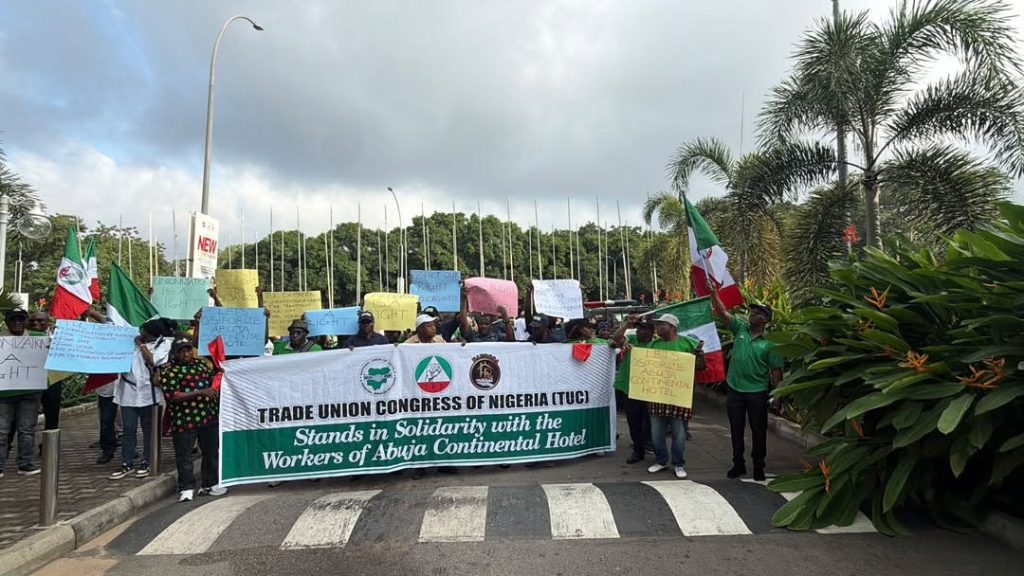
When members of the Trade Union Congress of Nigeria (TUC) and its affiliates blocked the gates of Abuja Continental Hotel on Monday, August 25, 2026, they were not merely staging a protest. They were reopening a question that many Nigerian employers would rather avoid. What does it actually mean to respect a worker’s right to organise, and who gets to decide when that right has been denied?
The picketing, led by TUC alongside the Hotel and Personal Services Senior Staff Association (HAPSSAN) and the National Union of Professional and Allied Staff of Nigeria (NUPSI), shut the hotel’s entrance for hours. However, the story that followed was not a simple one of workers against management. It was, instead, a dispute in which workers themselves ended up on opposite sides.
The Fight Over The Right To Organise
TUC Secretary-General Nuhu Toro told journalists that the union had exhausted efforts at dialogue before resorting to industrial action. According to Toro, TUC wrote to hotel management on August 4 seeking talks. However, management reportedly indicated it might not be available until the end of November because of ongoing renovation work. Toro described that response as unacceptable given what he called the urgency of workers’ concerns.
Toro also used the phrase “slaves” to characterise how affected workers were being treated. A description that HAPSSAN’s leadership echoed in stronger terms. It alleges that the hotel had been run “like a slave camp” since new investors took over after the COVID-19 pandemic. These remain the union’s characterisations rather than established findings, and CSR Reporters presents them as such.
TUC said picketing would continue through Friday, after which the union would review the situation. Importantly, Toro insisted that TUC remained open to negotiation if management showed readiness to engage in good faith. The union’s central demand, he said, was straightforward. That workers be allowed to exercise their constitutional and statutory rights to unionise and bargain collectively.
Workers Tell A Different Story
Not every voice at the hotel supported the picketing. Workers seconded to Abuja Continental through outsourcing firms publicly dissociated themselves from the action. Speaking through spokesman Samuel Esiakpoyere, they said their decision not to join the protest was deliberate, not coerced.
The workers argued that union membership is, in their words, a matter of individual choice, citing the TUC’s own constitution as recognising voluntary membership. They said they receive salaries and welfare benefits regularly, including HMO coverage. Also, that management operates an open-door policy with existing channels for raising concerns. Consequently, they urged the public not to associate them with the industrial action.
For its part, Abuja Continental Hotel management issued a statement rejecting claims of unfair labour practices. It said it fully respects workers’ freedom of association under Section 40 of the Nigerian Constitution, while categorically denying that it had prevented or attempted to prevent employees from exercising that right. TUC, meanwhile, rejected the argument that these workers’ position settled the matter. It is insisting the broader issue concerns the collective freedom to organise, not the preferences of any single group.
A Recent Warning From The Aviation Sector
This is not the only recent Nigerian dispute to raise these questions. On August 11, 2026, aviation unions led by the Nigeria Labour Congress and TUC picketed Air Peace terminals in Lagos, Abuja and Enugu, disrupting flights and stranding passengers.
Air Peace said it suffered losses exceeding ₦2 billion. It accused the unions of defying a Federal High Court injunction obtained in April 2024. This, the airline said, barred efforts to force its employees into union membership against their will. The Nigeria Civil Aviation Authority intervened, urging restraint, and operations later resumed pending further mediation.
The Air Peace case differs materially from the Abuja Continental dispute in its facts, its legal posture and its industry context. Nonetheless, taken together, both disputes suggest that questions of unionisation, worker choice and collective bargaining are increasingly visible flashpoints across Nigerian workplaces.
Where Worker Choice Meets Collective Rights
At the heart of both disputes lies a genuine tension. On one hand, freedom of association and collective bargaining are recognised internationally. Including under ILO Conventions 87 and 98, as fundamental principles at work.
On the other hand, individual workers retain the right to decide whether or not to join a union. A principle the dissenting Abuja Continental workers invoked directly. Responsible labour relations, therefore, cannot simply favour one principle over the other.
The Esg Test For Responsible Employers
Increasingly, how a company treats its workforce is judged as part of the Social pillar of ESG, alongside environmental performance and governance. Employee welfare, grievance mechanisms, job security and genuine worker-management dialogue all fall within this frame. So does Sustainable Development Goal 8, which calls for decent work and inclusive economic growth.
Investors, regulators and increasingly guests and clients now scrutinise these practices. This is not out of sentiment, but because unresolved labour disputes can disrupt operations, damage reputation and signal weaker governance overall.
The Outsourcing Question
The presence of outsourced workers at Abuja Continental adds another layer of complexity. When staff are supplied by third-party contractors, questions naturally arise over who bears responsibility for their welfare, representation and access to grievance channels: the hotel, the outsourcing firm, or both.
This does not mean outsourcing itself is improper. It does mean, however, that responsible employers must extend human rights due diligence to workers regardless of who technically employs them.
What Responsible Labour Relations Should Look Like
Ultimately, neither picketing nor blanket denial resolves genuine grievances. What both the Abuja Continental and Air Peace cases point to is the need for transparent grievance systems. It also pinpoints the importance of timely dialogue and mutual respect between employers and workers. Alongside space for individual choice within collective structures.
As more Nigerian workplaces face similar tests, how employers respond, openly or defensively, may increasingly shape how the market and regulators judge them.
[give_form id="20698"]