


 csrreporters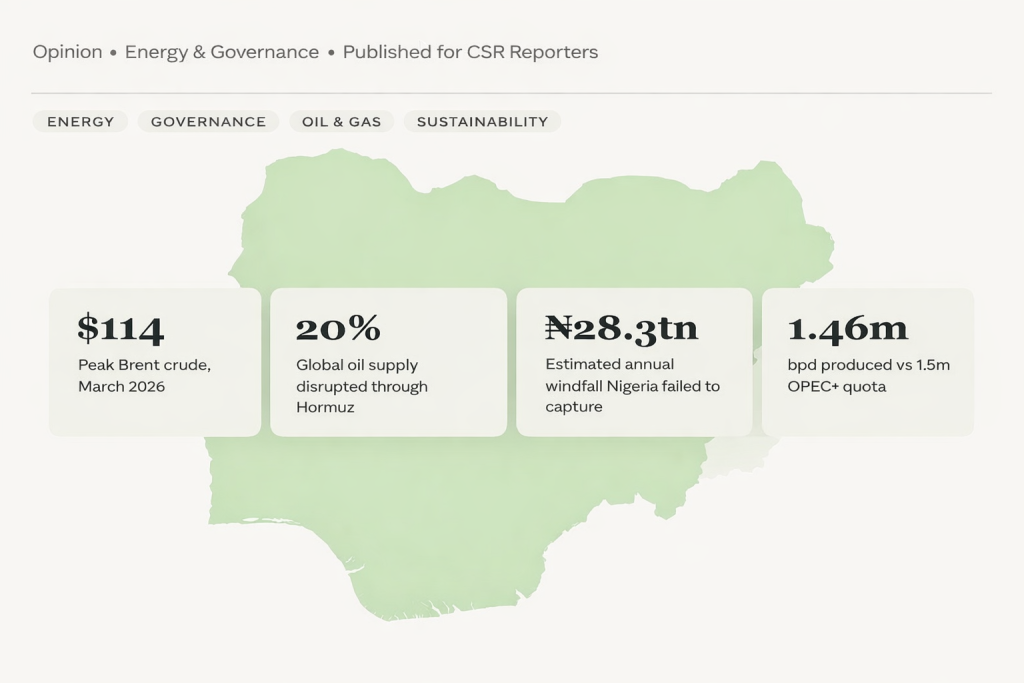
When the Strait of Hormuz shut the world’s oil tap, Nigeria sat on the remedy. What happened next is a story we have told before — and still refuse to end differently.
On February 28, 2026, the United States and Israel launched Operation Epic Fury against Iran. Within days, the Islamic Revolutionary Guard Corps declared the Strait of Hormuz closed to Western-allied shipping. As a result, tanker traffic collapsed by more than 95 percent.
Subsequently, Brent crude surged from below $70 to nearly $120 a barrel, while European natural gas prices jumped more than 70 percent. Therefore, the world’s energy system entered a full crisis, desperately scanning the horizon for an alternative supply.
Nigeria, a country sitting on the sixth-largest gas reserves on the planet and positioned along the Atlantic seaboard, far from any naval mine or drone, should have been that alternative. It was not.
To understand why, it helps to consider what the opportunity looked like from outside. Europe was suddenly short of roughly 12 to 14 percent of its LNG supply, the portion it normally receives from Qatar via the Strait. Belgium’s Fluxys began exploring alternative sources. Italy scrambled toward Algeria.
In response, Brussels convened emergency energy councils. Consequently, there was a rare and fleeting window in which African gas, specifically Nigerian gas, could have reoriented Europe’s energy dependency for a generation.
Algeria is already constructing the Trans-Saharan Gas Pipeline, a 4,128-kilometre corridor designed to carry 30 billion cubic metres per year from Nigeria’s southern fields through Niger and Algeria and into existing European gas corridors. This pipeline would give Europe a fixed, overland, blockade-proof supply route and construction was supposed to begin in 2026. However, it will not.
A Pipeline Fifty Years in the Making
The Trans-Saharan pipeline has been described as “imminent” since the 1970s. It was revived in 2002 through a memorandum of understanding between NNPC and Algeria’s Sonatrach. A feasibility study in 2006 then declared it technically and economically viable.
Additionally, a new MoU was signed in 2022 with fresh enthusiasm following Russia’s gas cutoff to Europe. Unfortunately, Niger’s military coup in 2023 fractured the transit corridor. Political relations with Niamey deteriorated, and ECOWAS sanctions followed. As a result, the pipeline stalled once again.
Nigeria pivoted diplomatically toward the Nigeria-Morocco Gas Pipeline as an alternative, but that project is still years from completion. Consequently, while Europe searched for supply alternatives in March 2026, Nigeria had nothing ready to offer. The pipeline remained a line on a map.
“The Trans-Saharan pipeline has been ‘imminent’ since the 1970s. The only thing we have successfully built around Nigerian gas is an extraordinary architecture of delay.”
The One Bright Spot and What It Reveals
There is, however, a brighter chapter in this story, and it belongs to the Dangote Petroleum Refinery. Having reached its 650,000 barrel-per-day nameplate capacity in February 2026, the refinery quickly emerged as Africa’s emergency fuel supplier.
When the crisis severed cheap refined products from the Gulf and disrupted the European supply chains that West Africa had relied upon, Dangote moved fast. It began shipping 12 cargoes totalling 456,000 tonnes to Ivory Coast, Cameroon, Tanzania, Ghana, and Togo. South Africa, Ghana, and Kenya then opened negotiations for long-term supply agreements.
For the first time, Nigeria’s refining capacity was meeting 92 percent of domestic petrol demand and doubling fuel exports to 214,000 barrels per day. In a continent where the refining-to-production ratio has long been a structural embarrassment, this was a genuine breakthrough.
Even so, the Dangote story carries the fingerprints of familiar dysfunction. The refinery needs roughly 13 to 15 crude oil cargoes per month to operate at full capacity. However, NNPC, the national oil company obligated to supply it, was allocating only five. After sustained public pressure in late March, that number rose to seven.
Therefore, the refinery was forced to import crude on international markets at premium prices during the very oil boom that should have cheaply supplied it from Nigeria’s own fields. This is not irony. Rather, it is governance failure in its most concentrated form.
Meanwhile, petrol prices for ordinary Nigerians rose from around N830 per litre before the war to N1,300 and above. Diesel climbed from N950 to N1,650. The refinery designed to act as a buffer against global price shocks instead became a transmission mechanism for them, because the structural preconditions for stability, including reliable crude supply, functional logistics, and consistent regulatory planning, simply do not exist.
The Fertilizer Window We Left Wide Open
Beyond refined fuel, there was another significant opportunity. Up to 30 percent of internationally traded fertilizers normally transit the Strait of Hormuz. The Persian Gulf also accounts for 30 to 35 percent of global urea exports. When the Strait closed, therefore, global fertilizer markets tightened sharply, with farmers and governments rushing to secure crop nutrients ahead of spring planting.
Nigeria, notably, has the gas reserves to be a dominant urea exporter. In addition, Dangote Industries operates a fertilizer plant adjacent to the refinery, with capacity to produce three million tonnes of urea annually. In a properly functioning system, this crisis would have been a moment to lock in long-term contracts with European agricultural processors and East African markets at historically elevated prices.
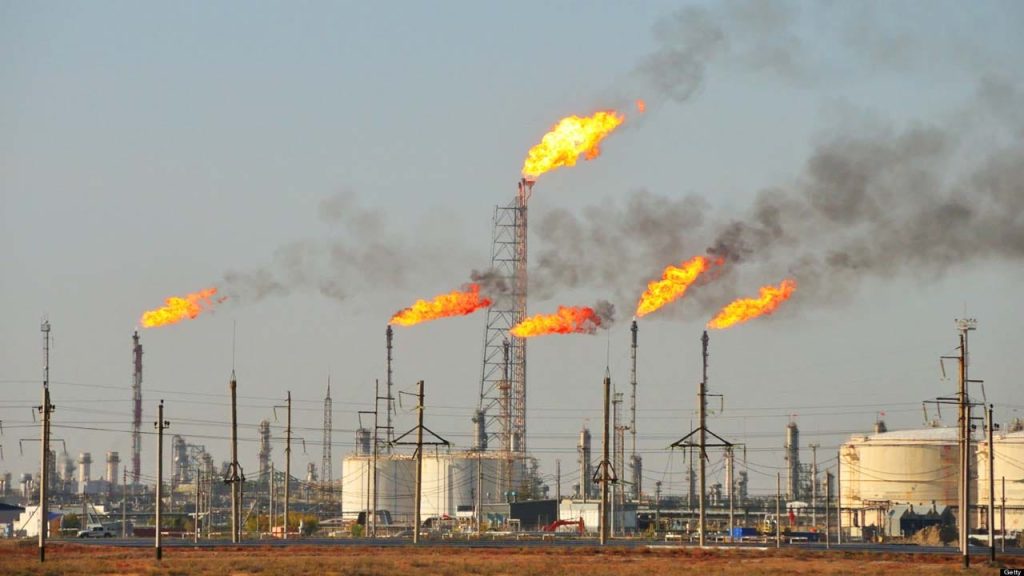
Instead, Nigeria continues to flare gas at rates that directly contradict its stated sustainability agenda. The gas burned into the atmosphere each year is not a byproduct of development. It is a choice, made by operators who find flaring cheaper than investing in gathering infrastructure, and supported by a regulatory environment that has never enforced penalties credibly enough to shift behaviour.
Every flared cubic foot of gas therefore represents a tonne of urea not produced, a megawatt not generated, and an LNG cargo never loaded. In the context of the Hormuz crisis, it also represents a negotiation that never happened with a European energy minister who was actively searching for a long-term African supplier.
The Bonny Light Windfall That Slipped Away
Nigeria’s 2026 budget was benchmarked at $64.85 per barrel. Crude, however, traded above $100 for most of March, peaking near $120. Consequently, the gap between those two numbers represents a theoretical windfall of roughly N28.3 trillion annually.
This money did not arrive. Not because the price was absent, but because the barrels were not there. Nigeria’s OPEC+ quota stands at 1.5 million barrels per day, yet actual production averaged closer to 1.46 million. In a market where every additional 100,000 barrels per day translates to roughly $4.1 billion in annual export revenue, the production gap alone cost the country billions.
Moreover, oil theft in the Niger Delta, pipeline vandalism, and underinvestment in upstream maintenance are not new problems. They are structural, they are known, and they have remained unsolved across every administration that has promised to address them.
A Pattern Nigeria Keeps Choosing to Repeat
Nigeria has experienced oil windfalls before. The First Gulf War in 1990, for instance, generated a price surge and surplus revenues. A government panel later found that a significant portion of those funds could not properly be accounted for.
Clearly, the pattern did not change after that inquiry, and it has not changed since. The Excess Crude Account, designed as a fiscal buffer for exactly this kind of windfall, holds a fraction of what it should. The Nigeria Sovereign Investment Authority, modelled on Norway’s Government Pension Fund, manages a portfolio that bears no comparison to the $1.6 trillion Oslo has quietly accumulated across decades of disciplined resource governance.
Norway’s fund is the product of a sustainability mindset applied to a finite resource. Ours, unfortunately, reflects the opposite approach: treating oil revenue as recurrent income rather than as a depleting asset that requires conversion into durable national wealth.
“Every flared cubic foot of gas represents a tonne of urea not produced, a megawatt not generated, and an LNG cargo never loaded.”
What CSR Must Actually Mean Going Forward
This is an opinion piece for CSR reporters, and so it is appropriate to end on this point. The failures described above are not only failures of government. They are, additionally, failures of an entire extractive economy in which corporate actors, including international oil companies, domestic operators, logistics firms, and financial institutions, have for decades optimised for their own position within a broken system rather than working to reform it.
CSR, as practised by most operators in Nigeria’s energy sector, has largely been a reputational instrument: a school here, a borehole there, photographs of community relations officers at ceremonial handovers. It has not, however, been a serious force for the systemic change that would allow Nigeria to capture value from its natural endowment.
The Hormuz crisis did not expose new weaknesses. Instead, it illuminated with uncommon clarity the weaknesses that have always existed: an unfinished pipeline that should have been built in 1982; an NNPC that cannot reliably allocate crude to its own domestic refinery; gas fields capable of supplying Europe that are currently supplying the atmosphere; and a fiscal architecture so porous that windfalls disappear between the moment of opportunity and the point of national benefit.
The world needed what Nigeria has. Nigeria, once again, was not ready. The question is therefore not whether the next crisis will call our name. It will. The real question is whether, by then, we will finally have built something worth answering with.
by Rosemary Imobhio
This opinion piece was produced for CSR Reporters. The views expressed are analytical in nature and based on publicly available reporting as of April 2, 2026.
[give_form id="20698"]