


 csrreporters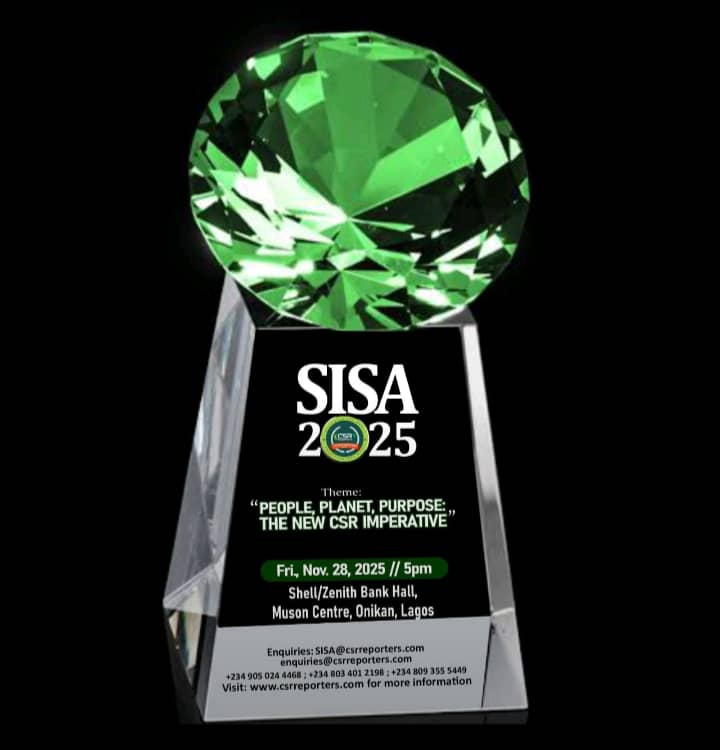
How SISA succeeded in coupling CSR puzzle in Nigeria
It has often been said that corporate social responsibility in Nigeria has suffered from fragmentation, with brands doing their part in silos, philanthropists taking up pet projects, NGOs running programmes in isolation and regulators only stepping in when things go wrong.
Recall that what was missing for years was a unifying platform that could bring these disparate pieces together into a cohesive picture, one that not only told the story of impact but also set a standard for accountability, recognition, and replication. That is the puzzle that the Social Impact and Sustainability Awards, popularly known as SISA, has succeeded in coupling, and it is this success that makes it one of the most important fixtures on Nigeria’s sustainability calendar today.
When SISA emerged on the scene, it was greeted with a mixture of curiosity and skepticism. Could there really be an award system in Nigeria that was not designed to flatter egos or curry corporate favour, but to genuinely evaluate and celebrate impact? The early editions quickly proved that this was not just another ceremonial gathering. Instead, it was a space where brands were called upon to open up their CSR books, present their projects with evidence, and submit themselves to scrutiny in order to be recognized. It was not about who had the deepest pockets or the loudest publicity machine, it was about who had made measurable differences in the lives of people, in the health of communities, and in the protection of the environment.
The genius of SISA lies in the way it wove together the different threads of CSR. For the corporate brands, it became a stage to showcase credibility beyond profit margins, giving them a chance to demonstrate how their businesses create value for society and not just shareholders. For philanthropists and humanitarians, it offered recognition that their often-silent sacrifices did not go unnoticed, and that their initiatives were equally a vital piece of the puzzle. For NGOs and development practitioners, it served as validation that their work was not only necessary but also inspirational to other players who could borrow ideas, scale them, or replicate them elsewhere. For regulators, it became a reference point, a signal that CSR and sustainability had moved beyond charity handouts into serious frameworks for nation-building.
Over the years, SISA has built credibility by insisting on evidence-based recognition. Brands that have won awards were those who could prove that their interventions went beyond token gestures. Companies had to show how their education programs actually improved literacy in communities, how their healthcare support reduced child mortality or maternal deaths, how their environmental initiatives curbed waste or reduced carbon footprints, or how their empowerment projects translated into lasting livelihoods. This insistence on proof was SISA’s greatest contribution to the Nigerian CSR space because it pushed the conversation from press releases to measurable impact.
It also succeeded in coupling the puzzle by breaking silos. At every edition, businesses sat side by side with NGOs, grassroots activists rubbed shoulders with CEOs, government regulators shared space with young sustainability professionals, and philanthropists shared ideas with social entrepreneurs. It was a cross-pollination of experiences, lessons, and aspirations, and it sent a strong message that no one player could solve Nigeria’s social and environmental challenges alone. This spirit of collaboration has been one of SISA’s enduring legacies because it continues to nurture partnerships that extend far beyond the event itself.
Another way SISA pieced the puzzle together was by tying local efforts to global goals. The awards did not only celebrate a company for drilling boreholes or planting trees; they also highlighted how such actions aligned with the UN Sustainable Development Goals, how they contributed to SDG 6 on clean water or SDG 13 on climate action. This alignment created a bridge for Nigerian brands to situate themselves on the global map of sustainability, reminding them that CSR was not just about goodwill in their host communities but also about contributing to a collective global agenda.
In the process, SISA changed the language of CSR in Nigeria. It shifted the narrative from philanthropy to strategy, from charity to sustainability, from handouts to impact. It showed brands that CSR was not just about doing good but about doing it in a way that created mutual benefit—strengthening community trust while also building business resilience and competitiveness. In a country where communities often feel exploited and neglected by corporations, this balancing act was revolutionary.
As SISA prepares for its 2025 edition, the stage is set for yet another gathering of changemakers, innovators, and impact leaders. But this time, the challenge and the opportunity are bigger. Nigeria faces mounting social and environmental pressures, plastic waste, flooding, unemployment, food insecurity, and an urgent energy transition. The role of CSR and sustainability has never been more critical. SISA 2025 will therefore not just be about awards; it will be about convening a national dialogue on how businesses, governments, and civil society can co-create solutions that are scalable, impactful, and sustainable.
This is why the call now goes out to brands, philanthropists, and humanitarians anywhere they may be. The time has come to step forward and become headline sponsors for SISA 2025. To take ownership of this platform that has successfully coupled Nigeria’s CSR puzzle and to help elevate it to the next level. Sponsorship is not just about putting a name on a banner, it is about taking a stand for accountability, for sustainability, and for the kind of impact that outlives financial statements. It is also an opportunity to align with a platform that enjoys credibility, respect, and recognition as the only true convener of Nigeria’s CSR ecosystem.
And for those who may not be in a position to headline, the invitation is still open to partner in whatever way possible, through collaborations, exhibitions, knowledge-sharing, or simply lending support to amplify the cause. The puzzle has been coupled, the pieces are now in place, and what remains is for more hands to join in strengthening the structure.
SISA has proven that CSR in Nigeria can be more than token gestures, more than isolated interventions, and more than glossy press releases. It has shown that when commitments are measured, celebrated, and replicated, they create a chain of impact that transforms communities and redefines businesses. That is why SISA 2025 is not just another event on the calendar, it is a national mission.
Desire to partner us already?
Kindly reach us via sisa@csrreporters.com , enquiries@csrreporters.com or call +2349136779152; +234804012198; +2349093555449.
[give_form id="20698"]