


Rewarder-in-Chief: How Institutionalized Recognition Turns CSR from Obligation to Pride
 csrreporters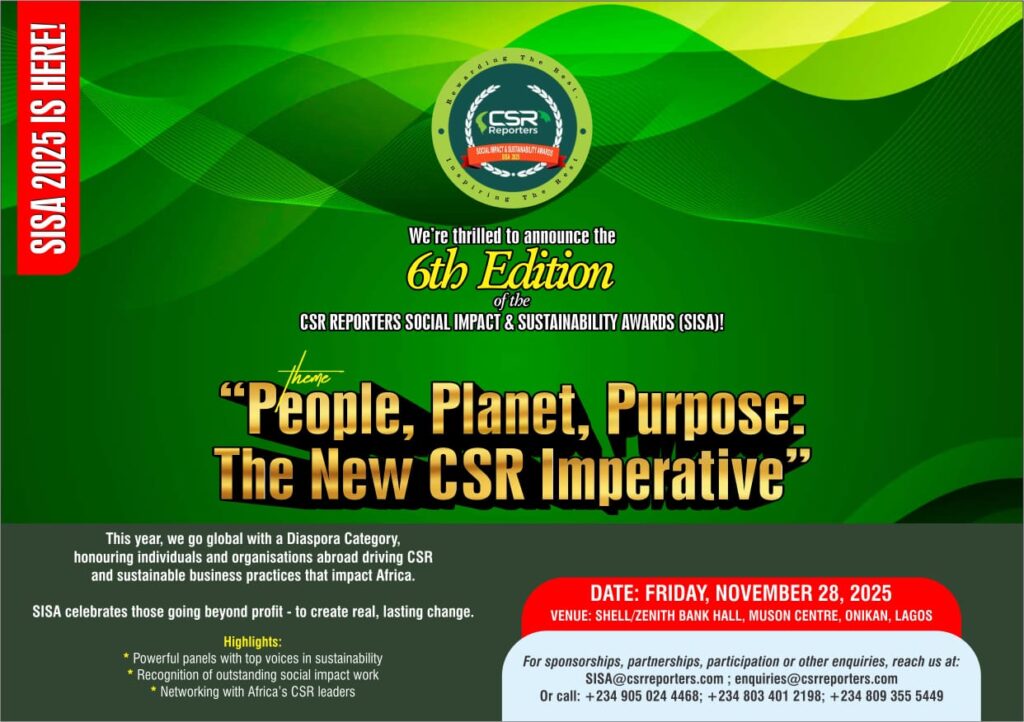
In every society worth the name, progress is driven not just by the work done in business premises but also by the impact businesses leave behind in the communities they serve.
Yet for decades, corporate social responsibility (CSR) in Nigeria and across the globe was seen as a side activity, an obligation to be met when profits allowed, rather than an intrinsic part of business identity. Need we shout this more? At CSR REPORTERS, we do not mind.
Companies often donated to orphanages, funded boreholes, or distributed branded souvenirs to the less privileged, ticking a box under the broad banner of “giving back.” While such efforts were not without impact, they remained fragmented, one-off, and detached from the long-term essence of sustainability.
But what happens when recognition is institutionalized? What if doing good becomes not just a charitable duty but a badge of honour, something companies aspire to not because they must, but because they genuinely want to be celebrated for it? That is where awards and rankings come in, and why platforms like CSR REPORTERS’ Social Impact and Sustainability Awards (SISA) have become more than annual events, they are cultural markers, shifting the corporate mindset from obligation to pride. Hurrah!
Recognition has always been a powerful human motivator.
From ancient laurel wreaths to Nobel Prizes, societies have long understood that rewarding good behavior sustains it.
In the business world, this principle is no different. A 2020 report by the Reputation Institute found that over 73% of global consumers are more likely to support brands recognized for responsible practices. Recognition reassures stakeholders, employees, investors, regulators, and customers that the company is not just chasing profit but embedding social good into its DNA. More importantly, institutionalized awards create healthy competition, pushing brands to innovate not just in products but in how they serve their people and communities.
Nigeria provides fertile ground for this shift. Despite a vibrant corporate sector, trust in big business remains shaky, with communities often accusing firms of exploitative practices and tokenistic CSR. Oil and gas giants, for instance, have long battled accusations of “chequebook CSR” lavish community donations that barely scratch the surface of long-term issues like pollution, youth unemployment, and healthcare. Such skepticism thrives because the public often lacks a reliable yardstick to measure which companies are genuinely committed to sustainability. Awards and rankings fill that void, providing credibility and a structured benchmark for judging impact.
The annual SISA organized by CSR REPORTERS does precisely this. Unlike sporadic accolades that are given behind closed doors, SISA operates transparently, celebrating companies across industries that have shown measurable, consistent, and innovative approaches to CSR and sustainability. By recognizing organizations that go beyond philanthropy to embed sustainability in core strategy such as companies integrating renewable energy into operations, driving plastic waste recycling, or scaling up women’s inclusion in leadership, SISA sends a signal to the wider business ecosystem: this is what true corporate citizenship looks like.
The ripple effect is significant. First, recognition drives internal pride. Employees of award-winning firms feel validated working for a company acknowledged publicly for doing good. This translates to loyalty, motivation, and a culture of belonging. For example, when Access Bank was recognized multiple times for sustainability initiatives, staff morale visibly improved, with many employees proudly sharing their company’s achievements on social media. Recognition became not just an external PR tool but an internal rallying point, strengthening organizational identity.
Second, awards reshape external perception. A brand featured in a respected CSR ranking automatically earns credibility in the eyes of communities and consumers. Consider how Unilever’s repeated acknowledgment for sustainability globally has helped position it as a leader in responsible business. In Nigeria, telecom firms like MTN have leveraged recognition for their educational and health initiatives to deepen trust in markets where network charges and service quality are frequently criticized. Recognition does not erase operational flaws, but it provides evidence that a company is sincerely trying to balance profit with purpose.
Third, recognition institutionalizes sustainability itself. One-off donations rarely transform industries, but when companies know they will be measured, ranked, and possibly rewarded, CSR stops being a philanthropic afterthought and becomes a boardroom priority. Awards act as a form of soft regulation, nudging companies toward compliance with global best practices. In effect, they create a voluntary but powerful accountability system.
Sceptics argue that awards risk turning CSR into a vanity project, companies scrambling for trophies rather than genuine impact. That concern is valid, but only if recognition platforms lack credibility. When awards are bought, manipulated, or divorced from transparent evaluation, they lose their power to inspire real change. This is why CSR REPORTERS has been deliberate about creating a transparent process for SISA, vetting projects, engaging independent assessors, and ensuring recognition is merit-based. Only then does institutionalized recognition retain its transformative force.
Globally, this model has worked. The Dow Jones Sustainability Index and FTSE4Good have become global benchmarks for socially responsible investing, influencing trillions of dollars in capital flows. Similarly, Fortune’s “Change the World” list has given corporate giants like IBM, Nestlé, and Mastercard global recognition not for their profitability but for solving pressing social challenges. These platforms demonstrate that recognition can be as important a driver of corporate behavior as regulation or consumer activism. Nigeria’s private sector, with its scale and complexity, needs its own homegrown benchmarks.
In many ways, CSR REPORTERS has assumed the role of Nigeria’s “Rewarder-in-Chief,” creating the symbolic infrastructure that makes doing good aspirational. It is not enough for companies to have glossy CSR reports buried in their websites; the wider society needs visible acknowledgment of what works and who is leading. And when companies see their peers applauded on stage, featured in rankings, and celebrated on media platforms, a subtle competition is sparked. The desire not to be left out pushes laggards to step up, slowly lifting the collective bar.
The deeper truth is that recognition changes the narrative of CSR in Nigeria. It reframes it from being a burden, a legal requirement, a community appeasement, or a PR gimmick to being a source of pride, identity, and even market advantage. In a world where consumers are increasingly values-driven, and where young talent prefers to work for purposeful companies, recognition is no longer a side benefit. It is a strategic asset.
Ultimately, institutionalized recognition ensures that sustainability is not just a slogan but a measurable reality. Awards like SISA will continue to evolve, but their underlying philosophy remains the same: to reward what is good, amplify it, and make it contagious across the business ecosystem. In so doing, CSR REPORTERS is proving that in Nigeria, doing good is no longer just an obligation. It is a badge of pride.
[give_form id="20698"]