


Special Report – Africa’s Transparency Leaders: 25 Companies Setting the Standard for Corporate AccountabilityLeaders
 csrreporters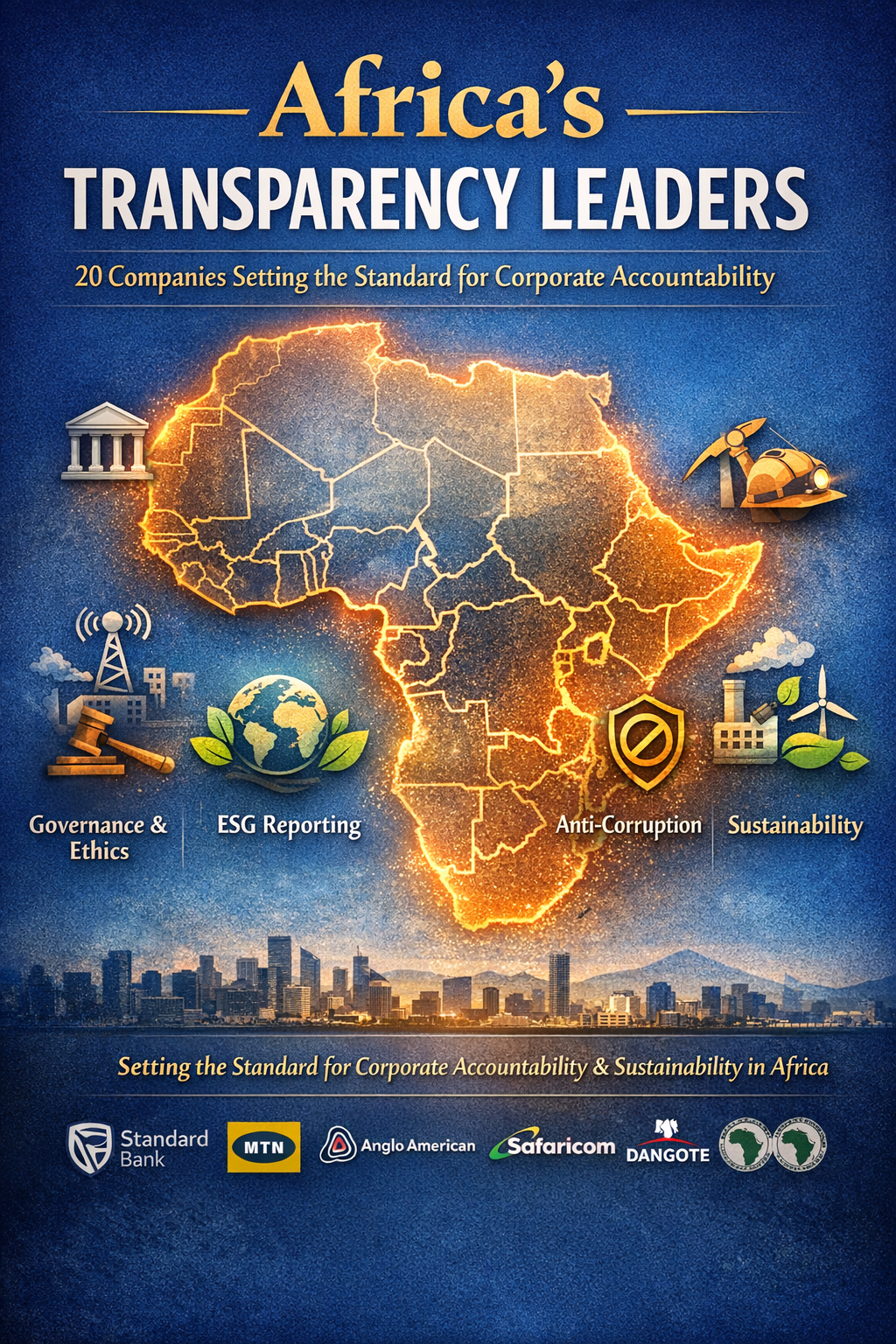
Special Report - Africa's Transparency Leaders: 25 Companies Setting the Standard for Corporate AccountabilityLeaders
Corporate transparency in Africa isn’t just a governance checkbox anymore. It’s become a genuine competitive edge — and a growing number of companies are proving that accountability and ambition can coexist. Across sectors, from financial services to retail to mining, these organisations have made a conscious choice to operate with greater openness than the law requires. That choice matters.
What sets them apart isn’t just the reports they publish, it’s the systems behind those reports. Audit committees that actually push back, sustainability disclosures that don’t read like marketing copy, and governance structures with real teeth. Anyone can produce a glossy annual report. Far fewer can back it up.
The continent’s regulatory landscape is uneven, and that’s precisely what makes this list meaningful. Several of these companies operate in environments where disclosure requirements are thin and enforcement is inconsistent. They’ve chosen higher standards anyway. Strong board independence shows up again and again across the group. So does a willingness to disclose not just what went right, but what didn’t. A rarer quality than it should be.
None of these companies are perfect. Transparency, by its very nature, tends to reveal complexity rather than hide it. But that’s the point. These are organisations that have decided the discomfort of openness is worth it. Their stakeholders, increasingly, are holding them to that standard.
THE 25 COMPANIES
1. Nedbank Group — South Africa
Nedbank has built one of the most comprehensive ESG disclosure frameworks on the continent. In 2024, it became the first South African bank to publish carbon reduction targets specifically tied to its lending activities — not just its own operations. By December 2024, it had committed R183 billion — 19% of its total loan book — to sustainable development finance, with a target to grow that to 20% by end of 2025.
Its governance reporting covers board composition, remuneration, and risk management with a level of detail that sets a regional benchmark. Nedbank was named Africa’s Sustainable Bank of the Year for 2025. It was recognised for embedding ESG principles into its operations and products rather than treating sustainability as a standalone function.
2. Standard Bank Group — South Africa
Standard Bank operates across more than 20 African countries. It publishes a standalone Sustainability Disclosures Report annually alongside its integrated annual report. Its disclosures address climate risk, board independence, and social impact in granular detail.
The group has been a consistent voice in pushing for higher governance standards across the continent. Its corporate reporting is regularly cited as among the most thorough of any African financial institution.
3. Absa Group — South Africa
Absa’s integrated reporting covers everything from climate risk frameworks to how its board navigates political instability in the markets where it operates. Its 2024 Integrated Report explicitly addresses strong financial controls, corporate governance, and ethics as foundational priorities — not afterthoughts.
Absa also discloses its approach to IFRS sustainability standards in detail. Its board brings together a diverse set of independent directors with genuine international experience. Absa is one of the few African banks that acknowledges, in plain language, where governance challenges remain rather than papering over them.
4. Shoprite Holdings — South Africa
Africa’s largest food retailer is also one of its most transparent. Shoprite’s 2024 Sustainability Report was prepared for a broad range of stakeholders. It concluded shareholders, ESG rating agencies, employees, NGOs, customers, and local communities — covering operations across 10 African countries.
Its governance framework follows King IV, South Africa’s gold-standard corporate governance code. Additionally, the company’s audit committee holds genuine independent authority. Private sessions between the committee chair and external auditors are held without management present — a detail that sounds procedural but signals real structural independence.
5. Capitec Bank — South Africa
Capitec’s rise from a small microlender to one of Africa’s most valuable banks has been accompanied by unusually clear communication to shareholders and customers alike. Its market capitalisation grew from $12.8 billion to $19.5 billion in a single year. Additionally, it has achieved this while maintaining a reputation for straightforward pricing, plain-language product disclosures, and accessible financial reporting.
Its annual reports don’t hide behind complexity — a deliberate choice that has earned strong, sustained investor confidence.
6. FirstRand Group — South Africa
FirstRand is the parent of FNB, Rand Merchant Bank, and WesBank. It publishes detailed integrated reports covering strategy, risk, remuneration, and sustainability in a single cohesive document. The group has been a consistent adopter of King IV governance principles and has invested significantly in board independence and diversity.
Its remuneration disclosures are particularly thorough — a sore spot for many African corporates that still obscure executive pay.
7. KCB Group — Kenya
KCB is the largest bank in East Africa by assets, and has a strong reputation for governance across the region. In one of the most detailed corporate governance rankings of Kenyan listed companies, KCB tied for first place with a score of 85.4%. A win supported by gender and ethnic diversity in board composition, a strong proportion of independent directors, defined tenures to accommodate rotation, and high levels of international exposure among board members.
For a market where governance enforcement is inconsistent, KCB’s voluntary adherence to these standards is notable.
8. Equity Group Holdings — Kenya
Equity Group has made financial inclusion central to its identity, and it backs that positioning with unusually transparent stakeholder reporting. The group publishes investor booklets that break down performance across Kenya, Uganda, Tanzania, Rwanda, and South Sudan individually. This is a level of geographic granularity that most pan-African groups avoid.
It also maintains a public whistleblowing mechanism, which says something about the internal culture the organisation is deliberately trying to build.
9. Safaricom — Kenya
Safaricom remains one of the most scrutinised companies in East Africa. Howver, it has consistently ranked among Kenya’s top companies for corporate governance practices, scoring well on board composition, director independence, and transparency metrics.
The scrutiny itself reflects a company operating under genuine public and regulatory accountability. In governance terms, that level of public accountability is precisely the point.
10. East African Breweries Limited — Kenya
EABL has for years been one of the most consistent performers in Kenyan corporate governance rankings. As a Diageo subsidiary listed on the Nairobi Securities Exchange, it operates under both local requirements and the standards of a global parent. This combination produces thorough disclosures on supply chain, environmental performance, and board remuneration.
It has issued corporate bonds that were oversubscribed, a reflection of the market trust its governance practices have built over time.
11. Ecobank Transnational Incorporated — Togo / Pan-Africa
Ecobank is the most geographically ambitious bank on the continent, operating in 35 African countries. Managing transparency at that scale is genuinely difficult. What makes it worth including here is that the group produces country-by-country subsidiary annual reports. This allows investors and regulators to examine performance at a national level rather than hiding it inside a consolidated group figure.
That is a practice that far larger global banks resist. For a pan-African institution operating in markets with vastly different regulatory environments, it represents a meaningful and costly commitment to disclosure.
12. Stanbic Bank — Uganda / East Africa
Stanbic Uganda has been recognised repeatedly for corporate governance and sustainable financial practices in the East African market. It has received awards for best SME accelerator, financial inclusion, sustainable financial solutions, and best corporate banking brand across its markets.
Its annual disclosures include community investment, staff development, and environmental impact. These are areas where many regional banks still produce little more than boilerplate language.
13. MTN Group — South Africa
MTN operates across 19 countries and is one of Africa’s most valuable companies. It has invested heavily in integrated reporting and ESG disclosure in recent years, following a period of serious governance controversies that forced a genuine reset. The transformation has been real.
Today, MTN’s reporting covers regulatory compliance, anti-corruption policy, network investment, and stakeholder engagement across every market it operates in. In Transparency International’s corporate reporting assessments of emerging market multinationals, MTN achieved the best score among the South African companies evaluated. A credible external benchmark.
14. Aspen Pharmacare — South Africa
Aspen is the continent’s largest pharmaceutical manufacturer and one of the few African companies that has genuinely globalised. Its transparency practices have matured alongside its footprint. The company publishes detailed reports covering manufacturing quality, supply chain ethics, pricing policies, and governance. All areas of particular sensitivity for a pharmaceutical company operating across developing markets.
Its board includes independent directors with deep technical and governance expertise, not just well-connected figureheads.
15. Gold Fields — South Africa
Gold Fields operates gold mines across Africa, Australia, South America, and Canada. It also publishes some of the most detailed climate and environmental disclosures of any mining company with significant African operations.
The company reported a 42% rise in profits in 2024, and alongside that financial performance, its reporting covers water use, community impact, carbon emissions, and safety data at a mine-by-mine level. In an extractives sector where opacity has historically been the default, Gold Fields is a genuine outlier.
16. Bidvest Group — South Africa
Bidvest is a diversified services and trading conglomerate valued at $8.6 billion, with operations spanning food distribution, automotive, financial services, and facilities management. Its governance reporting reflects the complexity of managing a highly decentralised group.
Bidvest produces consolidated sustainability disclosures while also holding individual business units accountable for their own environmental and social performance. That structure is harder to manage — and harder to fake.
17. Attijariwafa Bank — Morocco
Morocco’s largest bank and one of the most internationally active financial institutions in Africa, Attijariwafa has built a governance reputation that draws heavily from both French regulatory traditions and Moroccan central bank requirements. It is one of the few African banks with a sustained presence on global ESG indices.
Its expansion into West and Central Africa has been accompanied by a concerted effort to bring consistent governance standards across its subsidiary network — a challenge most pan-African banks underestimate.
18. Co-operative Bank of Kenya — Kenya
One of the lesser-celebrated governance stories in East Africa, Co-op Bank has steadily built a reputation for honest stakeholder communication. It serves a large cooperative movement base and publishes reports that directly address how it creates value for member societies, smallholder farmers, and low-income customers — not just shareholders.
Its financial disclosures are detailed, its board independent, and its community investment reporting is verifiable rather than aspirational.
19. Maroc Telecom — Morocco
Maroc Telecom, partially owned by the UAE’s e& group, operates across Morocco and several sub-Saharan African countries. It publishes sustainability reports aligned with GRI standards, discloses network investment plans, and maintains transparent pricing and regulatory compliance reporting.
In markets where telecom operators are frequently accused of opaque billing and poor accountability, Maroc Telecom’s disclosures stand out for their specificity and consistency.
20. Wilderness Holdings — Botswana
A smaller company by regional standards, but one worth including precisely because of that. Wilderness is a luxury safari and conservation business listed in Botswana. Its transparency practices around conservation impact, community benefit sharing, and carbon reporting are arguably the most rigorous of any tourism company operating in sub-Saharan Africa.
It publishes verifiable data on wildlife metrics, community employment, and environmental footprint. These are areas where the ecotourism sector globally struggles with greenwashing. Wilderness proves that meaningful disclosure is not only for large-cap companies.
21. Dangote Group — Nigeria
Dangote is the largest industrial conglomerate in Africa, and its listed subsidiaries — particularly Dangote Cement — have built a governance infrastructure that is increasingly hard to dismiss. In 2025, Dangote Cement reported full compliance with the rules of the Nigerian Exchange, the Securities and Exchange Commission, and the Financial Reporting Council, with no infringements or fines recorded during the year.
The group engages independent auditors specifically for ESG assurance, ensuring sustainability disclosures are verified externally rather than self-reported. Its seven Sustainability Pillars are embedded into operational culture, and its annual board retreat is used to actively interrogate strategy rather than rubber-stamp decisions already made. For a family-controlled conglomerate of this scale, that level of formal accountability is genuinely notable.
22. TotalEnergies Marketing Nigeria — Nigeria
TotalEnergies has been operating in Nigeria for over 60 years, and its local subsidiary operates under a governance framework that reflects both the Nigerian Code of Corporate Governance and the standards of its Paris-listed parent. The company maintains a Share Trading Policy, Complaints Management Policy, and a Whistle-Blowing Policy — providing stakeholders with clear accountability mechanisms at the local level.
At the group level, TotalEnergies publishes a Universal Registration Document, a Sustainability & Climate Report, a Human Rights Briefing Paper, and a Report on Payments Made to Governments — each applying directly to its African operations. The payments-to-governments disclosure is particularly significant in a region where revenue flows between energy companies and host governments have historically been opaque. TotalEnergies also became the first major operator in Nigeria to completely eliminate routine flaring from all operated assets, a commitment backed by verifiable data rather than stated ambition.
23. First Bank of Nigeria — Nigeria
First Bank is one of Africa’s oldest financial institutions — over 130 years old — and in recent years it has worked hard to ensure its governance reputation keeps pace with its heritage. FirstBank was named Nigeria’s Best Bank for ESG at the Euromoney Awards for Excellence 2025, its second consecutive win in the category. Sustained external recognition of this kind is harder to manufacture than a one-off award.
What drives it is structural: in 2024, FirstBank screened 237 transactions worth over ₦3 trillion for sustainability risks, integrating ESG considerations directly into its credit framework. That means sustainability analysis is happening at the deal level, not just in the annual report. For a bank serving over 25 million active digital customers, embedding this kind of scrutiny into day-to-day lending decisions is a genuine operational commitment — not a PR exercise.
24. United Bank for Africa (UBA) — Nigeria
UBA operates across 20 African countries and three global financial centres — London, Paris, and New York — which makes its governance obligations considerably more complex than most African banks. In 2024, UBA commissioned Deloitte & Touché to conduct an independent evaluation of its Board of Directors, with the results confirming full compliance with Central Bank of Nigeria governance guidelines as well as the Nigerian Code of Corporate Governance. That is an external verdict, not a self-assessment.
The Board Audit and Governance Committee monitors ESG matters at quarterly meetings, with management presenting progress reports at each session. In 2024, the group also invested ₦1.98 billion in CSR programmes covering education, youth empowerment, gender equality, and public health — and publishes a standalone sustainability report to account for where that money goes. For a pan-African institution of this size, the consistency of governance disclosure across such a diverse footprint is what stands out.
25. Nestlé Nigeria — Nigeria
Nestlé Nigeria has been listed on the Nigerian Stock Exchange for decades, and its approach to corporate disclosure reflects the discipline of a global parent combined with the accountability demands of a local market that watches it closely. Sustainability and Creating Shared Value are described as integral to the company’s business strategy — not a bolt-on — with ESG pillars covering environmental stewardship, social investment, and governance embedded into day-to-day operations.
What makes its reporting credible rather than cosmetic is the assurance process behind it. Nestlé Nigeria obtained independent limited assurance on its ESG key performance indicators under ISAE 3000, strengthening stakeholder confidence in the data it publishes. The company also makes publicly available its Board Charter, Code of Ethics, Annual Board Plans, and Corporate Governance Evaluation Reports — a level of documentary transparency that far exceeds what most Nigerian-listed companies publish. In 2025, it invested ₦678.46 million in community projects including water access, the Nestlé for Healthier Kids programme, and its Rural Women Empowerment Project, accounting for that spending in verifiable detail.
WHAT CONNECTS THESE 25
None of them are perfect. Transparency, by its very nature, tends to reveal complexity rather than hide it. What these companies share is a willingness to be held to a standard — by investors, by civil society, and by their own boards.
In a continent where illicit financial flows cost Africa an estimated $89 billion a year, the companies that choose accountability over opacity aren’t just doing good governance. They’re making a statement about what kind of business culture they want to build — and what kind of continent they want to operate in.
Africa’s business environment is changing fast. Capital is more discerning. Regulators are getting sharper. And a new generation of investors and consumers wants to know not just what a company does, but how it operates. These 25 are ahead of that curve.
Published by CSR Reporters | All rights reserved | For editorial enquiries, contact the editorial team.
CSR Reporters | Africa’s Transparency Leaders
[give_form id="20698"]