


 csrreporters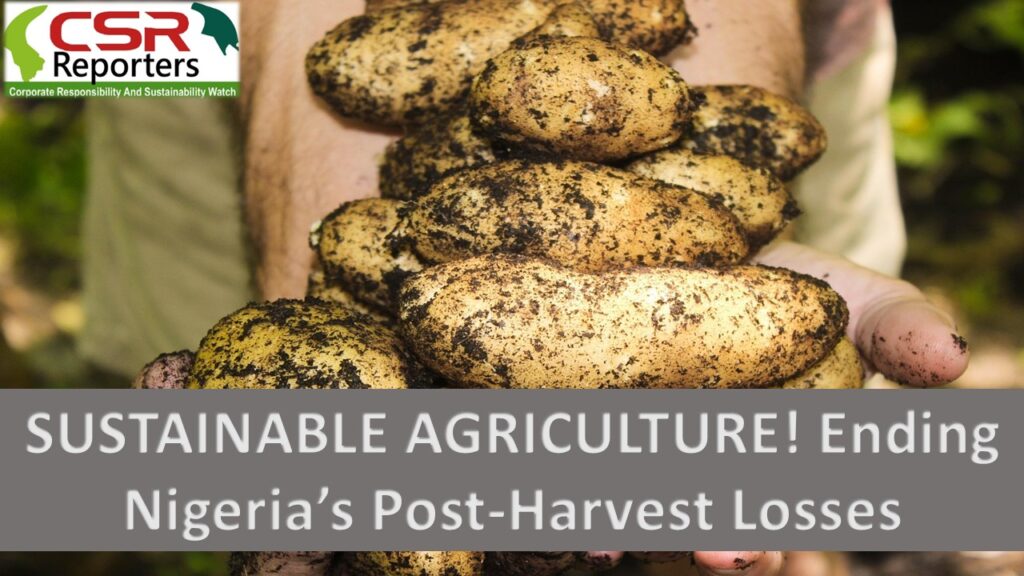
SUSTAINABLE AGRICULTURE! Ending Nigeria’s Post-Harvest Losses
Nigeria’s agricultural sector is trapped in a costly and dangerous contradiction.
CSR Reporters notes, the country ranks among Africa’s largest producers of food, yet it loses an astonishing volume of what it grows before it ever reaches the table. This failure is no longer tolerable. Post-harvest losses on a scale estimated at between 30 and 50 per cent of annual output represent not just inefficiency but a systemic collapse that threatens food security, environmental sustainability, rural livelihoods, and national stability.
Industry estimates suggest that Nigeria loses between $9 billion and $10 billion worth of agricultural produce annually to post-harvest wastage. In naira terms, this translates into trillions lost every year, sums that dwarf the country’s entire agricultural budget over several years. This haemorrhage occurs at a time when Nigeria’s population is rapidly expanding and is projected to approach 400 million within the coming decades. A nation that wastes nearly half of what it produces cannot credibly claim to be preparing for such demographic pressure.
The tragedy of post-harvest losses goes beyond economics. Almost half of Nigeria’s fruits and vegetables rot before they reach markets, not because farmers fail to grow enough food, but because the systems required to preserve, transport, and process that food are largely absent. In a country battling hunger, malnutrition, and rising food prices, this level of waste is morally indefensible and environmentally reckless.
At the heart of the problem lies Nigeria’s chronic infrastructure deficit. Poor rural roads, unreliable electricity, lack of storage facilities, and an almost non-existent cold-chain network ensure that food deteriorates rapidly once it leaves the farm. For tomato farmers around Ibadan and other producing belts, losses of close to one-fifth of daily harvests before reaching markets are common. Cassava farmers across the South-West and South-South face similar realities, watching tonnes of produce spoil because they cannot be processed quickly enough or transported efficiently.
This failure directly undermines farmers’ incomes. Forced to sell perishables at distress prices or discard them entirely, smallholder farmers who make up the bulk of Nigeria’s agricultural workforce, remain trapped in poverty. The result is a vicious cycle: low incomes discourage reinvestment, productivity stagnates, youth abandon farming, and food systems become increasingly fragile. From a sustainability standpoint, this model is fundamentally broken.
Food security and nutrition are perhaps the gravest casualties of Nigeria’s post-harvest crisis. The country continues to battle alarming levels of malnutrition, with millions of children suffering from stunting and wasting. Micronutrient deficiencies, particularly in iron, vitamin A, and zinc, are widespread, weakening immune systems and impairing cognitive development. These outcomes are not solely the result of insufficient production; they are also the direct consequence of food that is grown but never consumed.
Nigeria’s status as one of the countries with the highest burden of childhood stunting globally is a damning indictment of its food system. It is difficult to reconcile this reality with the scale of food wasted annually. Sustainable agriculture is not only about producing more; it is about ensuring that what is produced nourishes people efficiently, equitably, and responsibly.
The environmental implications of post-harvest losses are equally severe. Every wasted crop represents squandered land, water, energy, fertiliser, and labour. In an era of climate change, where agriculture is under pressure from erratic rainfall, rising temperatures, and soil degradation, wasting food amounts to wasting scarce natural resources. Reducing post-harvest losses is therefore one of the most effective climate-smart strategies available to Nigeria. Experts agree that cutting these losses could increase effective food supply by as much as 50 per cent without expanding farmland or intensifying chemical inputs.
CSR Reporters recommends, addressing this challenge requires a decisive shift in policy and practice. Cold-chain infrastructure must move from the margins to the centre of agricultural planning. Refrigerated transport, modern pack houses, and solar-powered cold storage facilities can dramatically reduce spoilage, particularly for fruits, vegetables, fish, and dairy. Evidence from other developing economies shows that such systems can cut losses by more than 80 per cent while significantly boosting farmers’ incomes. For a country producing millions of tonnes of fruits and vegetables annually, the potential gains are immense.
Equally critical is farmer education. Poor harvesting, handling, and storage practices accelerate spoilage across value chains. Many losses occur within days of harvest due to bruising, contamination, and exposure to heat. Training farmers in basic post-harvest techniques, coupled with access to simple preservation technologies such as solar dryers and small-scale processing units, would extend shelf life, add value, and stabilise incomes. Sustainable agriculture thrives when knowledge flows as freely as inputs.
Policy reform must also play its part. Government has a responsibility to create an enabling environment for private sector investment in agro-processing and logistics. Incentives for establishing processing hubs, cold storage facilities, and aggregation centres in rural areas are essential. So too are investments in feeder roads, reliable power supply, and market information systems that link farmers directly to buyers. Programmes that aggregate produce for urban markets, such as bulk procurement initiatives pioneered in some states, demonstrate how structured demand can stabilise supply chains and reduce waste.
Beyond food consumption, Nigeria must rethink waste as a resource. Crops that cannot be sold fresh can be converted into animal feed, organic fertiliser, bioenergy, and industrial raw materials. Such circular approaches align perfectly with sustainability principles, creating new income streams while reducing environmental pressure. What is currently lost to decay could instead power rural economies and stimulate innovation.
Nigeria cannot continue to tolerate a system where hunger coexists with waste, and scarcity exists alongside abundance. Post-harvest losses are not an inevitable feature of agriculture; they are a policy failure. Addressing them is among the fastest, cheapest, and most sustainable ways to improve food security, strengthen rural livelihoods, and build resilience against climate shocks.
The path is clear. Government must lead with coherent policy and infrastructure investment, the private sector must innovate and scale solutions, and development actors must prioritise post-harvest systems alongside production. Ending Nigeria’s post-harvest scandal is not merely an agricultural necessity. It is a national imperative that speaks to the country’s commitment to sustainable development, social equity, and the responsible stewardship of resources.
[give_form id="20698"]