admin
admin 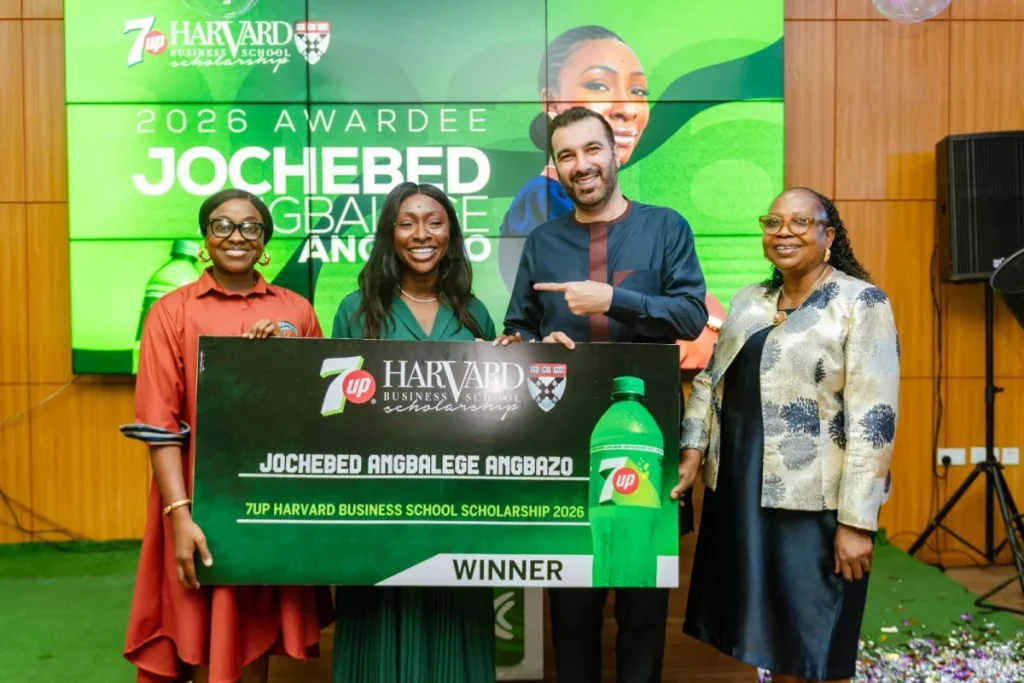
For many companies, corporate social responsibility is measured by the number of people reached by a donation, the communities visited during an outreach programme or the amount committed to a one-off intervention.
But there is another form of corporate investment that can take years before its full impact becomes visible: investing in people.
Seven-Up Bottling Company’s (SBC) Harvard Business School Scholarship offers an example of what that long-term approach can look like.
In August 2026, SBC unveiled Jochebed Angbazo as the 16th recipient of the 7UP Harvard Business School Scholarship (7UP-HBSS), continuing an initiative that has supported Nigerian professionals to pursue MBA studies at Harvard Business School since 2010.
The latest award is significant not simply because another Nigerian professional will gain access to one of the world’s leading business schools, but because the programme has now operated for 16 years.
That continuity raises a broader question about corporate social investment in Nigeria: what happens when companies commit to developing people for the long term rather than focusing only on immediate, visible outcomes?
From One Scholarship to a 16-Year Investment
The 7UP-HBSS was established in 2010 to commemorate Seven-Up Bottling Company’s 50th anniversary.
The programme provides selected Nigerian professionals with the opportunity to pursue an MBA at Harvard Business School. According to the company, recipients are assessed not only on their professional achievements and academic potential, but also on their commitment to creating meaningful impact in Nigeria.
That selection philosophy is important.
The programme is not positioned simply as an academic award. The expectation is that recipients will use the knowledge, networks and leadership experience gained through the programme to contribute to their communities and the wider society.
Over the years, the scholarship has produced a growing network of Nigerian professionals working across business, entrepreneurship, public policy and social development.
The latest recipient, Jochebed Angbazo, brings more than eight years of professional experience across real estate, financial services, digital media and hospitality.
Born in Jos, Plateau State, Angbazo has expressed a strong belief in Nigeria’s potential and said the scholarship would help her pursue her long-held ambition of studying at Harvard Business School. She also used the occasion to encourage Nigerian parents to continue investing in the education of girls.
Her story adds another dimension to the programme: access to global education can also become part of the conversation around women’s leadership and professional development.
The Real Test of a Scholarship Is What Happens Afterwards
A scholarship can look impressive on paper.
But for CSR and sustainability professionals, the more important question is what happens after the beneficiary receives the opportunity.
Does the investment produce new businesses?
Does it create jobs?
Does it strengthen institutions?
Does the recipient transfer knowledge to others?
Does the impact extend beyond the individual?
One of the clearest examples associated with the 7UP-HBSS is Misan Rewane, the programme’s first recipient.
After receiving the scholarship, Rewane went on to establish West Africa Vocational Education (WAVE), an organisation focused on developing industry-relevant skills and connecting young people with employment opportunities.
Earlier reports cited WAVE as having trained and placed more than 5,000 graduates in companies, particularly within the hospitality sector.
WAVE’s own materials also show an emphasis on employability, employer partnerships, mentorship and post-training support.
This is where the CSR conversation becomes more interesting.
The impact of the original scholarship is no longer confined to the person who received it. At least in this example, the education and leadership development of one beneficiary became connected to an organisation working to improve the employability of other young people.
That is the multiplier effect that human-capital investment can create.
Beyond the Donation Culture
Nigeria has no shortage of corporate interventions.
Companies regularly support schools, donate equipment, provide scholarships, fund healthcare initiatives and respond to community needs.
These interventions can be valuable, particularly where communities face immediate challenges.
But long-term human-capital programmes operate differently.
Their impact is often less immediate and more difficult to capture in a photograph or a press release.
A scholarship recipient may spend two years studying. They may then spend several more years building an organisation, developing a business, entering public service or mentoring other young people.
The return on that investment therefore cannot always be measured in the same way as the number of beneficiaries reached during a single CSR campaign.
This is why the longevity of the 7UP-HBSS matters.
The company has continued the programme through different economic cycles and leadership periods, and the 2026 award brings the total number of recipients to 16.
In a CSR environment where programmes can sometimes disappear when budgets change or leadership priorities shift, continuity itself becomes an important part of impact.
Creating Leaders, Not Just Recipients
Another notable feature of the scholarship is its emphasis on leadership.
Harvard Business School provides more than an academic qualification. An MBA experience can expose participants to global business practices, networks, case studies, entrepreneurial thinking and different approaches to solving complex organisational problems.
For Nigerian professionals, the value can therefore extend beyond the certificate.
The broader objective of the 7UP-HBSS has consistently been linked to developing leaders who can contribute to Nigeria and the wider African economy.
Past recipients have gone on to pursue different professional and social-impact paths. The scholarship’s alumni network now represents a diverse group of Nigerians whose careers span multiple sectors.
That diversity matters because Nigeria’s development challenges are not located in one industry.
The country needs stronger entrepreneurs, better managers, innovative policymakers, social entrepreneurs, professionals and institutional leaders.
Investment in people can therefore have a wider development value than investment in a single project.
But Impact Should Also Be Measured
There is, however, an important lesson here for companies looking to build credible CSR programmes.
Longevity alone does not automatically equal impact.
A programme can run for 20 years and still need to answer questions about outcomes.
For initiatives such as the 7UP-HBSS, meaningful impact measurement could include tracking alumni careers, businesses established, jobs created, people mentored, policies influenced, communities reached and knowledge transferred.
It could also examine how many recipients return to Nigeria, how they apply their skills and whether the programme’s original leadership-development objectives are being achieved.
That kind of measurement would move the conversation from “How many scholarships have we awarded?” to “What has changed because we awarded them?”
The distinction is important.
Modern CSR increasingly requires organisations to demonstrate not only activity, but outcomes.
A Model for Long-Term Corporate Social Investment?
The 7UP-HBSS does not mean every company needs to sponsor an MBA at Harvard.
The more useful lesson is the principle behind it: identify a development gap, invest consistently, select beneficiaries with the potential to create wider impact, and stay committed long enough to see what happens.
For Nigeria, where human capital remains central to conversations around youth unemployment, leadership, entrepreneurship and economic development, such investments can complement the work of government, educational institutions and development organisations.
The 16th scholarship recipient is therefore more than another name added to an alumni list.
Jochebed Angbazo represents the continuation of an experiment that began in 2010: whether corporate investment in individual Nigerians can eventually translate into broader social and economic value.
Sixteen years later, there are now 16 people carrying that opportunity into different sectors.
The next measure of success will not simply be where the 16th scholar studies.
It will be what she—and the 15 who came before her do with the opportunity.
And perhaps that is the more important lesson for corporate Nigeria: the strongest social investments may not always be the ones with the quickest results. Sometimes, the real impact is what happens when an opportunity given to one person creates opportunities for many others.
[give_form id="20698"]