csrreporters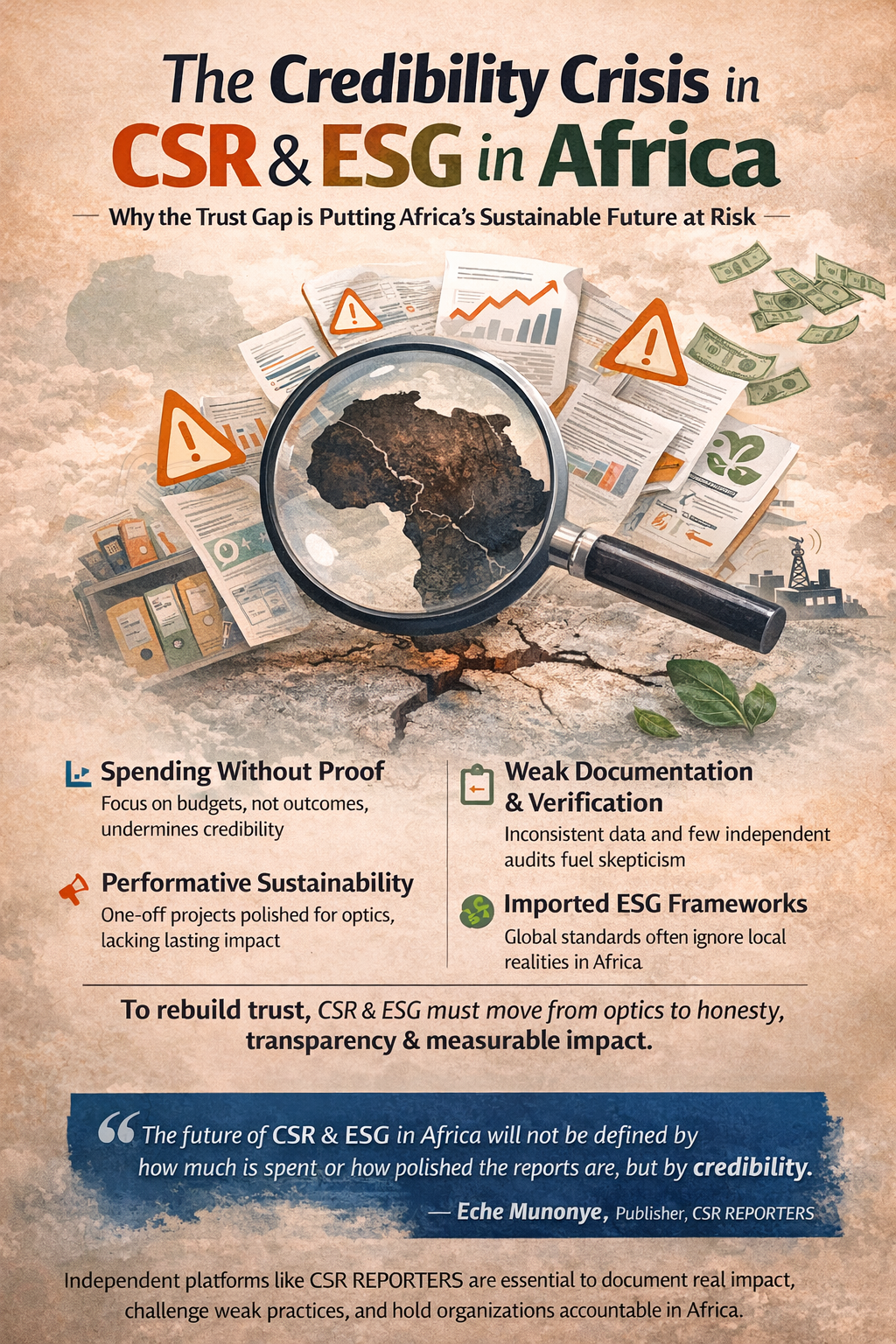
The Credibility Crisis in CSR & ESG in Africa
Across Africa, Corporate Social Responsibility (CSR) and Environmental, Social and Governance (ESG) commitments have never been more visible. Sustainability reports are thicker, climate pledges more ambitious, and corporate messaging increasingly framed around purpose and responsibility. Yet, beneath this surge in activity lies a growing problem that threatens the legitimacy of the entire ecosystem: a crisis of credibility.
The issue is not whether African companies are doing CSR. Many are spending significant resources on education, health, livelihoods, community development, and environmental initiatives. The deeper concern is whether these efforts are trusted, verifiable, and delivering lasting impact.
When Visibility Outruns Trust
Over the past decade, CSR in Africa has evolved from ad-hoc philanthropy to structured programmes embedded in business strategy. ESG frameworks followed closely, driven by global investor expectations, regulatory pressure, and the desire to align with international standards.
But visibility has expanded faster than accountability. Stakeholders are increasingly sceptical, asking questions that sustainability reports often fail to answer clearly: What problem was identified? Why this intervention? What changed? Will the change last?
In many cases, CSR narratives remain heavy on spending figures and light on outcomes. ESG disclosures mirror global templates but offer limited insight into local realities. The result is a widening trust gap between corporate claims and stakeholder confidence.
The Rise of Performative Sustainability
One of the most damaging consequences of weak accountability is the rise of performative sustainability. CSR projects are increasingly designed to be seen rather than to solve complex problems. ESG commitments are polished for international audiences, while on-the-ground realities remain largely unchanged.
This pattern shows up in familiar ways: repeated success stories with little evidence of evolution; short-term interventions framed as long-term solutions; climate commitments unsupported by operational shifts; and glossy reports disconnected from lived community experience.
Performative sustainability may protect reputations in the short term, but it erodes trust over time. When stakeholders sense that CSR and ESG are more about optics than outcomes, credibility collapses.
Spending Without Proof
Africa does not suffer from a lack of CSR spending. What it lacks is proof at scale.
Many organisations can report how much they invested or how many beneficiaries they reached. Far fewer can demonstrate whether those investments led to sustained improvements in education, health outcomes, income stability, or environmental protection.
Impact measurement remains inconsistent. Baselines are often unclear, follow-up assessments rare, and failures quietly ignored. Without evidence, even genuine efforts struggle to withstand scrutiny, and weak practices go undetected.
The Verification Gap
A central driver of the credibility crisis is poor documentation and limited independent verification. Across sectors, CSR data is often fragmented across departments, with little coordination between sustainability teams, foundations, and operations.
Third-party verification is still treated as optional rather than essential. Independent audits, external evaluations, and longitudinal impact studies remain the exception, not the norm. As a result, CSR and ESG claims rely heavily on self-reporting, which inevitably raises questions of bias.
In an era of increasing global scrutiny, this gap leaves African companies exposed to accusations of greenwashing, social washing, and inflated ESG performance.
Imported Frameworks, Local Disconnects
Another layer of complexity lies in the adoption of global ESG frameworks without sufficient localisation. While international standards provide useful structure, they often fail to capture Africa’s social, economic, and environmental realities.
Informal economies complicate labour assessments. Infrastructure deficits reshape environmental priorities. Community development carries immediate social value that may not fit neatly into conventional ESG metrics.
When frameworks ignore context, reports become technically compliant but substantively weak. They satisfy auditors and investors but fail to resonate with communities or address systemic challenges.
The Missing Middle: Independent Scrutiny
Africa’s CSR and ESG ecosystem also suffers from a lack of independent, sustained scrutiny. Much of the available information in the public domain is corporate-produced content. Critical analysis, investigative documentation, and long-term tracking of impact remain limited.
This creates an imbalance. Organisations doing meaningful work struggle to differentiate themselves. Poor practices go unchallenged. Stakeholders lack trusted reference points to assess what good CSR or ESG actually looks like in practice.
Credibility cannot be built in an echo chamber.
Rebuilding Trust Through Evidence
Addressing Africa’s CSR and ESG credibility crisis requires a shift from optics to substance. This means designing interventions around clearly defined problems, embedding measurement from the outset, and reporting honestly on both progress and limitations.
It also requires a cultural shift. Failure must be recognised as part of learning. Transparency must extend beyond success stories. Independent verification must be normalised rather than resisted.
Most importantly, CSR and ESG must be treated as long-term commitments, not communication tools.
The Role of Independent Documentation
Rebuilding trust cannot be left to corporates alone. Independent platforms play a critical role in strengthening accountability by documenting, analysing, and contextualising CSR and sustainability efforts.
Platforms such as CSR REPORTERS help fill this gap by providing independent coverage, preserving institutional memory around social impact, and encouraging higher reporting standards through visibility and comparison. By shifting attention from claims to evidence, such platforms contribute to a more credible and mature ecosystem.
This role is not about promotion. It is about record-keeping, scrutiny, and raising the bar.
From Budget Size to Impact Integrity
As scrutiny intensifies, the future of CSR and ESG in Africa will be shaped by credibility. Organisations that invest in proper documentation, transparent reporting, and independent verification will earn trust. Those that rely on visibility without substance will increasingly be questioned.
The credibility crisis facing CSR and ESG in Africa is real, but it also presents an opportunity. An opportunity to reset expectations, strengthen standards, and ensure that social and environmental investments deliver meaningful, lasting value.
In the years ahead, leadership in CSR and ESG will not be defined by how much is spent or how well stories are told. It will be defined by impact integrity.
And in Africa’s evolving sustainability landscape, credibility will be the currency that matters most.
[give_form id="20698"]