csrreporters
Nigeria’s fuel supply chain is sending distress signals. The Nigerian Midstream and Downstream Petroleum Regulatory Authority (NMDPRA) has released its March 2026 Fact Sheet. The data shows that petrol imports surged by nearly 97% in a single month.
Meanwhile, gas allocated to power generation slumped to its lowest point in five months. Together, these trends reveal a system under serious strain, where policy reversals, infrastructure gaps, and rising costs are creating real consequences for businesses, households, and Nigeria’s long-term energy governance.
Imports Nearly Double as Domestic Supply Shrinks
In February 2026, oil marketers imported 3.0 million litres of Premium Motor Spirit (PMS) per day. By March, that figure had nearly doubled to 5.9 million litres per day. That is a 96.7% jump in a single month.
At the same time, domestic supply slipped from 36.5 to 34.2 million litres per day, a drop of 2.3 million litres. The shortfall in local production was filled, and then some, by imports. Total daily PMS supply edged from 39.5 million litres to 40.1 million litres.
On the surface, this looks like a functioning supply chain. However, dig deeper and the picture becomes more concerning.
Petrol consumption fell sharply, from 56.9 million litres per day in February to 47.3 million litres per day in March. Nigerians are not consuming more fuel. Rather, they are consuming less, largely because they cannot afford to.
Pump prices climbed at least five times during the month alone. Dangote refinery’s retail price reached N1,275 per litre, with maximum actual prices touching N1,368 per litre in Enugu. As a result, the NMDPRA’s 2026 daily consumption benchmark of 50 million litres per day remains unmet.
Petroleum consumption is now on a three-month slump, having fallen from a December 2025 peak of 63 million litres per day. This downward trajectory is not a sign of efficiency. It is a sign of demand being priced out.
The Import Licence Reversal Under the Spotlight
At the centre of this shift is a regulatory reversal that has sparked significant debate. Previously, the NMDPRA had restricted PMS import licences to prioritise domestic refining. This move was made in direct support of the Dangote refinery’s ramp-up.
Yet subsequently, the authority reissued those licences, citing the need to prevent supply disruptions during the energy transition. That decision appears to have opened the floodgates.
Consequently, a notable governance question emerges. If domestic capacity is growing, why did imports nearly double within a single month? Moreover, according to data obtained by CSR Reporters, petrol stock sufficiency fell from 30.7 days in February to just 21.2 days in March. More imports arrived, yet buffer days declined.
That contradiction points to demand suppression and structural weakness in the supply chain. From a responsibility standpoint, this kind of policy volatility directly undermines the investor confidence needed to grow domestic refining capacity sustainably.
Gas to Power: Five Months of Decline
Beyond petrol, the gas-to-power trajectory is equally worth close attention. According to data obtained by CSR Reporters, gas allocated to the power sector stood at just 0.485 Bscf/day in March. That marks a five-month low.
The decline has been consistent: 0.645 Bscf/day in November 2025, then 0.586 in December, 0.648 in January 2026, and 0.536 in February. March represents the worst reading in this sequence. For a country where electricity underpins nearly every productive sector, this trajectory is deeply concerning.
To add context, gas for commercial use stood at 0.601 Bscf/day in March. Gas-based industries received 0.430 Bscf/day. Notably, the power sector received less gas than the commercial segment.
For businesses already grappling with high petrol and diesel costs, declining gas-to-power means greater reliance on diesel generators and higher operating overheads. This compounds the financial burden across the productive economy. In that sense, the gas story and the petrol story are two sides of the same coin.
Meanwhile, total domestic gas supply rose marginally to 4.888 Bscf/day, up from 4.771 Bscf/day in February. Nevertheless, the bulk of this was directed to NLNG for export, at 3.033 Bscf/day. Only 1.855 Bscf/day reached the domestic market. In other words, export volumes continue to outweigh domestic allocations, even as local power and industrial sectors absorb the shortfall.
The ESG Stakes: Governance, Environment, and Society
Taken together, these numbers carry significant ESG implications for Nigeria’s energy sector.
From a governance perspective, the reissuance of import licences raises urgent questions about regulatory predictability. When policies shift within months, uncertainty follows. That uncertainty discourages long-term investment in refining infrastructure.
Furthermore, greater import dependence ties Nigeria’s fuel stability directly to global crude oil markets. In March, Dated Brent averaged $103.89 per barrel, directly fuelling five pump price increases that month. Sustained exposure to this volatility is not a sound energy governance posture.
On the environmental side, rising import volumes mean increased shipping emissions and a larger carbon footprint for Nigeria’s fuel supply chain. Additionally, state-owned refineries in Port Harcourt, Warri, and Kaduna remain entirely shut down. Idle infrastructure represents wasted capital and a missed opportunity for cleaner domestic production.
The Waltersmith Refinery’s second train has commenced hydrocarbon introduction. That is a welcome development, though the pace remains modest given the scale of the challenge ahead.
Socially, the consequences are most visible at the pump. Prices in March ranged from N1,073 per litre in Lagos to N1,368 per litre in Enugu. For millions of low-income Nigerians who depend on fuel for transport and small business operations, these levels erode purchasing power daily.
Aviation fuel consumption also declined, from 2.9 million litres per day in February to 2.1 million litres per day in March. High costs are clearly rippling across multiple sectors of the economy.
One Refinery Carrying the Load
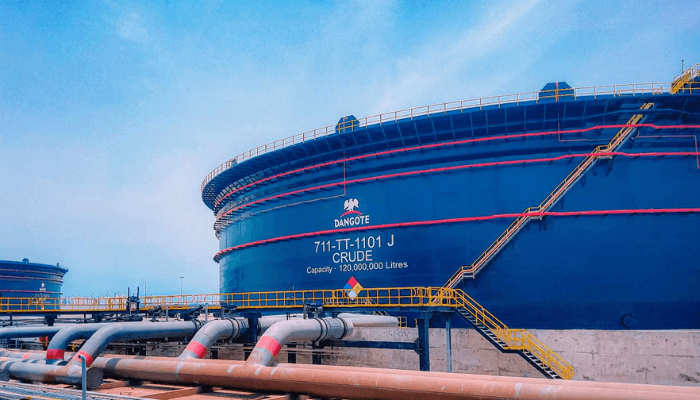
Despite these challenges, the Dangote refinery continues to function as Nigeria’s dominant stabilising force downstream. In March, it operated at 93.62% average capacity utilisation. It produced 48.2 million litres per day of PMS and supplied 34.2 million litres per day domestically. It accounted for virtually all domestic PMS output.
By comparison, the three operational modular refineries, namely Waltersmith, Edo Refinery, and Aradel, collectively contributed just 0.629 million litres per day. State-owned refineries in Port Harcourt, Warri, and Kaduna contributed nothing. One facility is holding the domestic supply side together.
This concentration of domestic supply in a single facility represents a structural vulnerability. Therefore, the urgency of activating idle state refineries cannot be overstated. Scaling modular refinery capacity is equally critical. Over-reliance on one refiner, no matter how capable, is not a resilient energy strategy.
Closing the Gap Before It Widens Further
The March 2026 data tells a clear story of a fuel system under serious strain. Consumption is declining not because demand is satisfied, but because prices are suppressing it. Imports are surging even as domestic capacity grows. Gas to power is trending in the wrong direction. At just 21 days of petrol stock sufficiency, Nigeria’s buffer against disruption remains razor-thin.
For Nigeria to genuinely close the gap between local production and national demand, import licence policies must be stabilised and clearly communicated to the market. Gas-to-power allocation must be treated as a national priority, not a residual consideration. Idle refining assets must be brought back online in earnest.
Until these structural changes take hold, the data will keep reflecting a system where energy independence remains an aspiration, and import dependence remains an expensive daily reality.
As Nigeria navigates shifting fuel supply dynamics, the need for transparency, accountability, and sustainable energy solutions becomes more urgent. At CSR Reporters, we continue to track how policy decisions and industry actions shape real outcomes for people, the environment, and the economy. Stay informed. Stay engaged. Follow our coverage for deeper insights, and join the conversation on how Nigeria can build a more resilient and responsible energy future.
[give_form id="20698"]