csrreporters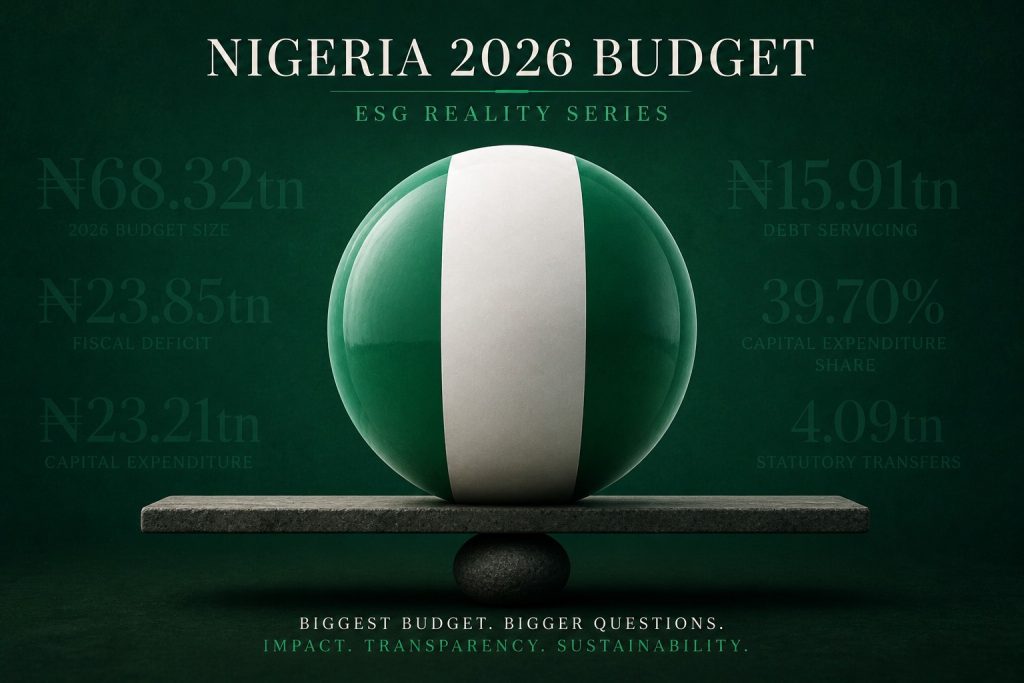
As the government drowns in debt, Nigeria’s private sector faces its most consequential sustainability moment yet
A Record Budget in a Troubled Economy
Nigeria has officially entered new fiscal territory. In April 2026, President Bola Ahmed Tinubu signed the 2026 Appropriation Bill into law, approving a budget of ₦68.32 trillion. It’s the largest in the country’s history by a considerable margin.
The signing marked the conclusion of an extended legislative process. It also drew immediate attention from us, economists, investors, and development practitioners across the continent.
However, the real significance of this budget extends far beyond its headline figure. For the country’s corporate leaders, sustainability professionals, and ESG practitioners, the ₦68.32 trillion budget is not a triumph. It is a structural signal.
This budget tells a story about a government operating at the outer limits of its fiscal capacity. It also quietly, almost inevitably, transfers a growing burden of social and environmental responsibility onto the shoulders of Nigerian business.
This editorial is the first in CSR Reporters’ flagship series examining ESG governance in the context of Nigeria’s 2026 macroeconomic reality. Therefore, it is important to establish not just what the budget says, but what it reveals.
What the Numbers Actually Say
The ₦68.32 trillion budget breaks down in ways that should concern every stakeholder with an interest in Nigeria’s sustainable development. Drawing from data published by the Budget Office of the Federation and independently analysed by CSR Reporters, debt servicing alone consumes approximately ₦15.91 trillion, representing 27.21% of total expenditure. Meanwhile, capital expenditure stands at ₦23.21 trillion, roughly 39.7% of spending. Personnel costs claim a further ₦10.75 trillion.
Consequently, when debt repayment is added to recurrent obligations, Nigeria’s budget is structurally constrained. This is before a single development project is funded or a single sustainability target is pursued.
The revenue side compounds the challenge. Total projected revenue sits at approximately ₦33.19 trillion, against an expenditure figure of ₦68.32 trillion. The resulting deficit requires additional borrowing to bridge, deepening the very debt spiral that crowds out investment.
Moreover, Nigeria’s track record on revenue credibility raises further concern. In eight of the last nine years, actual government revenues fell short of projections, sometimes by close to half.
CSR Reporter’s independent fiscal analysts note that this persistent pattern of optimistic revenue planning has consistently weakened the government’s capacity to deliver on its budget promises, ESG-related or otherwise.
What the Budget Really Reveals
Beyond the aggregate figures lies a structural truth that policymakers rarely state plainly: Nigeria is spending an increasing share of public funds simply to remain solvent. Debt servicing has surged by more than 300% over the past five years, rising from ₦3.76 trillion in 2022 to ₦15.91 trillion in 2026. Furthermore, this now accounts for over 51% of projected recurrent spending in 2026 alone.
Service-wide votes, which function as discretionary contingency reserves, add another layer of opacity. These allocations, reaching ₦9.31 trillion in 2025, are implemented with very limited transparency and remain housed under a single ministry rather than being distributed to the agencies that will eventually use them. Statutory transfers to independent agencies have similarly risen by 404.8% over five years, reaching ₦4.09 trillion in 2026. However, these agencies still operate with limited public accountability.
CSR Reporters’ analysis shows that this combination of debt pressure, opacity in discretionary spending, and credibility gaps in revenue planning creates a fiscal environment fundamentally hostile to sustained public investment in ESG priorities. In short, the government is not hiding its limitations; the budget documents them clearly. The question is whether Nigerian business is paying close enough attention.
The ESG Picture: Governance, Society, and Environment
Governance: A Transparency Deficit That Matters
The governance dimension of Nigeria’s 2026 budget is perhaps its most consequential ESG signal. Statutory transfers, service-wide votes, and independent agency budgets all share a common feature: limited oversight and minimal public accountability. For international investors applying ESG frameworks to Nigerian market exposures, this opacity is a material risk factor.
Good governance is the foundation of every credible ESG structure. However, when nearly 15% of the national budget sits in a single ministry as contingency reserves without clear disbursement rules, it fundamentally undermines the governance pillar. Therefore, companies operating in Nigeria that aspire to global ESG standards must prepare to demonstrate governance credibility that their operating environment does not automatically provide. The burden of proof falls on the private sector, not the state.
Society: Ambition Without Adequate Investment
On social expenditure, the 2026 budget contains some encouraging line items. The school nutrition feeding programme for primary schools received ₦42 billion. Support for out-of-school children was allocated ₦35 billion. Cancer equipment procurement across six major teaching hospitals was funded at ₦44.52 billion, and drugs and consumables targeting ten million vulnerable Nigerians received ₦42.18 billion.
These are not insignificant commitments. Nevertheless, they exist within a country of over 220 million people, with a poverty rate that has climbed steadily over the past decade and especially in the past one year.
In addition, the Ministry of Humanitarian Affairs and Poverty Alleviation, responsible for the government’s most direct anti-poverty interventions, received relatively modest capital allocations compared to infrastructure-heavy ministries. Social investment at this scale, while welcome in intent, cannot close the gaps that decades of structural underfunding have created. Nigerian communities will feel this shortfall. In many instances, it will be companies, not governments, that fill it.

Environment: A Climate Budget That Barely Exists
Perhaps the most striking finding in the 2026 budget is what it reveals about Nigeria’s environmental priorities. The top ten climate-related projects under the Ministry of Environment range from ₦270 million for a greenhouse gas emission reduction programme through biological carbon sequestration, to ₦42 million for agroforestry training and sustainable management. Combined, these ten flagship environmental projects represent a fraction of a fraction of a ₦68.32 trillion budget.
Meanwhile, transport infrastructure, including bus terminals and railway connectivity, received allocations exceeding ₦100 billion for single projects. Therefore, the gap between Nigeria’s stated climate commitments and its actual budget priorities is not merely wide. It is structurally embedded. Nigeria is a signatory to major international climate agreements. Yet its domestic budget architecture assigns climate action a spending priority that barely registers.
This matters acutely. Nigeria is one of the most climate-vulnerable nations on earth. Flooding across its southern states, rapid desertification in the north, and the displacement of farming communities throughout the Middle Belt are not future projections. They are present, in-your-face-every-day realities. However, the 2026 budget treats them as secondary concerns.
The Shift to Private Sector ESG Responsibility
This is the central implication that Nigerian business leaders must now confront directly. When a government is structurally constrained by debt, when climate investment is functionally absent, and when social gaps outpace public resources, the private sector does not get to observe from a distance. It gets pulled into the centre.
Investors no longer evaluate companies solely on whether they run CSR programmes or produce sustainability reports. Instead, they are increasingly assessing whether their operations actively contribute to addressing governance deficits, social infrastructure needs, and environmental challenges. This is not a philanthropic ask. It is the direction that global capital markets, development finance institutions, and local regulatory frameworks are all moving toward, often simultaneously.
An ESG practitioner CSR Reporters spoke to noted that the governments most constrained fiscally tend to produce the sharpest, most consequential turns toward private-sector-led sustainability. Nigeria in 2026 fits that pattern with near-perfect precision. Therefore, companies operating in Nigeria should not treat this budget as a government document with limited relevance to their own strategy. It is, in effect, a redrawing of the ESG responsibility map.
Why This Moment Is Different
The 2026 budget arrives at a moment of unusual convergence.
Internationally, ESG scrutiny is intensifying. Development finance institutions are tightening governance and environmental conditions on concessional financing. Global rating agencies are integrating ESG risk factors more explicitly into sovereign and corporate assessments. Furthermore, Nigerian companies seeking cross-border investment, partnerships, or listings are finding that ESG readiness is increasingly a baseline requirement rather than a differentiating asset.
Domestically, the pressure is equally real. Civil society has become more organised and vocal on accountability issues. Younger employees and consumers are making choices based on values as much as price or salary. Additionally, regulators at the Securities and Exchange Commission and the Central Bank of Nigeria have introduced sustainability reporting frameworks that signal a more demanding compliance environment ahead.
This convergence of external expectations and internal pressures creates something the previous decade rarely produced: a genuine sense of urgency in Nigerian boardrooms about sustainability. Companies that approach this urgency as a compliance exercise will find themselves managing reputational risk. Those that approach it as a strategic opportunity will be better positioned to attract capital, talent, and trust.
Conclusion: The New ESG Compact Nigeria Needs
The 2026 budget is, in many ways, a mirror. It reflects a country of substantial potential navigating deep structural constraints. However, it also delivers a clear message to the private sector. The era in which Nigerian companies could delegate sustainability responsibility entirely to the state is over. A new compact is necessary, one in which business, civil society, and government share genuine accountability for Nigeria’s social and environmental outcomes.
This compact already exists informally in pockets of the Nigerian economy. Some financial institutions have embedded climate risk into lending frameworks. Several consumer goods and manufacturing companies have launched community development programmes with measurable outcomes. A growing number of firms are publishing sustainability reports aligned to recognised international standards. These are encouraging signals. However, the 2026 budget makes clear that the pace must accelerate and the ambition must widen considerably.
Nigeria cannot simultaneously service its historic debt and fund its future without meaningful private sector partnership. That is not a political position. It is a fiscal reality, written plainly in 68.32 trillion-naira worth of evidence. Therefore, the question facing every Nigerian boardroom is not whether to step forward on ESG. It is how far, how fast, and how credibly to do so.
The country’s largest-ever budget has, paradoxically, produced its most urgent call to corporate action. The private sector should answer.
[give_form id="20698"]