csrreporters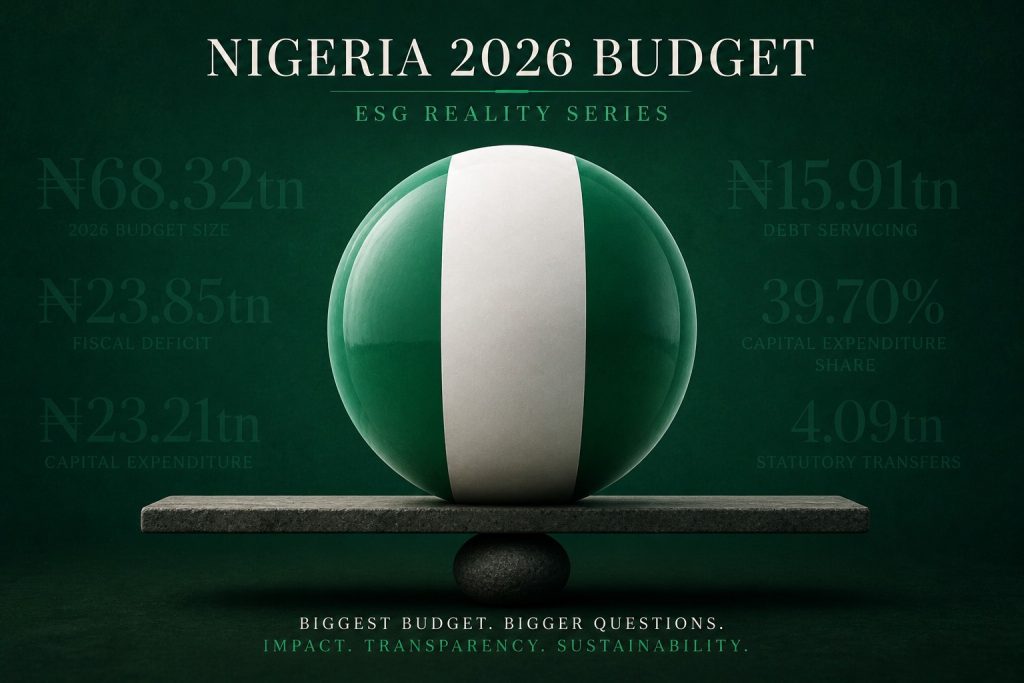
Nigeria Signs Its Biggest Budget Yet. The Revenue to Back It? That’s Another Story.
Nigeria just signed its largest budget in history. Yet the ink on that record-breaking document barely conceals a troubling question. One that should trouble every ESG investor, development professional, and corporate sustainability officer working in this country: what is a record budget worth when the revenue to fund it almost certainly will not arrive in full?
On April 17, 2026, President Bola Ahmed Tinubu signed the 2026 Appropriation Bill into law, authorising a record ₦68.32 trillion in aggregate expenditure. The signing drew praise, political goodwill, and familiar pledges about infrastructure, inclusive growth, and shared prosperity. But an analysis by CSR Reporters shows Nigeria has missed its revenue targets in eight of the last nine budget cycles. That pattern is not simply a fiscal inconvenience. It is a governance failure with direct and measurable consequences for sustainability, social development, and long-term ESG credibility.
The Budget and Nigeria’s Revenue Problem
The numbers in the 2026 budget are genuinely striking. Of the ₦68.32 trillion total, ₦15.8 trillion goes to debt servicing, ₦32.2 trillion to the Development Fund for Capital Expenditure, and ₦15.4 trillion to recurrent spending. On paper, this signals serious ambition. The administration has titled the plan the “Budget of Consolidation, Renewed Resilience and Shared Prosperity.”
The critical question, however, is not what the budget promises. It is whether the revenue will materialise to fund those promises. In a study accessed by CSR Reporters, the pattern of revenue failure is stark. In 2017, the government projected ₦5.08 trillion and collected only ₦2.66 trillion. 2018 followed with a projection of ₦7.17 trillion, yielding just ₦3.87 trillion.
By 2020, with a target of ₦5.84 trillion, actual revenue collapsed to ₦2.55 trillion, barely 44 percent of the estimate. However, the lockdown and the COVID-19 pandemic can be given as excuses. The only year targets were met in that nine-year window was 2023, when actual revenue of ₦12.48 trillion narrowly exceeded the ₦11.05 trillion projection. Every other year, the shortfall was real, often severe, and in some cases amounted to nearly half the projected figure.
The 2026 budget projects total revenue at ₦33.19 trillion. Given the trajectory documented above, that figure demands scrutiny. Furthermore, the budget’s key assumptions include oil production at 1.84 million barrels per day. Even though Nigeria has averaged closer to 1.6 million barrels per day over the past year. The exchange rate assumption of ₦1,400 to the dollar diverges from market realities. Without structural reform behind these projections, optimism alone widens fiscal gaps rather than closing them.
Why Budget Credibility Is an ESG Crisis, Not Just a Fiscal One
For ESG practitioners, budget credibility is not an abstract concept. It is the foundation upon which everything else rests. When a government consistently projects revenue it cannot collect, every downstream commitment becomes suspect. Social programmes get underfunded. Infrastructure contracts stall. Climate pledges lose their financing basis entirely.
CSR Reporters’ review of the 2026 budget reveals a deeply troubling structural imbalance. The budget allocates ₦15.91 trillion to debt service, representing a staggering 303.99 percent increase in just five years. In 2022, debt servicing cost Nigeria ₦3.76 trillion. By 2026, that figure is projected at nearly ₦15.91 trillion.
For context, that single line item now consumes 51.06 percent of the entire recurrent spending envelope. Meanwhile, education receives ₦2.56 trillion and health receives ₦2.46 trillion. Together, those two foundational sectors attract less than one-third of what the government sends to its creditors.
For any investor applying ESG criteria to sovereign risk, this inversion matters enormously. It reflects a fiscal structure that systemically deprioritises human capital investment in favour of debt obligation servicing. Moreover, according to recent reports, policy unpredictability and persistent revenue shortfalls now feature prominently in how institutional investors and sustainability-focused funds evaluate exposure to markets like Nigeria. Credibility is not a soft concept. It carries a measurable cost in capital flows, borrowing rates, and long-term investor confidence.
Governance and Transparency: Nigeria’s Deepest ESG Wound
Governance remains Nigeria’s most acute ESG vulnerability, and the budget process illustrates precisely why. For years, the country has produced ambitious spending plans built on assumptions that even government officials acknowledge are fragile. President Tinubu, when presenting the original 2026 bill in December 2025, warned that agencies would face consequences for underperformance, declaring that Nigeria could no longer afford leakages or inefficiencies in strategic institutions. Yet the structural conditions enabling such inefficiencies continue to persist.
CSR Reporters analysis shows statutory transfers have risen by 404.8 percent over the last five years, climbing from ₦810.12 billion in 2022 to ₦4.09 trillion proposed for 2026. These transfers are constitutionally paid first, yet the document notes pointedly that “transparency comes last.” Independent agencies receiving these funds still operate with limited openness, making meaningful impact assessment nearly impossible.
Service-Wide Votes are equally revealing. At 14.82 percent of the total proposed budget, these contingency funds are implemented with very limited transparency, housed centrally under the Ministry of Budget and Economic Planning rather than allocated directly to beneficiary ministries. The fundamental question is: why not allocate these funds to the ministries that use them, enabling clearer monitoring and genuine accountability?
When the public cannot trust official fiscal projections, accountability suffers at every level of governance. And without accountability, the governance component of ESG ratings inevitably deteriorates. Nigeria consistently underperforms in governance indices globally, and the structural reasons for that are visible in its annual budget cycle.

Social Consequences: Who Bears the Cost of the Shortfall?
The human cost of perpetual revenue underperformance tends to get buried in fiscal jargon. The consequences, however, are concrete, and they fall hardest on those least able to absorb them.
As of the first half of 2025, actual revenue stood at only ₦10.92 trillion against a full-year target of ₦36.35 trillion. That pace of collection points to yet another year of significant underperformance. When shortfalls of this scale materialise, capital budgets are among the first casualties because recurrent obligations, including salaries, overheads, pensions, and especially debt service, take priority as first-line charges. Social protection programmes consequently bear a disproportionate share of the gap.
The National Social Investment Programme (NSIPA), for instance, receives only ₦150 billion under Service-Wide Votes in the 2026 proposed budget. A fraction of what a country with 133 million people living in multidimensional poverty requires. Healthcare capital spending, while higher in nominal terms, depends entirely on revenue performance to materialise at all. A budget allocation for cancer equipment across six teaching hospitals or drugs for 10 million vulnerable Nigerians means nothing if the revenue to release those funds never arrives.
Furthermore, the growing personnel cost burden, at ₦10.75 trillion for 2026, leaves increasingly little room to manoeuvre when revenue falls short. Rising inequality is therefore not incidental to Nigeria’s fiscal choices. It is the structural output of a system that consistently promises social investment but cannot generate the revenue to deliver it.
Sustainability and Climate: The Funding Gap That Could Prove Catastrophic
Nigeria’s climate commitments deserve serious examination through the same fiscal lens. The country has made pledges under the Paris Agreement and presented its Updated Nationally Determined Contribution with targets for emissions reduction and renewable energy transition. Yet climate action demands predictable, long-term public financing. And predictable financing requires credible revenue projections that Nigeria has historically been unable to meet.
The numbers within the 2026 budget are sobering. CSR Reporters notes that the Ministry of Environment receives a total allocation of just ₦164.14 billion, with capital expenditure of ₦106.19 billion. The top ten climate-related capital projects within that ministry range from ₦270 million for greenhouse gas reduction through afforestation, all the way down to ₦42 million. In a budget totalling ₦68.32 trillion, the combined value of those top ten environmental projects barely registers as a rounding error.
Renewable energy funding tells a similar story. Several power sector projects in the capital expenditure list depend on multilateral and bilateral tied loans. Including the Distribution Access through Renewable Energy Scale-Up project at ₦375 billion. Relying on external financing for climate infrastructure creates its own fragility. Particularly when domestic fiscal credibility is weak and the government’s ability to provide counterpart funding is routinely in doubt.
The conclusion is difficult to avoid. Without realistic revenue and disciplined execution, Nigeria’s sustainability pledges will continue to outrun the financing available to honour them. Climate action, ultimately, requires fiscal health. And fiscal health requires telling the truth about revenue.
Why the Private Sector Now Carries More Weight Than Ever
In this environment, the private sector’s ESG responsibility has expanded considerably, and many Nigerian companies already feel that pressure acutely. When government cannot reliably deliver social infrastructure, power, healthcare, or clean water, businesses operating in affected communities face growing expectations and genuine reputational risks if they fail to respond.
Consequently, CSR in Nigeria has evolved beyond traditional philanthropy. It is now something more strategic and, in many cases, structurally necessary. Leading companies now fund schools, equip clinics, build roads, and train community health workers in locations where government services remain absent or unreliable.
This shift reflects neither charity nor reputational management alone. It reflects the rational response of organisations that understand how service delivery failures translate into operational disruption, social instability, and investor concern.
For ESG-focused institutional investors, the implications are significant. Policy uncertainty and fiscal instability raise the overall risk premium attached to Nigerian operations. Therefore, businesses that demonstrate strong ESG performance, credible community investment, and transparent governance increasingly serve as stability anchors in an environment where sovereign fiscal credibility remains structurally weak. Their sustainability standards compensate, at least partially, for the chronic gaps that public finance has repeatedly failed to close.
A Record Budget Is Not the Same as a Credible One
The signing of Nigeria’s ₦68.32 trillion budget on April 17, 2026, was genuinely historic. But history, in this context, offers limited comfort. In eight of the last nine years, Nigeria’s actual revenue fell short of projections, and sometimes by nearly half. The cycle has become so familiar that independent analysts factor in the underperformance before the fiscal year even begins.
CSR Reporters’ review of the 2026 budget shows that this pattern is no longer merely an economic concern. It is a governance and sustainability crisis. It weakens public trust, stunts infrastructure delivery, delays climate action, and leaves vulnerable Nigerians bearing the cost of promises that budget arithmetic could never keep.
A Ministry of Environment funded at ₦164 billion in a ₦68 trillion budget is not a climate strategy. Debt servicing growing by 304 percent in five years, while health and education compete for scraps, is not a social investment plan. And revenue projections that have missed their mark in eight of the last nine years are not a credible foundation for any ESG commitment worth the name.
Until Nigeria builds a fiscal culture grounded in realistic projections, transparent execution, and genuine accountability, every ESG framework applied to this country will operate in the shadow of a fundamental structural flaw. Ambitious budgets without credible revenue are not development plans. They are deferred disappointments and the people who wait longest for those promises to arrive are always those who can least afford to keep waiting.
CSR Reporters is Nigeria’s foremost platform for sustainability, ESG, and corporate responsibility journalism. The views expressed represent editorial analysis based on publicly available data. See The First Part of This Series Here.
[give_form id="20698"]