csrreporters
The decision by the Joint Admissions and Matriculation Board and heads of tertiary institutions to retain 150 as the minimum admissible score for universities in 2026 has triggered widespread debate across the country.
During the 2026 policy meeting in Abuja, stakeholders agreed that universities and colleges of nursing would admit candidates from 150 and above. Polytechnics would maintain 100 as their benchmark. In addition, candidates seeking admission into Colleges of Education and Agriculture programmes for non-engineering courses will no longer require UTME scores.
For many Nigerians, however, the outrage extends far beyond numbers. A score of 150 out of 400 translates to just 37.5 percent. Consequently, critics argue that the country may be normalising weak academic performance instead of confronting deeper structural problems affecting the education system.
Yet the controversy surrounding JAMB benchmarks also reveals something bigger. It raises important concerns around sustainability, workforce development, social investment, and long-term national competitiveness. In many ways, the conversation has now moved beyond admissions alone.
A Decade of Falling Admission Benchmarks
In 2016, the minimum admissible score for universities, polytechnics, and colleges of education stood at 180. At the time, education experts already questioned whether the benchmark was too low. Nevertheless, the years that followed brought even lower figures.
By 2017, universities adopted 120 as the minimum score, while polytechnics and colleges of education accepted 100. Subsequently, the benchmarks fluctuated over the years.
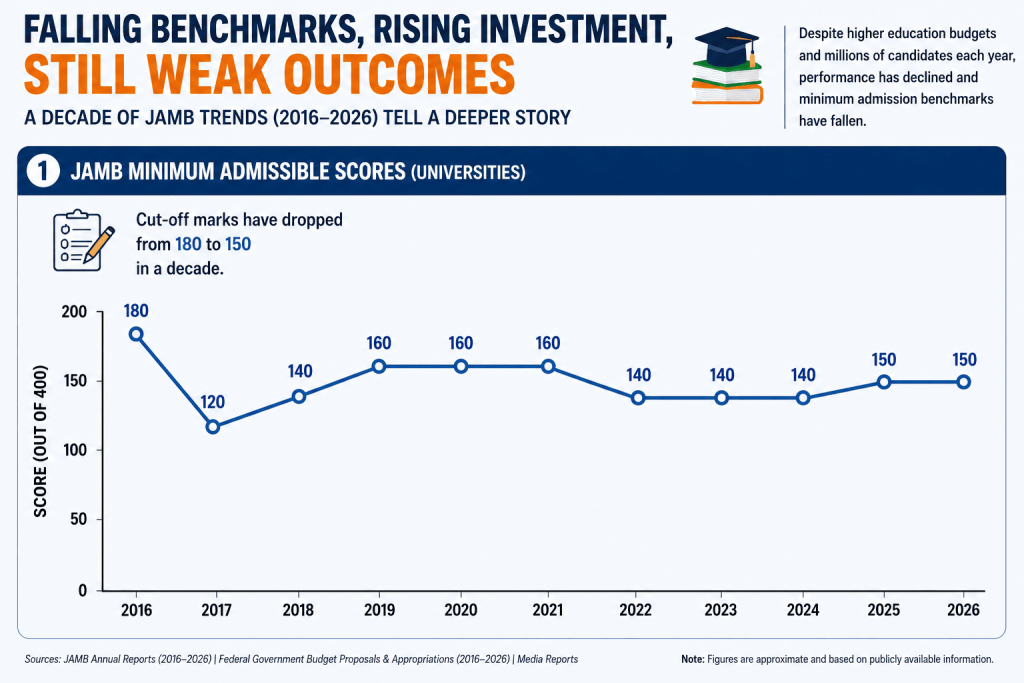
Meanwhile, polytechnics largely retained 100 throughout the period. Although institutions can still set higher departmental requirements, the repeated lowering or stagnation of national minimums has continued to fuel concern among stakeholders.
The 2026 decision has already generated strong reactions online. Across social media platforms and education forums, many Nigerians described the benchmark as evidence of weakening academic standards within the system.
The Real Concern Is Student Performance
A closer look at UTME performance trends paints a more troubling picture. In 2016, about 35.8 percent of candidates scored above 200 marks. However, performance steadily declined in later years.
The numbers reveal a worrying pattern:
- 2017: roughly 32 percent scored above 200
- 2018: around 25 percent
- 2019: 23.83 percent
- 2020: about 21 percent
- 2021: only 12.97 percent
- 2022: approximately 22 percent
- 2023: 23.37 percent
- 2024: roughly 24 percent
- 2025: around 21 percent
- 2026: approximately 21.5 percent
As a result, nearly eight out of every ten candidates consistently scored below 200 marks over the last decade. That reality raises serious questions about Nigeria’s foundational learning system and broader educational outcomes.
See: Why 140 JAMB score is equal to mediocrity
At the same time, participation levels remain high. UTME registrations increased from approximately 1.59 million candidates in 2016 to nearly 1.95 million candidates in both 2025 and 2026. Therefore, demand for tertiary education remains strong despite weak performance outcomes.
Young Nigerians still see higher education as an important route toward economic opportunity. Unfortunately, the system increasingly appears unable to prepare many students adequately for competitive academic environments.
Education Funding Has Grown Significantly
One major contradiction within Nigeria’s education sector is that budgetary allocations have increased sharply over the years. In 2016, education received between ₦369.6 billion and ₦403 billion, representing roughly 7.9 percent of the national budget. Since then, allocations have risen consistently getting to roughly ₦3.52 trillion in 2026 Budget.
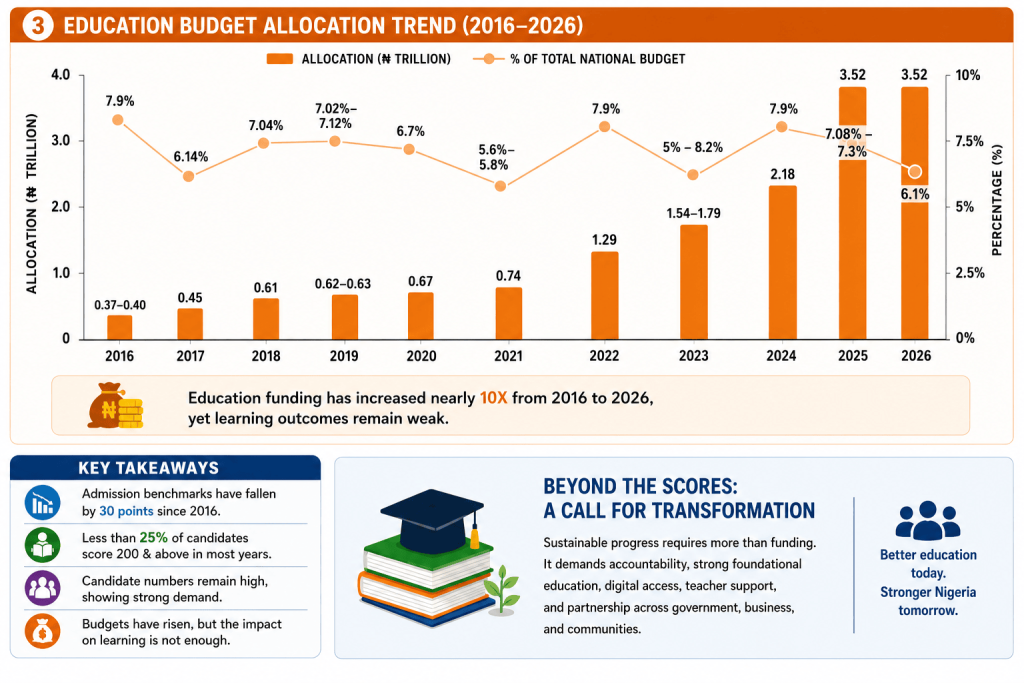
Despite these increases, Nigeria still allocates far below the global recommendation for education spending. More importantly, stakeholders continue to question how effectively the funds are utilised across the sector.
Across many public schools, students still learn in overcrowded classrooms with outdated materials. In several rural communities, schools operate without laboratories, internet access, stable electricity, or adequate furniture. Teacher shortages also remain widespread in many states.
Consequently, many observers argue that increased spending has not translated into stronger educational outcomes or improved learning quality.
Why This Matters Beyond Education
The education crisis also carries major implications for ESG and sustainability conversations in Nigeria. Education falls directly under the “Social” pillar of ESG frameworks because it influences human capital development, inequality reduction, workforce readiness, and social mobility.
When learning outcomes decline, the long-term economic impact affects both businesses and communities. Companies operating in Nigeria increasingly discuss sustainability, youth empowerment, and digital inclusion within their CSR strategies. However, weak foundational education threatens those objectives significantly.
A country cannot build a globally competitive workforce if students consistently struggle with basic academic benchmarks. For instance, sectors such as technology, healthcare, renewable energy, engineering, agriculture, and manufacturing require highly skilled talent pipelines. Yet declining educational performance may weaken Nigeria’s ability to meet future labour demands.
As a result, businesses may eventually face talent shortages despite Nigeria’s large youth population. Furthermore, poor learning outcomes can increase unemployment, widen inequality, and deepen poverty levels. Those challenges directly affect social stability and sustainable development goals.
CSR May Need to Shift Toward Foundational Learning
Traditionally, many corporate social responsibility projects in Nigeria focus on scholarships, classroom renovations, or donation drives. While those interventions remain valuable, experts increasingly believe companies may need to invest more heavily in foundational learning support.
That includes:
- teacher training
- digital literacy
- STEM education
- reading culture programmes
- internet access
- educational technology
- rural learning infrastructure
Several organisations already support education-focused interventions across Nigeria. We’ve documented lots of them here on our website. However, the scale of the learning crisis suggests broader collaboration may become necessary.
In addition, sustainability experts argue that education should no longer be treated solely as a government responsibility. Instead, it should become a shared national development priority involving policymakers, companies, NGOs, communities, and development agencies.
Without stronger investment in learning quality, Nigeria’s demographic advantage could eventually become an economic burden rather than an asset.
The Problem Starts Before UTME
Importantly, many analysts CSR Reporters spoke to, believe the JAMB controversy merely exposes deeper foundational problems. If nearly 80 percent of candidates repeatedly score below 200, then the issue likely begins long before university entrance examinations.
Many students struggle with literacy, comprehension, numeracy, and analytical reasoning from early educational stages. Insecurity has also disrupted learning across several states. Additionally, inflation and economic hardship have placed enormous pressure on families and school systems.
Some students now combine schooling with income-generating activities to support their households. Therefore, educational performance cannot be separated from broader socioeconomic realities affecting Nigerian families.
At the same time, digital inequality continues to widen learning gaps between urban and rural students. While some candidates prepare with online tutorials and CBT simulations, others still lack access to stable electricity or internet services. That disparity significantly affects examination preparedness and learning outcomes.
A National Conversation Beyond Cut-Off Marks
The national debate surrounding JAMB benchmarks ultimately reflects a larger question about Nigeria’s future. The issue is no longer whether 150 is acceptable or whether universities should raise their cut-off marks.
Rather, the deeper concern is whether Nigeria is building an education system capable of supporting sustainable national growth. For CSR leaders, policymakers, and ESG advocates, the conversation should now focus on measurable learning outcomes instead of admission figures alone.
Questions around accountability, funding efficiency, teacher quality, curriculum relevance, and digital access have become increasingly urgent. Meanwhile, businesses also have a growing stake in the outcome because today’s students will eventually become tomorrow’s workforce, consumers, innovators, and entrepreneurs.
If learning outcomes continue to weaken, the economic consequences may extend far beyond universities. Ultimately, Nigeria’s education challenge is not simply about admission scores. It is increasingly about whether the system is adequately preparing young Nigerians for the future at all.
[give_form id="20698"]