csrreporters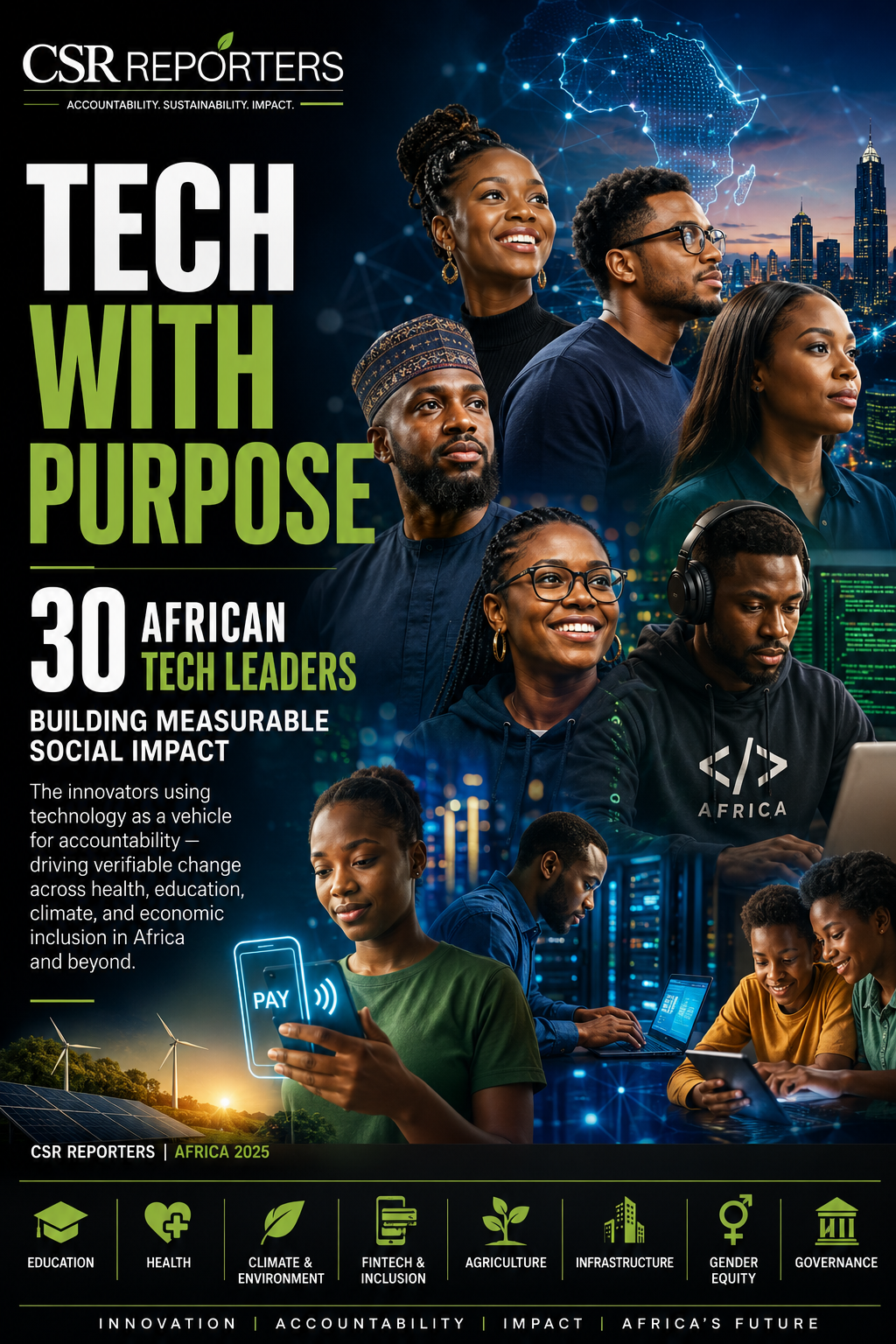
30 African Tech Leaders Making Measurable Social Impact
Africa’s technology sector has become one of the world’s most dynamic stories of the last decade. From Lagos to Nairobi, Accra to Cape Town, African tech founders, investors, and ecosystem builders have raised billions in capital, built companies valued in the billions, and placed the continent at the centre of conversations about the future of digital finance, artificial intelligence, and the global talent economy.
But beyond the unicorns and the funding rounds, something more important is happening. Africa’s most visionary tech leaders have understood something that their counterparts in Silicon Valley have often struggled to grasp: that in a continent where hundreds of millions of people lack access to basic financial services, quality education, and economic opportunity, building technology is not separable from building a better society. Every payment platform that includes a previously unbanked merchant, every digital skills programme that trains a young woman for a tech career, every AI system built in an African language — these are acts of social transformation dressed in code.
This CSR Reporters special feature — Tech With Purpose — celebrates 30 African tech leaders whose social commitment is as bold as their commercial ambition. From Tunde Onakoya’s chess marathons funding children’s scholarships, to Blessing Abeng’s Ingressive for Good training 150,000 young Africans in digital skills; from Iyinoluwa Aboyeji’s Future Africa backing 100+ purpose-driven startups, to Pelonomi Moiloa’s Lelapa AI building language infrastructure for a continent the global AI industry has largely ignored — these are the builders who understand that Africa’s technological future must be built for all Africans, or it is not Africa’s future at all.
1. Iyinoluwa Aboyeji | Nigeria
Iyinoluwa Aboyeji — simply ‘Iyin’ to Africa’s tech ecosystem — has done something that very few of his generation have achieved: he co-founded not one but two of Africa’s most consequential technology companies. Andela, which he co-founded in 2014, trained thousands of African software engineers and placed them with global firms including Microsoft and GitHub, reshaping the world’s perception of African technical talent. Flutterwave, which he co-founded in 2016, became one of Africa’s most valuable fintech unicorns with a $3 billion valuation. After these landmark achievements, Aboyeji could easily have rested. Instead, he founded Future Africa — a venture platform that provides capital, coaching, and community to the next generation of African founders. With over 100 startups backed and a portfolio worth more than $6 billion, Future Africa is proof that Africa’s tech success can be deliberately recycled into Africa’s tech future. In 2024, he joined Nigeria’s 3MTT Advisory Committee, working to scale digital skills training nationally. He holds Nigeria’s Order of the Niger (OON) national honour. His governing philosophy — that purpose and prosperity are not in conflict — makes him one of the continent’s most important ecosystem builders.
| Initiative | Future Africa — Venture Platform for Mission-Driven African Founders |
| Beneficiaries | 100+ African startups across fintech, healthtech, edtech, and agritech; combined portfolio value exceeds $6 billion |
| Investment | Active venture platform deploying capital and coaching; backed Andela ($200M+ raised) and Flutterwave ($3B+ valuation); 2024 appointed to Nigeria’s 3MTT Advisory Committee for national digital skills scale-up |
2. Olugbenga Agboola | Nigeria
Olugbenga Agboola is the architect of one of Africa’s most critical pieces of financial infrastructure. As the founder and CEO of Flutterwave, he has built a payment platform that processes over 26 million transactions monthly across more than 35 countries, enabling African businesses to send and receive money across borders with a simplicity that was previously unimaginable. Recognised by Forbes and Bloomberg and named among ThisDay’s 2024 Young Global Leaders of the Year alongside Grammy winner Tems and chess champion Tunde Onakoya, Agboola’s impact is both commercial and social: every Flutterwave transaction that completes is a small act of financial inclusion. In 2024, Flutterwave partnered with American Express, expanding payment options for African markets, and co-launched a Cybercrime Research Centre with Nigeria’s EFCC, directly addressing digital security challenges that disproportionately affect Africa’s emerging digital economy. His mission statement — that there are ‘so many problems to solve on the continent’ — reads not as a complaint but as an invitation.
| Initiative | Flutterwave Financial Infrastructure / Cybercrime Research Centre Partnership / Payment Inclusion Across Africa |
| Beneficiaries | Businesses across 35+ African countries; merchants, SMEs, and individuals accessing digital payments; cybercrime prevention across Nigeria |
| Investment | $475M+ raised; $3B+ valuation; 26 million+ monthly transactions worth $500M+ as of 2024; launched Cybercrime Research Centre with EFCC |
3. Shola Akinlade | Nigeria
When Stripe acquired Paystack in 2020 for over $200 million, it was the largest tech acquisition in African history at the time — a validation not just of Shola Akinlade’s company, but of Africa’s entire digital commerce potential. Akinlade co-founded Paystack with a clear social purpose: to simplify online payments so that African businesses could compete and grow. The impact has been structural. Hundreds of thousands of businesses — from individual entrepreneurs to established enterprises — now operate with payment infrastructure that previously required significant technical sophistication and financial resources to access. Named alongside Olugbenga Agboola among ThisDay’s 2024 Young Global Leaders and consistently featured on Africa’s tech power lists, Akinlade represents the generation of African founders who understand that building great products and building a more equitable continent are the same mission.
| Initiative | Paystack — Payment Infrastructure for African Businesses |
| Beneficiaries | Hundreds of thousands of African businesses across Nigeria, Ghana, Kenya, South Africa and beyond; SMEs accessing digital payments for the first time |
| Investment | Acquired by Stripe for $200M+ in 2020; continues to invest in African payment ecosystem development and capacity building |
4. Tunde Onakoya | Nigeria
Tunde Onakoya’s story begins in a barbershop in Ikorodu, Lagos, where a boy who couldn’t afford secondary school fees taught himself chess by watching strangers play. That boy grew up to break the Guinness World Record for the longest chess marathon — twice. In April 2024, he played for 60 hours in New York’s Times Square, raising over $110,000 for children’s education. In April 2025, he extended that record to 64 hours, with every second dedicated to his singular goal: raising $1 million to give Africa’s slum children access to education. Through Chess in Slums Africa, the nonprofit he founded in 2018, Onakoya has already provided over 200 children with scholarships spanning primary school through university. His model is radical in its simplicity: teach a child chess, and you teach them to think, to plan, to believe in their own intellect. From slum communities in Makoko and Oshodi to stages at TEDx, Harvard, MIT, and the UN, Onakoya has carried one message — that no zip code should determine a child’s ceiling. He is, without question, one of the most moving social impact stories in contemporary Africa.
| Initiative | Chess in Slums Africa (CISA) — Education Through Chess in Underserved Communities |
| Beneficiaries | 200+ children provided with scholarships from primary school through university; slum communities in Ikorodu, Makoko, and Oshodi, Lagos |
| Investment | Raised $110,000+ through 2024 Times Square marathon; officially broke Guinness World Record in April 2025 with 64-hour marathon, raising further funds toward $1 million education goal |
5. Blessing Abeng | Nigeria
Blessing Abeng co-founded Ingressive for Good (I4G) in the middle of a pandemic, with an $80,000 seed donation and a conviction that Africa’s greatest untapped resource was its young people — if only they had access to the right skills. What followed was one of the continent’s most impressive non-profit growth stories. I4G has trained over 150,000 individuals in tech skills, placed more than 2,000 in jobs, and built a community of over 250,000 members across Africa. Partnerships with Coursera, Meta, and Datacamp have delivered millions of dollars’ worth of education at no cost to learners. Abeng’s philosophy is precise and personal: ‘Africa has huge problems, but sometimes our youth just need a little help.’ The results bear this out — I4G members have transitioned from unemployment to tech careers, from selling goods on roadsides to coding landing pages, from precarity to earning power. As one of Africa’s most impactful female tech leaders, Abeng is proving that social investment in digital skills is not charity — it is economic development at scale.
| Initiative | Ingressive for Good (I4G) — Tech Skills, Job Placement and Earning Power for African Youth |
| Beneficiaries | 150,000+ individuals trained in tech skills; 2,000+ placed in jobs; community grown to 250,000+ members across Africa |
| Investment | $80,000 seed donation; $250,000 Google donation; Coursera partnership providing $2M+ in free course access to 5,000+ Africans; Meta, Datacamp collaborations |
6. Sim Shagaya | Nigeria
Sim Shagaya — Harvard Business School graduate, serial entrepreneur, and founder of uLesson — has turned his attention to one of Africa’s most persistent and consequential gaps: the quality of education. Founded in 2019, uLesson provides video lessons and interactive quizzes aligned to national curricula across West Africa, meeting students where they are — on mobile devices — and delivering teaching quality that was previously the preserve of elite schools and expensive private tutors. In a continent where the quality of education a child receives is largely determined by the wealth of the postcode they’re born into, uLesson is a structural intervention: it is not a charity but a business deliberately designed to serve those the market has historically ignored. Shagaya’s previous ventures, including Konga, demonstrated his ability to build at scale. With uLesson, he is applying that ambition to Africa’s most important long-term investment — the minds of its children.
| Initiative | uLesson — Affordable, High-Quality Digital Education for African Students |
| Beneficiaries | Students across West Africa, particularly in Nigeria and Ghana, from secondary to university level |
| Investment | Raised significant venture funding; edtech platform delivering curriculum-aligned video lessons and interactive content at accessible price points |
7. Tosin Eniolorunda | Nigeria
When Moniepoint reached unicorn status in 2024 with a $1 billion valuation, it was not merely a financial milestone — it was a statement about where Africa’s real economic opportunity lies. Tosin Eniolorunda co-founded and leads a company that has built financial infrastructure specifically for the merchants, traders, and small business owners who form the backbone of Nigeria’s economy but have historically been ignored by the formal banking system. Moniepoint’s point-of-sale devices and business banking tools have brought millions of small enterprises into the digital financial mainstream, giving them access to payment processing, credit, and financial data for the first time. In Africa’s informal economy — which accounts for the majority of employment and economic activity — Moniepoint is not just a fintech company. It is a financial inclusion engine, and Eniolorunda its quiet but transformative architect.
| Initiative | Moniepoint — Financial Infrastructure and Business Banking for Africa’s Informal Economy |
| Beneficiaries | Millions of small and micro businesses across Nigeria and expanding African markets; merchants previously excluded from formal financial services |
| Investment | Reached unicorn status with $1 billion valuation in 2024; serving millions of previously unbanked and underbanked merchants |
8. Pelonomi Moiloa | South Africa
Pelonomi Moiloa is working on a problem that most of the world’s AI industry has failed to address: the fact that Africa’s hundreds of millions of indigenous language speakers are being left behind by a global AI revolution built almost entirely on English and a handful of other dominant languages. As the CEO and founder of Lelapa AI, she is building the language infrastructure that will allow African languages to participate in the AI economy — not as an afterthought, but as a foundation. Her work is both technical and deeply humanistic: she understands that language is identity, and that an AI future that cannot speak Zulu, Yoruba, Swahili, or Amharic is an AI future that does not include Africa. Recognised among Africa’s tech power list for 2025, Moiloa represents a new generation of African technologists who are not simply adapting global tech for local use — they are building from scratch, for Africa first.
| Initiative | Lelapa AI — Building African Language AI Infrastructure |
| Beneficiaries | African language speakers historically excluded from AI tools; indigenous language communities across the continent |
| Investment | Venture-backed; building foundational language models for African languages that global AI systems have ignored |
9. Omobola Johnson | Nigeria
Omobola Johnson occupies a rare position in Africa’s tech landscape — she has shaped the ecosystem from both the inside of government and the inside of venture capital. As Nigeria’s Minister of Communication Technology, she drove national broadband expansion and ICT policy reforms that laid groundwork for Nigeria’s subsequent digital economy boom. As a Senior Partner at TLcom Capital, she now helps direct investment into the next generation of African tech startups, bringing institutional rigour and deep ecosystem knowledge to the allocation of growth capital. Her trajectory — from engineer to minister to investor — reflects a consistent underlying purpose: building the conditions under which African technology can flourish at scale. She is one of the most consequential women in African tech, and her impact is measured not just in portfolio returns but in the architecture of an entire digital economy.
| Initiative | TLcom Capital — Venture Investment in African Tech Startups | National ICT Policy Leadership |
| Beneficiaries | African tech startups receiving growth capital; Nigerian citizens served by transformative ICT policy during ministerial tenure |
| Investment | TLcom manages significant VC funds targeting African tech; as minister, oversaw national broadband and ICT strategy |
10. Maya Horgan Famodu | Nigeria/USA
Maya Horgan Famodu has built two of Africa’s most impactful institutions for different but complementary reasons. Ingressive Capital, which she founded and manages, is a venture fund deploying tens of millions of dollars into early-stage African tech startups — having backed Paystack before its landmark Stripe acquisition and continued to champion founders that others overlook, with 40% of her portfolio companies founded by women. Ingressive for Good, which she co-founded alongside Blessing Abeng and Sean Burrowes, translates those same values — belief in African talent, commitment to access — into a non-profit that has trained over 150,000 young Africans in tech skills. As a two-time Forbes 30 Under 30 honoree and Kauffman Fellow, Famodu has demonstrated that the most powerful intervention in Africa’s tech ecosystem is not choosing between commercial investment and social impact — it is refusing to accept that those are different choices.
| Initiative | Ingressive Capital — Early-Stage VC for African Tech Startups | Ingressive for Good |
| Beneficiaries | Early-stage African tech founders including Paystack, Mono, and Carry1st; 40% of portfolio companies founded by women |
| Investment | $10M Fund I; $50M Fund II; portfolio includes successful exits including Paystack; two-time Forbes 30 Under 30 |
11. Tope Awotona | Nigeria/USA
Tope Awotona is one of the most quietly extraordinary success stories in global tech. A Nigerian-born entrepreneur who immigrated to the United States, he founded Calendly — a scheduling software platform — using $200,000 of his own savings after multiple attempts at other businesses. Calendly grew to a $3 billion valuation and is used by over 10 million people worldwide, making it one of the most widely used productivity tools on the internet. But Awotona’s social impact reaches beyond Calendly’s commercial success. Following a personal commitment, he invested $10 million to support Black and minority founders who face systemic barriers in accessing venture capital. His story — of persistence, self-funding, and eventual breakthrough — has become a touchstone for African diaspora entrepreneurs across the world. He represents what is possible when structural barriers do not succeed in defining the ceiling.
| Initiative | Calendly — Scheduling Infrastructure Used Globally | $10M Investment in Black and Minority Founders |
| Beneficiaries | Global users of Calendly (10M+); Black and minority entrepreneurs in the USA; African diaspora tech community |
| Investment | Calendly valued at $3B; committed $10M personal investment to support Black and minority founders following public commitment post-2020 |
12. Judith Owigar | Kenya
Judith Owigar has spent her career at the intersection of technology and equity, committed to the conviction that Kenya’s digital future cannot afford to leave women behind. As the co-founder of AkiraChix — a programme that trains young Kenyan women in technology — she has helped hundreds of women enter tech careers that would otherwise have been inaccessible to them. Her policy influence has extended to national AI strategy discussions, where she advocates for technology governance frameworks that are inclusive, transparent, and protective of ordinary citizens. In East Africa’s growing tech ecosystem, Owigar is a consistent and credible voice for the principle that digital transformation must be equitable transformation — or it is not transformation at all.
| Initiative | AkiraChix — Tech Training for Women in Kenya | National AI Policy Advisory |
| Beneficiaries | Young Kenyan women trained in technology and placed in tech careers; policy influence on national AI strategy |
| Investment | Co-founded AkiraChix, which has trained hundreds of Kenyan women in tech; ongoing policy advisory role |
13. Eghosa Omoigui | Nigeria
Eghosa Omoigui is a pioneer. As the founder and Managing Partner of EchoVC Partners, he was among the first institutional investors to commit systematically to African and African diaspora tech founders at a time when the continent’s startup ecosystem was in its infancy. EchoVC’s model — providing not just capital but active mentorship, network access, and ecosystem support — has helped shape the playbook for African venture investing. Many of today’s generation of African tech investors learned from or were influenced by Omoigui’s approach. His belief that Africa’s greatest competitive advantage is the ingenuity of its people — when properly resourced — has made EchoVC not just a fund but a philosophy. In a field that attracts attention primarily when valuations soar, Omoigui has consistently focused on the harder and more important work: finding founders early, backing them deliberately, and building the ecosystem they need to succeed.
| Initiative | EchoVC — Early-Stage Venture Capital for African and Diaspora Tech Founders |
| Beneficiaries | African and African diaspora tech entrepreneurs receiving first institutional capital and mentorship |
| Investment | Managed multiple funds deploying capital into early-stage African tech; one of Africa’s first institutional tech VCs |
14. Bosun Tijani | Nigeria
Bosun Tijani’s impact on Africa’s tech ecosystem spans two distinct and complementary chapters. As the CEO and co-founder of CcHUB — Co-creation Hub — for over a decade, he built Nigeria’s most recognised technology innovation centre, incubating startups, training developers, and creating the conditions for Nigeria’s tech ecosystem to develop institutional roots. Companies that passed through CcHUB’s orbit have gone on to raise hundreds of millions in funding. In 2023, President Bola Tinubu appointed Tijani as Nigeria’s Minister of Communications, Innovation and Digital Economy — taking his ecosystem-building work from institutional to national scale. His flagship policy initiative, the 3 Million Technical Talent (3MTT) programme, aims to train 3 million Nigerians in digital skills by 2025, working with Iyinoluwa Aboyeji and others on the advisory committee. In Africa’s tech story, Tijani is both a chapter author and an institutional architect.
| Initiative | 3 Million Technical Talent (3MTT) Programme | CcHUB — Africa’s Leading Tech Innovation Hub |
| Beneficiaries | Target of 3 million trained Nigerian digital workers by 2025; thousands trained through CcHUB since 2011 |
| Investment | Government-backed 3MTT programme with significant national budget allocation; CcHUB has mobilised hundreds of millions in grants and investment across 14 years |
15. Rebecca Enonchong | Cameroon
Rebecca Enonchong is one of the most consequential figures in African tech history — and one of the least talked about outside the ecosystem. As the founder and CEO of AppsTech, she has run a successful enterprise technology business for over two decades, proving the viability of African tech entrepreneurship at a time when almost no one believed in it. As the Chair of AfriLabs — the pan-African network connecting over 400 innovation hubs across more than 50 countries — she has become a structural force for the continent’s innovation ecosystem, ensuring that the benefits of technological progress are not concentrated in a few cities but distributed across the continent. A vocal advocate for women in tech, open internet access, and African data sovereignty, Enonchong combines commercial achievement with an unapologetically political commitment to Africa’s digital future.
| Initiative | AppsTech — Enterprise Technology Solutions | AfriLabs — Pan-African Innovation Hub Network |
| Beneficiaries | Innovation hubs across 50+ African countries; thousands of startups and entrepreneurs supported through the AfriLabs network |
| Investment | Decades of personal investment in African tech infrastructure; AppsTech serves enterprise clients globally while AfriLabs connects 400+ hubs continent-wide |
16. Kola Olutimehin | Nigeria
Kola Olutimehin has spent years at the coalface of Africa’s startup ecosystem, backing founders at the earliest and most vulnerable stage of company-building when most capital is unavailable. Ventures Platform, which he leads as CEO, has backed over 100 African startups, including early-stage investments in companies that went on to become category leaders. Beyond capital, Ventures Platform operates as a genuine ecosystem builder — hosting programmes, providing mentorship, and creating the conditions for founder success in a market where institutional support is still thin. Olutimehin’s commitment to African founders is not abstract; it is expressed in term sheets, board seats, and the patient work of company-building across a decade. He is one of the people who laid the ground on which Nigeria’s tech success stories stand.
| Initiative | Ventures Platform — Early-Stage VC and Ecosystem Building |
| Beneficiaries | 100+ African startups funded; founders across Nigeria and broader Africa receiving first institutional backing |
| Investment | Multiple fund cycles deployed; backed leading Nigerian startups including Paystack (early) and others that went on to significant commercial success |
17. Odunayo Eweniyi | Nigeria
Odunayo Eweniyi co-founded PiggyVest with a deceptively simple idea: make it easy for ordinary Nigerians to save. What followed was a financial revolution. PiggyVest now has over 4 million registered users who have collectively saved and invested billions of naira — much of it by people who had never had access to formal savings tools before. But Eweniyi’s impact is not only commercial. During the COVID-19 pandemic, she co-founded the #HalfOfAMillion initiative, which raised emergency funds and distributed direct relief to over 5,000 Nigerians in acute financial distress. As one of Nigeria’s most prominent female tech founders, she has also been a consistent advocate for women in entrepreneurship, using her platform to mentor and amplify the next generation of African female founders. She is proof that fintech, done right, is not just about profit — it is about the dignity of financial security for people who have never had it.
| Initiative | PiggyVest — Savings and Investment Platform for Everyday Africans | #HalfOfAMillion Initiative |
| Beneficiaries | 4M+ registered users saving and investing; #HalfOfAMillion COVID-19 relief fund supporting 5,000+ Nigerians in distress |
| Investment | PiggyVest has helped Nigerians save billions of naira; #HalfOfAMillion initiative raised and distributed significant emergency relief funds during COVID-19 |
18. Dare Okoudjou | Benin/Global
Dare Okoudjou founded MFS Africa on a conviction that seemed radical at the time: that Africa’s mobile money ecosystem — fragmented across dozens of operators and national borders — could be connected into a single, unified network. Today, MFS Africa is the largest digital payments network on the continent, linking over 400 million mobile wallets across more than 35 countries and facilitating billions of dollars in cross-border transactions annually. The social impact is immense: for African migrants sending money home, for rural traders receiving payments, for families separated by borders but connected by mobile phones, MFS Africa’s infrastructure is the invisible bridge. Okoudjou’s vision was always explicitly Pan-African — he saw fragmentation as a colonial inheritance and interoperability as a form of economic sovereignty. Building it has taken twenty years of conviction, capital, and patient infrastructure work.
| Initiative | MFS Africa — The Largest Digital Payments Network in Africa |
| Beneficiaries | Hundreds of millions of Africans connected through mobile money interoperability; over 400 million mobile wallets linked across 35+ countries |
| Investment | Raised over $100M; connecting 400M+ mobile wallets; facilitating billions in cross-border transactions annually |
19. Nangamso Matshoba | South Africa
Nangamso Matshoba has built her career on the conviction that South Africa’s digital economy cannot reach its potential while it continues to exclude women — particularly Black women — from its leadership and workforce. Through advocacy, mentorship, and the platforms she has built, she has worked to dismantle the structural barriers that prevent young South African women from entering and thriving in technology careers. Her approach is both personal — she mentors individual women — and systemic, pushing for changes in how tech education, hiring, and investment operate across the country. In South Africa, where the legacy of apartheid intersects with the gender gaps of the global tech industry, Matshoba’s work represents a form of social repair: using technology as a tool not just for economic growth but for historical correction.
| Initiative | Women in Tech Africa / Digital Skills Advocacy for South African Women |
| Beneficiaries | Young South African women pursuing tech careers; communities historically excluded from the digital economy |
| Investment | Platform-based advocacy; mentorship and programme development for women in tech |
20. Yele Bademosi | Nigeria
Yele Bademosi has positioned himself at the frontier of a question that will define Africa’s next decade of financial development: can blockchain and cryptocurrency technology democratise economic access across the continent in ways that traditional finance never managed? As the founder of both Nestcoin and Bundle Africa, and as the former Director of Binance Africa, Bademosi has been a consistent voice for the potential of Web3 tools to give young Africans — many without bank accounts but with smartphones — access to savings, earnings, and investment opportunities. Bundle Africa, his crypto super-app, has served over 300,000 users across Africa. His work sits at a contested frontier, but his purpose is clear: to ensure that if a new financial system is being built, Africans are building it too — not just using it.
| Initiative | Crypto and Web3 Financial Access for African Youth |
| Beneficiaries | African youth accessing digital financial tools and crypto-based earning opportunities; previously unbanked individuals |
| Investment | Raised $6.45M for Nestcoin; Bundle Africa serving 300,000+ users across Africa in crypto transactions |
21. Adenike Adeyemi | Nigeria
Adenike Adeyemi has led FATE Foundation — one of Nigeria’s oldest and most respected entrepreneurship development institutions — through two decades of training, mentoring, and supporting Nigerian entrepreneurs. Under her leadership, the foundation has equipped over 16,000 entrepreneurs with the business skills, networks, and resources to build sustainable enterprises. FATE’s model is deliberately inclusive: it targets entrepreneurs who are building businesses in the real Nigerian economy, not just the venture-backed tech elite, and its alumni businesses have collectively created thousands of jobs. In a country where entrepreneurship is often the primary path out of poverty, FATE is not just a training programme — it is social infrastructure for economic mobility. Adeyemi’s tenure at its helm has made her one of Nigeria’s most important figures in the quiet work of building an entrepreneurial ecosystem from the ground up.
| Initiative | FATE Foundation — Entrepreneurship Training and Business Support for Nigerian Entrepreneurs |
| Beneficiaries | 16,000+ entrepreneurs trained over two decades; small and growing businesses across Nigeria |
| Investment | Decades of operation; supported by corporate partnerships and donor funding; alumni businesses have created thousands of jobs |
22. Funmilayo Alabi | Nigeria
Funmilayo Alabi has dedicated her career to closing the digital divide that leaves millions of Nigerian women and young people economically vulnerable in an increasingly digital world. Her work in digital literacy and tech inclusion has been consistent and community-facing: she works not at the level of policy abstraction but at the ground level where real people need practical skills and real opportunities. In Nigeria’s tech ecosystem — which has generated enormous wealth but not always distributed it broadly — advocates like Alabi perform essential work: ensuring that the benefits of digital transformation reach those who need them most, not only those who are already best positioned to capture them.
| Initiative | Digital Literacy and Tech Inclusion Programmes for Nigerian Women and Youth |
| Beneficiaries | Nigerian women and youth in underserved communities gaining digital skills and economic access |
| Investment | Programme-based; ongoing advocacy and training work |
23. Samir Abdelkrim | Algeria/France
Samir Abdelkrim has done something that is undervalued but essential: he has told the story of Africa’s startup ecosystem to the world, systematically, over many years, and with genuine rigour. Through Startupbrics, he has documented tech entrepreneurs across more than 45 African countries, giving visibility to founders and ecosystems that international media consistently overlook. In an industry where capital follows narrative, and narrative follows visibility, Abdelkrim’s work has a practical social impact: the African founders he has profiled and amplified have found audiences, investors, and partners as a direct result. His is a form of tech philanthropy that does not write cheques but opens doors — and in Africa’s startup ecosystem, visibility itself is a form of capital.
| Initiative | Startupbrics — Documenting and Amplifying African Startup Ecosystems |
| Beneficiaries | African tech founders gaining visibility; international investors and partners learning about African ecosystems; hundreds of startups profiled and amplified |
| Investment | Platform and media investment; independent; travelled to 45+ African countries documenting the startup ecosystem |
24. Tayo Oviosu | Nigeria
Tayo Oviosu founded Paga in 2009 with a clear and urgent purpose: to make financial services accessible to the hundreds of millions of Nigerians who had been excluded from the formal banking system. Over fifteen years, Paga has built a mobile payments platform that processes billions of naira in transactions and is used by millions of Nigerians — including many in rural and semi-urban areas where bank branches are absent. The Paga agent network has created economic opportunity for thousands of small operators who serve as the last-mile distribution point for financial services across the country. Oviosu has also expanded into Ethiopia, recognising that the problem of financial exclusion is continental, not national. His persistence — fifteen years of building in one of the world’s most challenging business environments — is itself a form of social commitment.
| Initiative | Paga — Mobile Payment and Financial Services Platform |
| Beneficiaries | Millions of Nigerians and Ethiopians accessing digital payments and financial services; agents and small business operators in the Paga network |
| Investment | Raised $35M+; processed billions in transactions; serving millions of users across Nigeria and expanding into Ethiopia |
25. Chioma Ifeanyi-Eze | Nigeria
Chioma Ifeanyi-Eze identified a gap that most of the African tech ecosystem had overlooked: the majority of Africa’s small and medium businesses lacked access to affordable, culturally appropriate accounting software, leaving them financially opaque to investors, lenders, and even themselves. Accounteer, which she founded and leads, addresses that gap directly — building accounting tools designed for the realities of African SMEs rather than simply adapting Western solutions. Beyond the software itself, Ifeanyi-Eze is a tireless advocate for SME financial literacy, recognising that access to tools is only meaningful if business owners understand how to use them. In an economy where SMEs employ the majority of the workforce, tools that give these businesses financial clarity and credibility are economic development interventions of the first order.
| Initiative | Accounteer — Accounting Software for African SMEs | SME Financial Literacy Advocacy |
| Beneficiaries | African small and medium enterprises gaining access to affordable accounting tools and financial management skills |
| Investment | SaaS platform built for the African SME market; ongoing financial literacy education and advocacy |
26. Emeka Eze | Nigeria
Mark Anthony Essien and his co-founders at Hotels.ng built one of Africa’s first successful travel-tech platforms, indexing over 15,000 hotels across Nigeria and demonstrating that African consumers — given the right tools — would embrace digital commerce enthusiastically. The downstream social impact of that work is often underappreciated: by building digital infrastructure for Africa’s hospitality industry, Hotels.ng and its successors have helped hundreds of small hotels access customers, generate revenue, and compete in a digital marketplace. Emeka Eze’s continued work in African hospitality tech reflects the same underlying conviction — that Africa’s service sector, properly digitised, can be an engine of job creation and economic growth.
| Initiative | Hotels.ng / HotelOnline — Hospitality Tech for African Travel Markets |
| Beneficiaries | African hotels and hospitality businesses gaining digital distribution; travellers across Africa accessing better booking tools |
| Investment | Hotels.ng grew to index 15,000+ hotels; HotelOnline expanding pan-African hospitality tech infrastructure |
27. Camilla Owusu-Hayford | Ghana
Ghana’s tech ecosystem has grown significantly in recent years, attracting investment and producing globally competitive startups. Camilla Owusu-Hayford has worked to ensure that this growth does not replicate the exclusions of the global tech industry — particularly the systemic underrepresentation of women. Through Women in Technology Ghana and her broader advocacy work, she has built pathways for young Ghanaian women to enter, navigate, and lead in technology careers. Her contribution to Ghana’s tech ecosystem is structural and generational: she is not just helping individual women succeed but building the conditions under which the next generation of Ghanaian female technologists can take it for granted that there is space for them.
| Initiative | Women in Technology Ghana / Digital Skills Development for Ghanaian Women |
| Beneficiaries | Young Ghanaian women entering technology careers; underrepresented communities in Ghana’s growing tech ecosystem |
| Investment | Advocacy and programme-based; building community and pathways for women in Ghana’s tech sector |
28. Adaora Ikenze | Nigeria
Adaora Ikenze sits at the intersection of corporate tech power and African public policy — and she uses that position to ensure that Meta’s footprint in West Africa translates into genuine community benefit. Through the Boost with Facebook initiative, she has championed digital skills training for thousands of Nigerian and West African youth and entrepreneurs, partnering with organisations like Ingressive for Good to deliver training at scale. As a public policy leader, she advocates for digital regulation frameworks that protect ordinary users and enable digital entrepreneurship rather than stifling it. Her work is a model of what responsible corporate tech leadership looks like in Africa: not extracting value from a market but building the capacity of the people in it.
| Initiative | Digital Skills for African Youth and Entrepreneurs | Boost with Facebook Initiative |
| Beneficiaries | Thousands of Nigerian and West African youth and entrepreneurs trained in digital skills through Meta partnerships |
| Investment | Meta-backed Boost with Facebook programme delivering free digital training; policy advocacy for inclusive digital regulation |
29. Wole Coaxum | Nigeria/USA
Wole Coaxum is a Nigerian-American tech leader whose work on financial inclusion in the United States carries profound relevance for Africa. Through MoCaFi — Mobile Capital Finance — he has built a mobile banking platform specifically designed to reach communities that traditional banking has systematically excluded: Black and brown communities in the United States who, like the unbanked majority in many African countries, have been treated as unprofitable by conventional financial institutions. His advocacy for structural financial inclusion — and his success in building a commercial model that serves excluded communities — offers a blueprint that is directly applicable to Africa’s fintech challenge. As a member of the African diaspora building social impact in financial services, Coaxum represents a growing class of leaders whose lessons travel both ways across the Atlantic.
| Initiative | MoCaFi — Mobile Banking Platform Targeting Financially Underserved Communities |
| Beneficiaries | Unbanked and underbanked Americans, with a focus on Black and brown communities; model with strong relevance for African markets |
| Investment | Raised $10M+; partnered with cities across the USA to deliver banking access; thought leader on inclusive finance with African diaspora relevance |
30. Viola Llewellyn | Cameroon/USA
Viola Llewellyn is solving one of the most persistent constraints in African business: the inability of small and medium enterprises to access the working capital they need to grow. Through Ovamba Solutions, which she co-founded and leads as President, she has built an AI-driven trade finance and working capital platform that serves African SMEs who are consistently rejected by traditional lenders. Ovamba’s model uses alternative data and AI to assess creditworthiness in markets where conventional credit histories are absent — and then deploys capital to businesses that have the fundamentals to succeed but lacked the financial infrastructure to do so. As a Cameroonian-American woman leading a fintech company in a field historically dominated by men, Llewellyn is not just building a business — she is demonstrating that Africa’s SME financing gap can be closed, and that it can be closed by an African woman who refused to accept that the gap was permanent.
| Initiative | Ovamba Solutions — Working Capital and Trade Finance for African SMEs |
| Beneficiaries | African small and medium businesses accessing working capital and trade finance to grow; entrepreneurs in Cameroon, Kenya, and expanding markets |
| Investment | Raised multi-million dollar funding; deployed working capital to hundreds of African SMEs; pioneering AI-driven credit assessment for African markets |
About CSR Reporters
CSR Reporters is Africa’s leading independent accountability and sustainability intelligence platform. We help organisations move beyond rhetoric to measurable, verifiable impact. Our services include:
- Community Needs Assessments — ensuring your CSR investments target real, documented gaps
- CSR Impact Tracking — independent measurement of outcomes against stated objectives
- Social Investment Documentation — structured evidence for audits, reports, and stakeholder communication
- Transparent Independent Reporting — credible third-party validation that builds public trust
- Responsible Business Communications — authentic storytelling grounded in verified data
To partner with CSR Reporters or commission an impact intelligence report, visit www.csrreporters.com or email info@csrreporters.com.
[give_form id="20698"]