csrreporters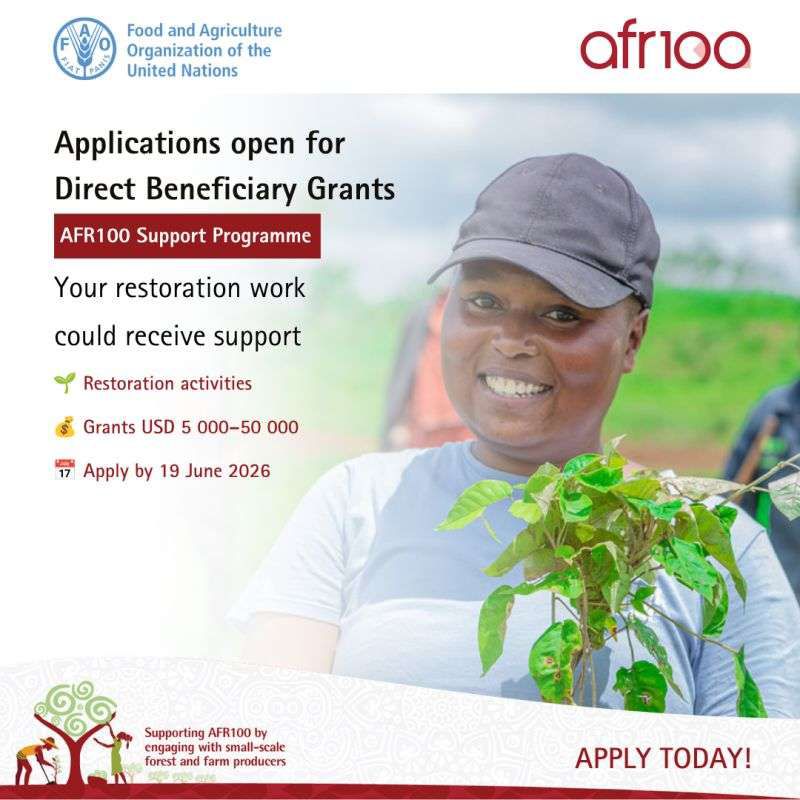
The Food and Agriculture Organization of the United Nations (FAO), through the African Forest Landscape Restoration Initiative (AFR100), has opened applications for its Direct Beneficiary Grants (DBG) programme, offering funding of up to USD 50,000 to support locally led forest and landscape restoration initiatives across selected African countries.
The call, part of the broader Supporting AFR100 Programme implemented with support from the Government of Germany, is aimed at strengthening grassroots action on environmental restoration while improving livelihoods and building climate resilience in vulnerable communities.
According to FAO, the grants are designed to directly support local organizations actively engaged in restoring degraded landscapes, scaling sustainable land-use practices, and developing restoration-based value chains.
Focus on Community Led Restoration
The AFR100 initiative is a continent-wide commitment by African countries to restore 100 million hectares of degraded land by 2030, combining climate action, biodiversity conservation, and rural development.
Through the Direct Beneficiary Grants scheme, FAO is channeling funding directly to local actors such as Forest and Farm Producer Organizations, Indigenous Peoples and Local Communities, women and youth groups, and community-based organizations.
The goal is to ensure that restoration is not only government-led but driven by the communities that depend most on land and natural resources.
What the Grants Support
Successful applicants can access grants ranging from USD 5,000 to USD 50,000, depending on the scope and impact of their project.
Funding will support practical, on-the-ground restoration activities including:
- Tree planting and agroforestry systems
- Assisted natural regeneration of degraded forests
- Soil and water conservation measures
- Community nurseries and biodiversity protection initiatives
- Livelihood activities linked to restoration such as beekeeping and sustainable farming
These interventions are designed to strengthen both environmental recovery and economic opportunities at the community level.
Eligibility
FAO states that the AFR100 Direct Beneficiary Grants are open to legally registered local organizations operating within designated restoration landscapes in participating countries.
Eligible applicants include:
- Forest and Farm Producer Organizations (FFPOs), including cooperatives and associations
- Indigenous Peoples and Local Communities (IPLCs)
- Community Based Organizations (CBOs)
- Women led groups and associations
- Youth groups and self-help organizations
- Small local enterprises engaged in restoration and sustainable land use
- Water Resource Users Associations and Community Forest Associations
- Other locally registered entities actively involved in forest and landscape restoration
Geographic Scope
Only organizations operating within the programme’s approved landscapes are eligible. These include selected areas in:
- Democratic Republic of the Congo
- Kenya
- Madagascar
- Malawi
- Togo
- United Republic of Tanzania
Applicants must demonstrate physical presence or proven implementation experience within these landscapes.
Selection Criteria
Applications will be assessed based on the following criteria:
- Demonstrated experience in restoration or related community development work
- Alignment with AFR100 restoration goals and landscape priorities
- Environmental impact and measurable restoration outcomes
- Inclusion of women, youth, and vulnerable groups in project design and implementation
- Sustainability and long-term viability of the project
- Feasibility and clarity of implementation plan
Application Timeline
Applications for the programme opened on May 22, 2026, and will close on June 19, 2026. Eligible organizations are encouraged to submit proposals before the deadline through the FAO application portal.
Driving Africa’s Restoration Agenda
AFR100 is a flagship African-led initiative focused on restoring degraded landscapes to improve food security, strengthen climate resilience, and reduce rural poverty.
Beyond tree planting, the initiative promotes full ecosystem restoration, linking environmental recovery with economic transformation at the community level.
By directing funding to grassroots organizations, FAO aims to accelerate progress toward Africa’s restoration targets while ensuring that local communities remain central to climate action.
Conclusion
The opening of the AFR100 Direct Beneficiary Grants marks another significant step in scaling locally driven environmental action across Africa.
With up to $50,000 available per project, the initiative presents a major opportunity for grassroots organizations working in restoration, conservation, and sustainable land management to expand their impact and contribute to long-term ecological recovery across the continent.
Click on the link to: APPLY
[give_form id="20698"]