csrreporters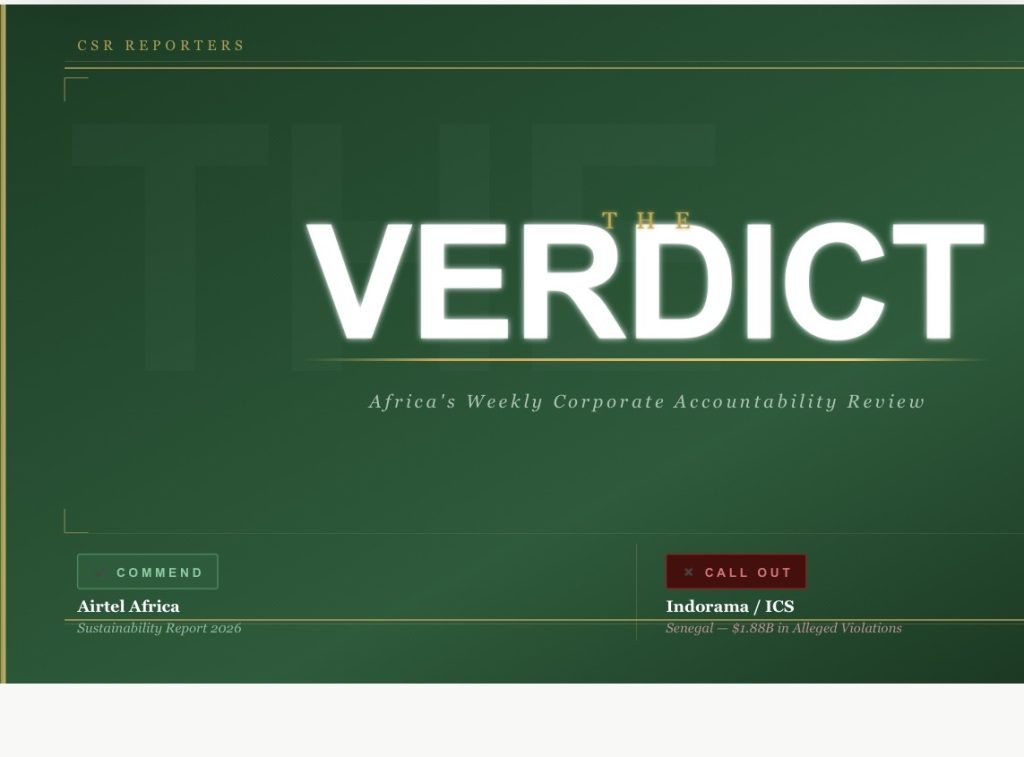
THE VERDICT Who Kept Their Word. Who Did not
EDITOR’S NOTE
The Verdict is CSR Reporters’ weekly accountability feature — an honest look at who in corporate Africa is walking the talk, and who is not. We commend where commendation is due. We call out where the evidence demands it. This week’s edition draws a sharp contrast: a telecom giant demonstrating what credible, measurable sustainability progress looks like, and a multinational extractive operator whose decade-long tenure in Senegal has ended in allegations of unpaid taxes, fiscal irregularity, and resource extraction without accountability.
✔ COMMENDED
Airtel Africa: Sustainability That Shows Its Work
14 Countries • Sub-Saharan Africa • Telecommunications
The Finding
On June 10, 2026, Airtel Africa published its Sustainability Report 2026, covering operations across 14 African countries for the 2025/26 financial year. In a continent where sustainability reports are increasingly common, and increasingly empty, this one contains something rarer: verifiable, year-on-year progress with operational specificity.
The report was prepared in accordance with the Global Reporting Initiative (GRI) Standards and the GSMA telecommunications industry disclosure framework — meaning it is not a self-congratulatory brochure, but a structured disclosure against internationally benchmarked criteria.
The Numbers That Matter
| 950+ Sites converted from diesel to grid power | 9.1M Litres of diesel consumption cut | 3,043 Schools connected to free internet (UNICEF) |
| 94% of total waste recycled • 81.9% population coverage across 14 markets • GRI-aligned disclosure | ||
Why This Matters
What distinguishes Airtel Africa’s report from the average sustainability publication in Africa is not ambition, but accountability. The company doubled its infrastructure conversion rate year-on-year — from 500 sites in 2024/25 to over 950 in 2025/26. That is not rhetoric. That is a measurable trajectory.
Across Nigeria specifically, Airtel deployed 200 solar-powered telecommunications towers in a single year, with reported outcomes of 21% improvement in network uptime and 90% reduction in monthly maintenance costs. In a country where telecom operators collectively burn over 40 million litres of diesel monthly to keep networks running, this is operationally significant — not just environmentally meaningful.
The free internet connection of 3,043 schools in partnership with UNICEF — up from 2,176 the previous year — represents a social dividend that goes beyond compliance. It is the kind of structured, reported, and scalable community investment that CSR Reporters defines as genuine impact: not random, not ceremonial, but tracked.
The Caveat
Commendation here is not unconditional. Women represent just 29.9% of Airtel Africa’s total workforce — a figure that requires improvement across an organisation operating at this scale. The company’s own 2050 net-zero ambition also demands scrutiny over time: interim targets must be held to account in future editions of The Verdict. But for the reporting period under review, Airtel Africa has demonstrated what credible, improving sustainability performance looks like — and that is worth acknowledging.
CSR REPORTERS VERDICT: Airtel Africa is commended for demonstrating measurable, year-on-year environmental progress and structured social investment across 14 African markets. The bar for future reports has now been set by their own numbers.
✖ CALLED OUT
Indorama Ventures / ICS: Twelve Years of Extraction, $1.88 Billion in Alleged Obligations Unpaid
Senegal • Extractive / Petrochemicals • Phosphate Production
The Finding
In March 2026, Senegal’s Prime Minister Ousmane Sonko announced the government’s decision to reclaim control of Industries Chimiques du Sénégal (ICS) — one of West Africa’s largest phosphate and fertiliser producers — ending the management licence previously held by Indorama Ventures, the Singapore-based Asian petrochemical conglomerate.
Indorama had acquired ICS in 2014, stepping in during a period of financial distress to take majority control of Senegal’s leading industrial complex. The company employed thousands of Senegalese workers and sat at the centre of the country’s phosphate value chain — mining phosphate rock and processing it into phosphoric acid and fertilisers for both regional and international markets.
What the government’s audit found, twelve years later, was not a story of responsible stewardship. It was a story of fiscal non-compliance at scale.
The Scale of the Alleged Violations
| CFA 1,075 Billion ≈ US$1.88 Billion in alleged unpaid taxes & royalties | 12 Years 2014 – 2026 period of alleged fiscal non-compliance |
| The alleged shortfall equals several percentage points of Senegal’s GDP — from a single company, over a single decade. | |
The Accountability Argument
This is not simply a story of a government reclaiming assets. It is a story about what happens when a multinational corporation treats an African country’s natural resources as a profit centre, and its fiscal obligations as optional.
ICS sits at the foundation of Senegal’s industrial economy. The phosphate deposits it mined belong — constitutionally — to the Senegalese people. Article 25-1 of Senegal’s Constitution is explicit: natural resources belong to the people. The revenues from those resources are supposed to fund schools, hospitals, infrastructure, and development. When a company extracts those resources while allegedly failing to pay taxes and royalties owed, it is not merely a contractual violation. It is a social violation.
Prime Minister Sonko stated at a press conference: “We found numerous contracts that did not sufficiently protect the interests of the Senegalese state.” The government subsequently froze corporate accounts, revoked licences across sectors, and moved to reclaim ICS assets entirely.
CSR Reporters notes that the alleged violations span the 2014–2026 period — meaning this is not a story of one bad year, one bad quarter, or one bad actor within a structure. If confirmed, it represents a systemic pattern of non-compliance across an entire management tenure.
The Broader Pattern
Senegal’s action is part of a wider, accelerating pattern across West Africa. Guinea, Mali, Niger, and now Senegal have all moved to reassert control over extractive contracts they consider disadvantageous or abusively structured. What is driving this is not politics alone — it is the accumulating evidence that too many foreign operators have treated African resource contracts as instruments of maximum extraction, rather than vehicles of mutual development.
For corporate Africa — and particularly for multinationals operating across the continent — the ICS case is a warning signal. The era of operating with impunity in African extraction is closing. Accountability is no longer merely reputational. It is increasingly legal, fiscal, and sovereign.
CSR REPORTERS VERDICT: Indorama Ventures and ICS are called out for an alleged twelve-year pattern of tax and royalty non-compliance in Senegal — representing one of the most significant corporate accountability failures in West African extractive history. The Senegalese people, whose natural resources funded this operation, deserved better.
The Lesson This Week
This week’s Verdict captures a defining tension in African corporate responsibility: the growing distance between companies that perform sustainability and those that practise it; between those that extract from the continent and those that contribute to it.
Airtel Africa has shown that measuring is the beginning of accountability. Numbers on a page, tracked year-on-year, create a public record against which performance can be judged. That is precisely what CSR Reporters exists to do — not to applaud reports, but to track the gap between what is promised and what is delivered.
Indorama and ICS have shown — if the allegations are confirmed — that secrecy is not a strategy. Twelve years of alleged underpayment eventually produced a reckoning. In the new Africa, where governments are asserting sovereignty and regulators are tightening oversight, the cost of non-compliance is no longer theoretical.
Accountability is not optional. It is the price of doing business in Africa.
WORK WITH CSR REPORTERS
If your organisation wants to move from random CSR activities to structured, measurable impact,
CSR REPORTERS helps organisations:
Conduct community needs assessments / Track and measure CSR impact Document and report social investments / Communicate CSR efforts transparently and independently
[give_form id="20698"]