CSR Personality of the Week: Iliass El Fali the Strategist Transforming Africa’s Green Future Boldly
 csrreporters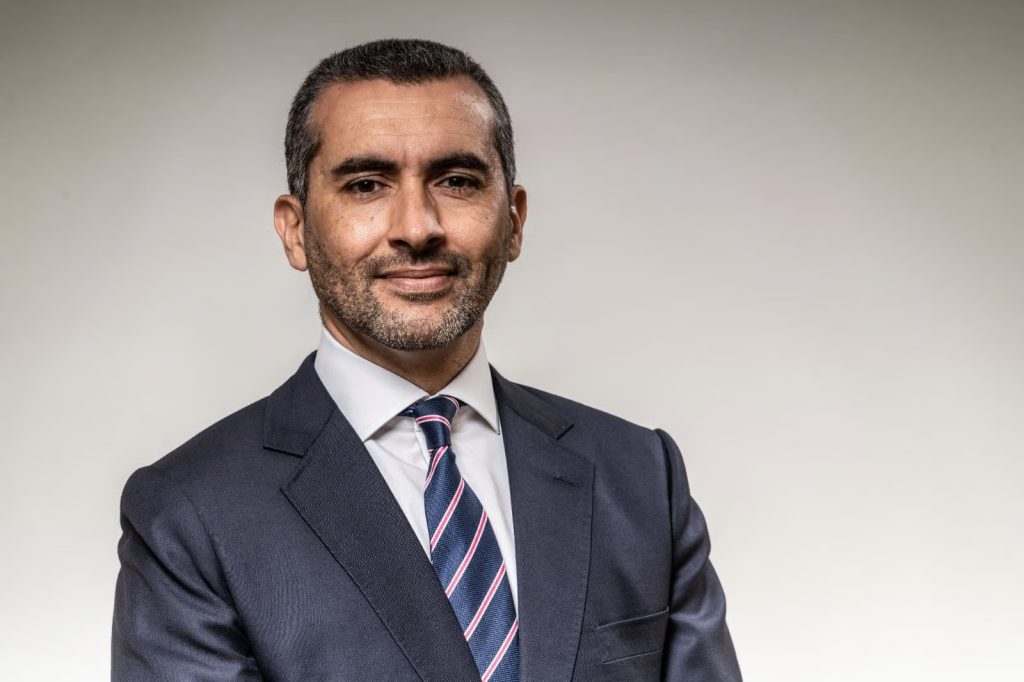
Managing Director of Corporate Strategy, Sustainability, and Innovation at OCP Group
Iliass El Fali is not merely a corporate strategist. He is, by every measure, the architect behind one of Africa’s most consequential sustainability transformations. He has spent over two decades turning industrial complexity into social purpose.
El Fali is the Managing Director of Corporate Strategy, Sustainability, and Innovation at OCP Group. He sits at the nerve centre of a $13 billion green investment programme. One that is reshaping how the world thinks about fertilizers, food security, and clean energy.
Furthermore, his leadership extends well beyond quarterly targets and boardroom presentations. It reaches into the soil of Ethiopian farms, the coastlines of southern Morocco, and the energy grids of a continent racing to feed itself sustainably.
From Engineer to Green Economy Pioneer
El Fali’s journey to the top of OCP’s sustainability agenda began in the lecture halls of Mines ParisTech in Paris. There he earned a Master of Science in Civil Engineering and Materials Science in 1998. That foundation, both technical and rigorous, would prove essential in the decades ahead.
He first built his professional credentials outside OCP entirely. At Lesieur Cristal, he managed production and launched the company’s hedging activity on the Chicago Board of Trade. Subsequently, at Air Liquide Maroc, he cut maintenance costs by 27% and reduced overtime by 67% through systematic operational reforms. Before joining OCP, he also served as Site Director at Ynna Steel, overseeing the erection of a 370,000-tonne-per-year hot rolling mill from the ground up.
These early experiences were, in retrospect, a masterclass in operational discipline. The kind that prepares a leader not just for strategy but for execution at scale.
Rising Through OCP’s Ranks
El Fali joined OCP Group in 2009 as Director of Partnerships. He served on the boards of several joint ventures including IMACID, Bunge Maroc Phosphore, and Pakistan Maroc Phosphore. Consequently, he developed a panoramic view of OCP’s global footprint at a remarkably early stage.
By 2013, he was heading the Safi Chemical Site, a 3,000-person platform producing fertilizers, animal feeds, and phosphoric acid. Two years later, he was elevated to Executive Vice President of Industrial Operations. There he was overseeing seven mining sites and two chemical complexes with 16,000 employees. Then, in 2020, he became Chief Operating Officer, managing industrial operations, sales, marketing, supply chain, and digital transformation simultaneously.
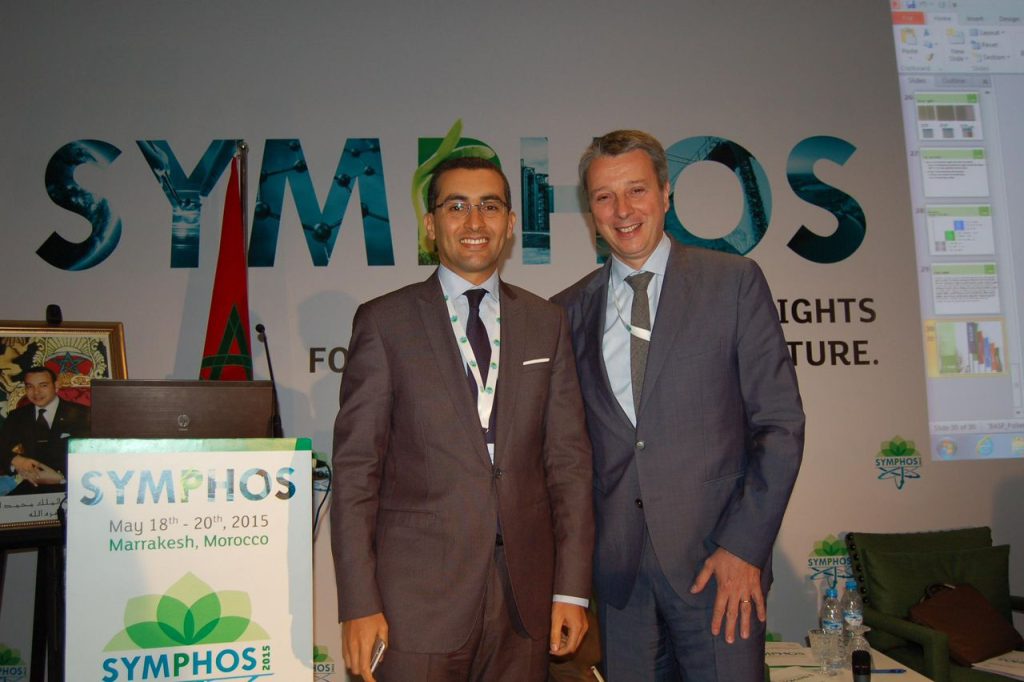
Each role, therefore, added another layer to a profile that was already unusually broad. When El Fali assumed his current position as Managing Director in June 2022, he brought with him not just strategy, but over a decade of hands-on industrial knowledge.
Leading OCP’s Most Ambitious Chapter
Since taking on the sustainability and innovation mandate, El Fali has been responsible for implementing what is arguably the most ambitious corporate green transformation currently underway in Africa.
OCP’s green investment strategy for 2023 to 2027 totals $13 billion and is built around four structural pillars. First, the group has already achieved 100% reliance on non-conventional water. It hit this milestone since early 2025, through desalination and wastewater recycling.
Second, OCP is targeting 100% clean energy by 2027, backed by 5 gigawatts of renewable capacity. Third, the group is building toward full carbon neutrality by 2040 across all scopes. Fourth, and perhaps most critically, it is scaling up green fertilizer production to serve Africa and the world.
Speaking on OCP’s ambitions for green ammonia, El Fali articulated the commitment plainly: “We’ve committed to carbon neutrality, scope 1 and 2, by 2030, and scope 3 by 2040. Part of this commitment is to ensure carbon neutrality will be to consume green ammonia. We are the largest ammonia importer in the world accounting for roughly 10% of global trade.”
That context matters enormously. Because OCP is the world’s largest phosphate producer and a dominant ammonia importer, its shift to green inputs does not simply benefit one company. It moves global markets.
The Green Ammonia Bet
Central to El Fali’s strategy is OCP’s flagship Tarfaya Green Ammonia Project, located on Morocco’s western coast. The Tarfaya site will hold 4 GW of renewable energy, anchoring a new industrial zone and port. El Fali described it as “offgrid and integrated,” with 100,000 hectares of secured land and no constraint on development.
OCP plans to produce 1 million tons of green ammonia annually by 2027. Scaling to 3 million tons by 2032. This will ensure ammonia self-sufficiency and enabling green hydrogen production for broader applications. The scale of that ambition is striking for an industry that has historically depended almost entirely on grey ammonia derived from fossil fuels.
Morocco’s position as a green hydrogen frontrunner has been noted by international bodies. OCP provides what analysts describe as “anchor demand.” Effectively de-risking the renewable energy market for other investors and accelerating the commercialisation of green hydrogen across the region.
Moreover, the financing behind these projects reflects strong global confidence. OCP raised $1.75 billion through a four-times oversubscribed international bond issuance in April 2025. This in addition to a €365 million green loan from Italy’s SACE and a €350 million facility from France’s AFD.
Fighting for Africa’s Food Security
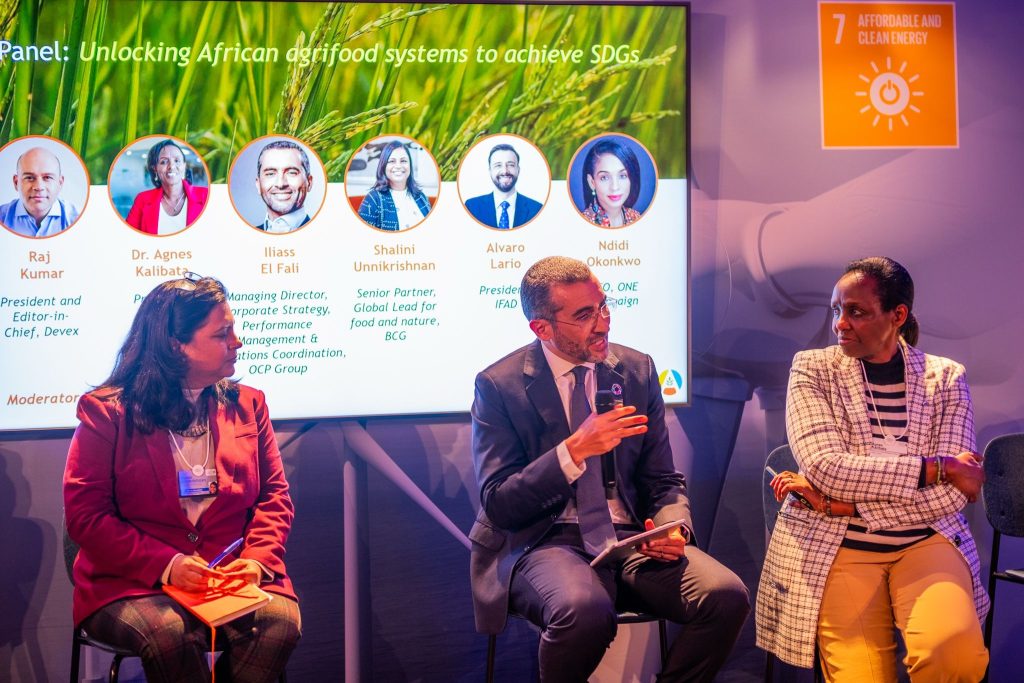
Beyond the energy transition, El Fali has been one of the most vocal executive voices on the urgency of Africa’s food security challenge. He has warned that the window of opportunity to foster sustainable agricultural development in Africa is narrowing. This is due to the combined effects of climate change, supply chain disruption, and conflict heightening risk in the sector.
That warning carries weight precisely because OCP is not merely observing the crisis. It is investing directly to address it. OCP is committed to investing in local fertilizer production units in countries like Ethiopia and Nigeria, where it supplies over 90% of annual fertilizer needs.
In Ethiopia, fertilizer formulated by OCP has increased yields of teff by 113% and maize by 37%. Customized fertilization has proven up to 40% cheaper for farmers since they do not pay for nutrients their soils and crops do not need. These are not marginal gains. They represent transformational improvements for smallholder farmers whose livelihoods depend on every harvest.
Additionally, OCP’s continent-wide presence now spans many local offices. They are in Côte d’Ivoire, Senegal, Cameroon, Kenya, Ghana, Nigeria, Zambia, Benin, Tanzania, Ethiopia, Burkina Faso, and Rwanda. Through programmes like Agribooster, the group creates ecosystems that connect farmers to inputs, financial tools, and technical guidance simultaneously.
Sustainability as Strategy, Not Compliance
What distinguishes El Fali’s approach from conventional corporate sustainability is, above all, the integration of long-term vision with industrial execution. Under his leadership, OCP has embedded sustainability directly into its core strategy rather than treating it as a reporting obligation.
In August 2025, OCP announced that its Triple Superphosphate production capacity would reach 7 million tons by the end of 2025. This through the commissioning of two new production lines at the Jorf Lasfar industrial platform. That expansion is not separate from the sustainability agenda; it is part of it. The aim is enabling the production of more efficient fertilizers that reduce soil nutrient waste and minimize environmental runoff.
Furthermore, El Fali has been a driving force behind OCP’s pioneering AI roadmap and group-wide data platform, recognising that digital intelligence is inseparable from operational sustainability in the modern era. Precision data, after all, enables precision agriculture. Precision agriculture is how the world will need to feed itself in the decades ahead.
A Voice That Commands Global Attention
El Fali is a regular contributor to global conversations on sustainability and food systems. As an agenda contributor at the World Economic Forum and a featured expert at World Bank events, he brings the weight of OCP’s industrial reality into policy spaces that too often lack it.
His message is consistent: Africa’s agricultural transformation cannot wait, and the tools to achieve it already exist. What is required, he argues, is political will, smart investment, and the kind of integrated industrial strategy that OCP has spent years building.
With global fertilizer prices projected to rise 31% in 2026 amid Middle East supply disruptions, the urgency of Africa producing more of its own agricultural inputs has never been clearer. El Fali understood that imperative years before it became a headline.
The Legacy Being Built
Iliass El Fali’s career is, a study in what happens when technical mastery meets genuine conviction. He did not begin with sustainability as his brief. Instead, he earned the responsibility through decades of operational excellence. He then used that platform to pursue something far larger than profitability alone.
Through his leadership, OCP Group is not simply decarbonising a phosphate company. It is demonstrating that African industry can lead the global energy transition. Showing that food security and green ambition are not competing priorities. OCP is also showing that he continent’s greatest resources, sun, water, soil, and human talent can be harnessed together for a future that works for everyone. That is the kind of leadership that defines a CSR Personality of the Week.
[give_form id="20698"]