admin
admin 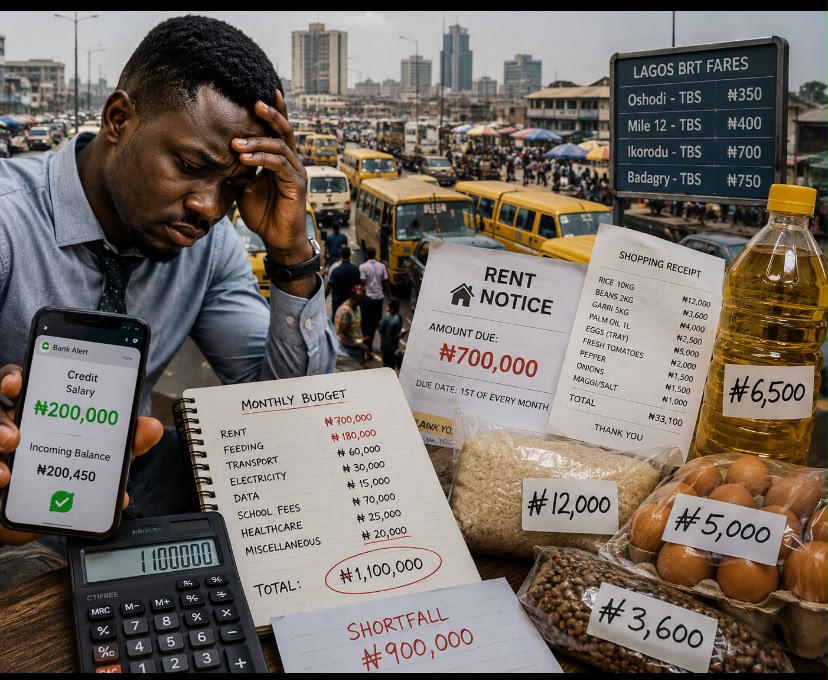
A recent online debate questioning whether a ₦200,000 monthly salary can sustain an individual or a family has grown beyond social media commentary into a wider reflection of Nigeria’s economic reality. What began as a casual discussion has evolved into a serious conversation about wages, inflation, and the sustainability of income levels across different socio-economic groups.
At the center of the debate lies a recurring question: what does “enough” mean in an economy where the cost of basic livi ng continues to rise faster than wages?
For many Nigerians, especially those living in urban centres such as Lagos, Abuja, and Port Harcourt, ₦200,000 monthly income is no longer automatically associated with financial comfort. Instead, it often represents a careful balancing act between essential needs rent, transportation, food, healthcare, and family responsibilities. In many cases, it is not a comfort wage but a survival threshold.
However, the conversation becomes even more revealing when attention shifts to lower income brackets, where ₦100,000, ₦70,000, and even ₦60,000 monthly salaries remain a reality for a large segment of the workforce. For these individuals, the debate is not about lifestyle quality but about financial endurance.
The intensity of the online reactions reflects a deeper issue: a widening gap between income levels and the actual cost of sustaining daily life in Nigeria.
Inflation and the shrinking value of income
Nigeria’s persistent inflationary pressure has significantly eroded the purchasing power of wages. Over the past few years, prices of essential goods and services have increased sharply, affecting everything from food items to transportation fares, rent, school fees, and healthcare services.
While nominal salaries in some sectors have seen slight adjustments, these increases have often failed to match the pace of inflation. As a result, many workers find that their income covers less at the end of each month than it previously did.
Food inflation, in particular, has had a direct impact on household budgeting. Staple items that once formed the foundation of affordable living have become increasingly expensive, forcing many families to adjust their consumption patterns or reduce dietary diversity. Transportation costs have also risen due to fuel price fluctuations, further stretching household budgets.
Rent remains one of the most significant financial burdens, especially in major cities. In many cases, workers earning ₦100,000 to ₦200,000 monthly are unable to secure decent accommodation without resorting to shared living arrangements or relocating to peri-urban areas with longer commute times.
The combined effect of these pressures is a gradual but consistent reduction in real income value, even where salaries remain unchanged on paper.
The reality behind “employed poverty”
One of the most concerning outcomes of this economic environment is the growing prevalence of what is often described as “employed poverty.” This refers to individuals who are formally employed but still struggle to meet basic living standards without additional support, debt, or secondary income sources.
For workers earning between ₦60,000 and ₦100,000 monthly, this reality is particularly pronounced. Many are forced to adopt survival strategies that include multiple informal jobs, heavy reliance on family networks, or strict austerity budgeting that leaves little room for savings or emergencies.
In practical terms, this often translates into:
- Shared accommodation or low-quality housing conditions
- Limited access to private healthcare services
- Dependence on public transportation regardless of distance or convenience
- Minimal or no savings capacity
- Postponement of long-term financial goals such as home ownership or investment
Even at the ₦200,000 income level, these pressures can still exist depending on family size, location, and financial obligations. This challenges the assumption that formal employment automatically guarantees financial stability.
The implications are significant: employment no longer consistently protects individuals from economic vulnerability.
The widening wage gap and inequality concerns
The debate also highlights the widening gap between different income groups in Nigeria. While some professionals in finance, tech, oil and gas, and senior management roles earn relatively high salaries, a large portion of the workforce remains within low-to-middle income brackets.
This imbalance creates a layered economic structure where quality of life is heavily determined by sector, location, and access to opportunities rather than effort alone.
The frustration expressed online is not only about specific salary figures but about perceived fairness. Many Nigerians question how individuals in similar working conditions can experience drastically different living standards solely due to industry or employer differences.
This perception contributes to growing dissatisfaction within the labour market and raises broader questions about wage equity and economic inclusion.
CSR implications: wages as a sustainability issue
From a Corporate Social Responsibility perspective, the conversation around ₦200,000 and lower income brackets is not just a social debate—it is a workforce sustainability issue.
Traditionally, CSR discussions have focused on environmental impact, community development, and ethical governance. However, there is increasing recognition that employee welfare, particularly fair compensation, is a critical component of sustainable business practice.
Wage levels directly affect productivity, employee retention, mental health, and overall organizational stability. When employees are financially strained, the ripple effects can include reduced efficiency, higher turnover rates, and lower engagement.
As a result, the idea of a “living wage” is gaining traction in CSR and ESG discussions. A living wage refers to income that is sufficient to cover basic needs such as food, housing, healthcare, transportation, and a modest level of savings.
However, implementation remains inconsistent across industries. Many organizations still rely on statutory minimum wage benchmarks, which often do not reflect real-world living costs, especially in urban areas.
Beyond compliance: rethinking employer responsibility
The gap between minimum wage standards and actual living costs raises an important question about the role of employers in addressing economic pressure.
While governments set baseline wage requirements, employers—particularly in the private sector—are increasingly being viewed as key stakeholders in addressing wage adequacy.
Progressive organizations are beginning to explore alternative compensation approaches, including:
- Regular salary reviews aligned with inflation trends
- Transport and housing allowances
- Expanded healthcare coverage for employees and dependents
- Performance-based incentives tied to productivity rather than static salary structures
- Financial wellness and support programs
These measures are not only seen as employee benefits but also as strategic investments in workforce stability and brand reputation.
In competitive labour markets, fair and responsive compensation structures are becoming essential for talent retention.
The human cost of economic pressure
Beyond economic indicators and policy discussions, the wage debate reflects a deeply human reality. For many Nigerians, monthly income is not just a financial figure but a determinant of quality of life, dignity, and opportunity.
The stress of stretching limited income across rising expenses affects mental health, family stability, and long-term planning. Decisions about healthcare, education, nutrition, and housing are increasingly shaped by affordability rather than preference.
For households earning ₦60,000 to ₦100,000 monthly, even minor economic shocks—such as transport fare increases or unexpected medical expenses—can disrupt entire budgets.
At the ₦200,000 level, while slightly more flexible, financial pressure still exists, particularly for individuals supporting dependents or living in high-cost urban areas.
A national conversation that cannot be ignored
What began as an online debate about whether ₦200,000 is sufficient has ultimately exposed a broader national conversation about income adequacy, wage fairness, and economic sustainability.
The issue is not limited to one salary bracket. Instead, it spans across income levels, revealing a structural challenge in aligning wages with the real cost of living.
As inflation continues to shape everyday realities, the gap between earnings and expenses is likely to remain a central economic concern. This will inevitably push conversations about wage reform, living wage policies, and employer responsibility further into the public and policy space.
Ultimately, the debate is not about whether ₦200,000 is “enough.” It is about a more fundamental question: in today’s economy, what level of income is truly sufficient to support a dignified standard of living?
Until that question is addressed in a structured and sustained way, the conversation around wages in Nigeria will continue to reflect not just economic data, but lived experience.
[give_form id="20698"]