CHUKS OLUIGBO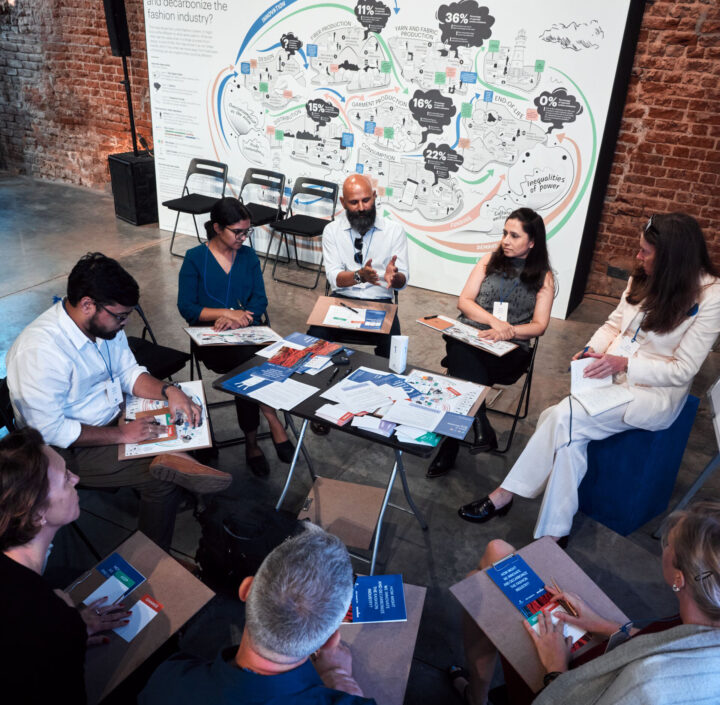
Discussions at one of our solutions sessions at the Global Change Award Summit in Mumbai 2024. Image credit: hmfoundation.com
Swedish multinational clothing company H&M Group, through the H&M Foundation, earlier this month announced the winners of the Global Change Award (GCA) 2026, an annual award that aims to accelerate innovation to support the textile industry in halving its greenhouse gas emissions every decade, reaching net-zero by 2050.
The innovation challenge recognises and supports emerging changemakers behind breakthrough solutions for the future of fashion.
The global textile and apparel industry currently accounts for an estimated 8 per cent to 10 per cent of global greenhouse gas emissions and targets to achieve net-zero emissions by 2050.
Announcing this year’s winners, H&M said they bring fresh perspectives to next-generation materials and bio-based alternatives, alongside advances in textile-to-textile recycling and low-impact production, showing how these fields continue to evolve through new ideas and approaches.
Meet the Winners
Among the ten winners are a Tanzanian duo, KelTex, transforming seaweed into biodegradable leather alternatives; Agro-Lyocell by Canvaloop (India), which turns agricultural waste into forest-free textile fibres, replacing wood-based inputs; Alu (US), which uses psychology and AI to make digital product passports drive circular behaviour; ArtSilk (Sweden), which creates spider silk-inspired fibres using microorganisms; and EntroMetrix (UK), which develops its own AI models to optimise energy and material use in manufacturing.
Others are Fiberly (France) – turns textile waste into precision-engineered, cotton-like fibres; MicroBlue by Microbeworks (India) – biodegradable dyes that work in existing dyeing systems; RheaCycle™ by Rhea’s Factory (US) – uses AI-designed enzymes to break down polyester waste into new fibre building blocks; Tera Mira (UK) – turns seaweed into stretch fibres, replacing elastane with a bio-based alternative, and threadBridge (Bangladesh), which brings real-time defect detection to factory floors using smart glasses.
What H&M Is Saying
H&M said many of the solutions innovated by the winners of the Global Change Award 2026 are grounded in the innovators’ own experiences, shaped by real-world challenges and designed to deliver tangible benefits for the communities they serve.
“Together, they target some of fashion’s most emissions-intensive challenges at a time when the industry must accelerate progress towards net zero,” the clothing giant said.
H&M further said the winners reflect a growing shift towards early-stage innovation and systems change.
“Rather than focusing on individual technologies alone, the programme prioritises ideas that can influence entire value chains and unlock broader transformation,” it said.
Beatrice Oldenburg, Project Manager at H&M Foundation, said this year’s challenges stands out not just for the strength of the ideas but also the people behind them.
“These changemakers combine deep understanding of real-world challenges with the drive to address them. A common thread across many of the solutions is resource efficiency, from reducing waste to making better use of existing materials and resources,” Oldenburg said.
“Ultimately, transforming the textile industry will depend on both breakthrough technologies and the people determined to bring them to life,” she said.
Empowering Early-Stage Innovations to Support Industry’s Net-Zero Target
The Global Change Award is not just an award. It is part of the H&M Foundation’s broader mission to support the textile industry in halving its greenhouse gas emissions every decade, reaching net-zero by 2050, while promoting a just transition for both people and the planet.
The textile and apparel industry accounts for an estimated 8 per cent to 10 per cent of global greenhouse gas emissions, making it one of the world’s most polluting sectors, according to Frontiers in Environmental Science. Most intensive impacts occur in material production and wet processing.
H&M reckons that addressing these challenges requires not only new technologies, but systemic shifts across the value chain, from how materials are produced to how garments are used and reused.
This is why the Global Change Award backs high-potential changemakers, thus providing the resources to turn bold, theoretical concepts into planet-positive realities, especially with the industry facing increasing pressure to decarbonise.
Each winner of the Global Change Award receives a €200,000 grant and joins the year-long GCA Changemaker Programme, provided by the H&M Foundation in collaboration with strategic partners Accenture and KTH Royal Institute of Technology.
The programme equips winners with textile industry knowledge, tools, connections, and a holistic mindset to help turn early-stage ideas into solutions that can be tested, refined, and adopted across the industry for the benefit of both people and the planet.
“The solutions we need already exist, what’s missing is speed and scale. By supporting changemakers at an early stage, we can help unlock the kind of innovations that don’t just improve the textile industry, but transform it,” said Karl-Johan Persson, Board Member, H&M Foundation.
Alignment with H&M’s Targets
In March 2026, H&M Group announced a target to source all of its materials sustainably by 2030, a commitment it aligned with efforts to strengthen the company’s risk management processes.
The initiative forms part of the group’s broader sustainability strategy and applies across its global supply chain.
To achieve this, the company is taking measures to avoid the conversion of natural ecosystems, reduce its absolute agricultural land footprint by 3.85 per cent from a 2019 baseline by 2030, and increase the proportion of recycled materials in its products to 50 per cent over the same period.
H&M Group also seeks to engage in priority landscapes, plans to enhance requirements for its suppliers to ensure all sourced materials are free from deforestation and ecosystem conversion, and says it will work with local organisations to restore degraded land and expand the use of regenerative agricultural practices within selected regions.
“The threats and depletion of nature also impact the resources our industry relies on – soil health, water cycles, biodiversity. By committing to SBTN’s land targets, we anchor our decisions in science and strengthen our ability to safeguard ecosystems together with our supply chain, farmers, and communities,” said Leyla Ertur, H&M Group Chief Sustainability Officer.
A Long-Term Commitment
The Global Change Award, also called The Nobel Prize of Fashion, was launched by the H&M Foundation in 2015. Since then, through the award, the Foundation has supported 66 teams from 24 countries with a total of €12 million in grants, helping to bring the next generation of climate solutions closer to scale.
[give_form id="20698"]