GEF Small Grants Program Opens Applications for $300,000 CSO Challenge to Scale Environmental Solutions
 admin
admin 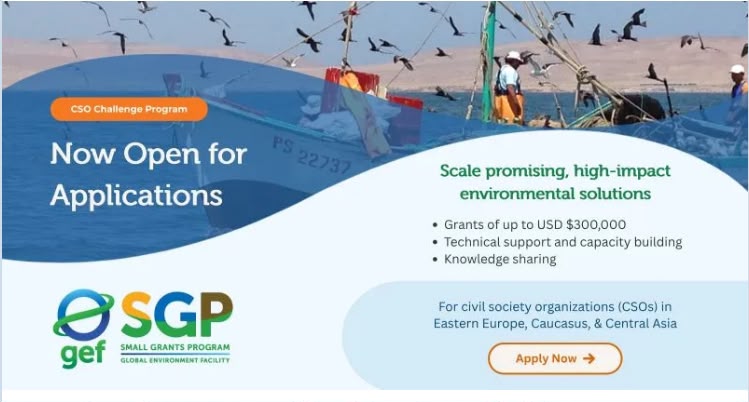
Civil society organisations (CSOs) working to address environmental challenges now have an opportunity to expand their impact through a new funding initiative under the Global Environment Facility (GEF) Small Grants Programme (SGP).
The GEF Small Grants Programme CSO Challenge Program, implemented by the International Union for Conservation of Nature (IUCN) with support from the Global Environment Facility (GEF), is inviting applications from eligible organisations with proven environmental solutions that are ready to be scaled or replicated.
The initiative is designed to help successful projects move beyond the pilot stage by providing financial support, technical expertise and collaboration opportunities, enabling organisations to deliver greater environmental and community benefits.
Successful applicants can receive grants of up to US$300,000 to implement projects over a period of up to 24 months.
Supporting Proven Environmental Innovations
Across many developing countries, civil society organisations play a vital role in tackling biodiversity loss, climate change, land degradation, pollution and unsustainable resource use. Yet many promising initiatives struggle to secure the funding needed to expand beyond their initial communities.
The CSO Challenge Program seeks to bridge this gap by supporting organisations that have already demonstrated success and are ready to scale their interventions.
Rather than funding early-stage concepts, the programme focuses on tested approaches capable of delivering measurable environmental and social outcomes across wider geographic areas or additional communities.
More Than Just Funding
Beyond financial support, the programme offers technical and institutional resources to help participating organisations strengthen project implementation and achieve long-term sustainability.
Successful applicants will benefit from:
- Grants of up to US$300,000
- Project implementation period of up to 24 months
- Technical assistance and mentoring
- Capacity-building support
- Peer learning and knowledge exchange
- Increased global visibility
- Opportunities to build strategic partnerships
These additional benefits are intended to strengthen organisational capacity while encouraging collaboration among environmental organisations across different regions.
Who Should Apply?
The programme is seeking civil society organisations that can demonstrate a proven environmental solution with strong potential for replication or expansion.
Competitive applications should show evidence that their approach has already delivered positive results and can generate measurable environmental and community impact when implemented at a larger scale.
Projects may focus on areas such as:
- Biodiversity conservation
- Ecosystem restoration
- Sustainable livelihoods
- Climate resilience
- Sustainable natural resource management
- Other environmental priorities aligned with the objectives of the Global Environment Facility
Applicants are also expected to present a clear strategy for scaling their interventions while demonstrating how the proposed project will create lasting environmental and social benefits.
Why It Matters
Civil society organisations continue to play an increasingly important role in advancing global sustainability goals. From protecting forests and wetlands to promoting clean energy, supporting climate adaptation and strengthening community resilience, grassroots organisations are developing innovative solutions to some of the world’s most pressing environmental challenges.
Access to larger funding opportunities such as the GEF Small Grants Programme can help these organisations expand successful models, reach more communities and build stronger partnerships with governments, development agencies and private sector actors.
Application Deadline
Interested organisations must submit their Concept Notes by 20 July 2026.
Eligible organisations are encouraged to review the programme requirements carefully before applying.
For organisations with proven environmental initiatives, the CSO Challenge Program offers more than funding. It provides an opportunity to scale impact, strengthen institutional capacity and collaborate with global partners working towards a more sustainable future.
[give_form id="20698"]