


 ROSEMARY IMOBHIO
A single regulation drafted in Brussels is now shaping decisions on cocoa farms in Ghana, rubber plantations in Liberia, and timber yards in Cameroon. That regulation is the European Union Deforestation Regulation, commonly known as the EUDR, and it has quickly become one of the most consequential sustainability and trade laws of this decade.
Although the EUDR is a European law, its reach extends well beyond the continent that wrote it. Because the EU remains one of the largest importers of agricultural commodities linked to deforestation, the regulation touches supply chains across Africa, Asia, and Latin America. For exporters, governments, investors, and CSR professionals, understanding the EUDR is no longer optional. It has become essential to staying competitive in international markets.
This article explains what the EUDR is, why it matters, and what it means specifically for Africa, while offering practical guidance for businesses preparing to comply.
| EUDR at a Glance | |
| Topic | Key Information |
| Regulation | European Union Deforestation Regulation (EUDR) |
| Objective | Prevent products linked to deforestation from entering the EU market |
| Commodities | Cocoa, coffee, palm oil, soy, rubber, wood, cattle |
| Applies from | 30 December 2026 (large/medium companies) |
| SMEs | 30 June 2027 |
| Key Requirement | Due diligence and supply chain traceability |
| Main Impact | Exporters, manufacturers, traders, governments and investors |
What is the EUDR?
The European Union Deforestation Regulation, formally Regulation (EU) 2023/1115, is a law designed to ensure that products sold in the EU market, or exported from it, do not contribute to deforestation or forest degradation. Consequently, companies placing certain commodities on the EU market must prove that their goods were not grown on land deforested after December 31, 2020.
The regulation was introduced because previous voluntary sustainability commitments had failed to slow global forest loss at the pace scientists consider necessary. Furthermore, the EU recognized that its own consumption patterns were driving deforestation abroad, even as forests disappeared for reasons tied directly to commodities the bloc imports in large volumes.
The environmental objectives are straightforward. First, the EUDR aims to reduce the EU’s contribution to global deforestation and forest degradation. Second, it seeks to protect biodiversity, since forests house a significant share of the planet’s plant and animal species. Third, it supports global climate action, given that forests function as vital carbon sinks. Ultimately, the regulation seeks to solve a problem that voluntary certification schemes alone could not: verified, traceable proof that a product’s supply chain is genuinely deforestation-free.
Why the World is Paying Attention
Governments, multinational companies, investors, and sustainability professionals are watching the EUDR closely, and for good reason. Unlike earlier deforestation initiatives, this regulation carries legal teeth. Non-compliant products simply cannot enter the EU market. This means the law effectively conditions access to one of the world’s largest trading blocs on proof of sustainable sourcing.
As a result, the EUDR could reshape international trade patterns more broadly. Multinational buyers are already restructuring procurement strategies, favoring suppliers who can demonstrate traceability. Meanwhile, investors are factoring EUDR compliance risk into decisions about which agribusinesses and exporters to fund. In turn, this creates a ripple effect that extends far beyond companies that trade directly with Europe, since many supply chains are interconnected across regions and intermediaries.
Additionally, other jurisdictions are watching closely to see how the EUDR performs. Should it succeed, similar deforestation-linked trade regulations could emerge elsewhere, making early alignment with EUDR standards a strategic advantage rather than a mere compliance exercise.
Commodities Covered by the Regulation
The EUDR applies to seven key commodities: cocoa, coffee, palm oil, soy, rubber, wood, and cattle. Beyond the raw commodities, the law also covers a wide range of derived products.
For instance, cocoa regulation extends to chocolate and cocoa powder. Coffee regulation covers roasted beans and instant coffee. Palm oil rules apply to items like margarine, cosmetics, and processed foods containing palm derivatives. Soy regulation reaches animal feed and soy-based food products. Rubber rules extend to tires and various rubber goods. Wood regulation covers furniture, paper, and printed materials. Finally, cattle regulation includes beef, leather, and other cattle-derived products.
Because these commodities appear in thousands of everyday products, the regulation’s scope is genuinely broad, touching supply chains that many consumers never associate with deforestation risk.
Product Scope is Still Evolving
Notably, the product list is not entirely fixed. As part of its May 2026 simplification package, the European Commission published a draft Delegated Act proposing to adjust which derived products fall under the regulation. Under this proposal, leather and retreaded tires would be removed from scope entirely. At the same time, the draft would add soluble coffee, several palm oil derivatives such as soap made with palm oil, and frozen cattle tongues.
However, businesses should treat these changes with appropriate caution for now. The Delegated Act remained in draft form as of mid-2026, with stakeholder feedback accepted through June 1, 2026. A final version is yet to be adopted as of the time of writing this. Companies in the leather, tire, instant coffee, and palm-derivative industries should therefore monitor this process closely, since a shift in scope could meaningfully change their compliance obligations before the December 2026 deadline arrives.
How the EUDR Works
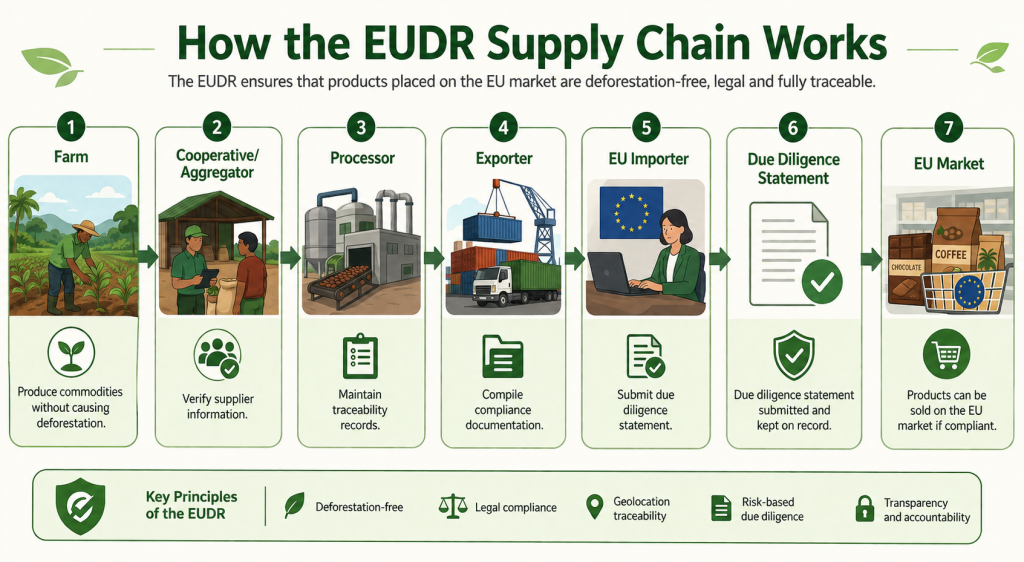
At its core, the EUDR requires companies to conduct due diligence before placing relevant products on the EU market. This process involves three main pillars.
First, companies must collect information, including precise geolocation coordinates of the farms or plots where commodities were produced. Second, they must assess risk, evaluating whether their supply chain carries a meaningful chance of deforestation-linked sourcing. Third, they must mitigate risk, taking concrete steps to address any concerns the assessment uncovers.
To put it simply, imagine a chocolate company that sources cocoa from several farms in West Africa. Under the EUDR, that company must trace each shipment back to specific plots of land, confirm those plots were not deforested after 2020, and document this evidence in a due diligence statement submitted through the EU’s information system before goods enter the market.
Supply chain traceability sits at the heart of this system. Without accurate geolocation data, businesses simply cannot generate a valid due diligence statement. This means non-compliant shipments risk being blocked, fined, or seized.
Penalties vary by member state but can include fines calculated as a percentage of annual turnover, confiscation of goods, and exclusion from public procurement contracts. Given these stakes, compliance expectations have become a board-level priority for many companies rather than a back-office task.
Timeline and Implementation
Originally, large and medium companies faced a compliance deadline of December 30, 2024, while smaller enterprises had until mid-2025. However, implementation was postponed after companies and governments raised concerns about the readiness of the EU’s information system and the practical difficulties of collecting geolocation data at scale.
Following further consultation, EU lawmakers postponed the deadlines a second time. Under the revised regulation, large operators must comply with their main obligations from December 30, 2026, while natural persons and micro and small enterprises have until June 30, 2027. Notably, micro and small operators already covered under the older EU Timber Regulation must still comply by December 30, 2026. So the extended timeline does not apply universally.
Consequently, 2026 has become widely regarded as the essential preparation year. Businesses that use this window to map supply chains, gather geolocation data, and test their due diligence systems will enter late 2026 with considerably less operational pressure. Those that delay risk compressing months of necessary work into a narrow window before enforcement begins.
Why Africa Matters
Africa occupies a central position in the EUDR conversation, largely because several of its economies depend heavily on commodities the regulation covers. Ghana and Côte d’Ivoire together supply a significant share of the world’s cocoa, making them particularly exposed to EUDR compliance requirements. Similarly, Nigeria and Cameroon export cocoa, rubber, and timber, while Liberia’s rubber sector remains a critical part of its national economy. Kenya, meanwhile, plays a major role in global coffee markets.
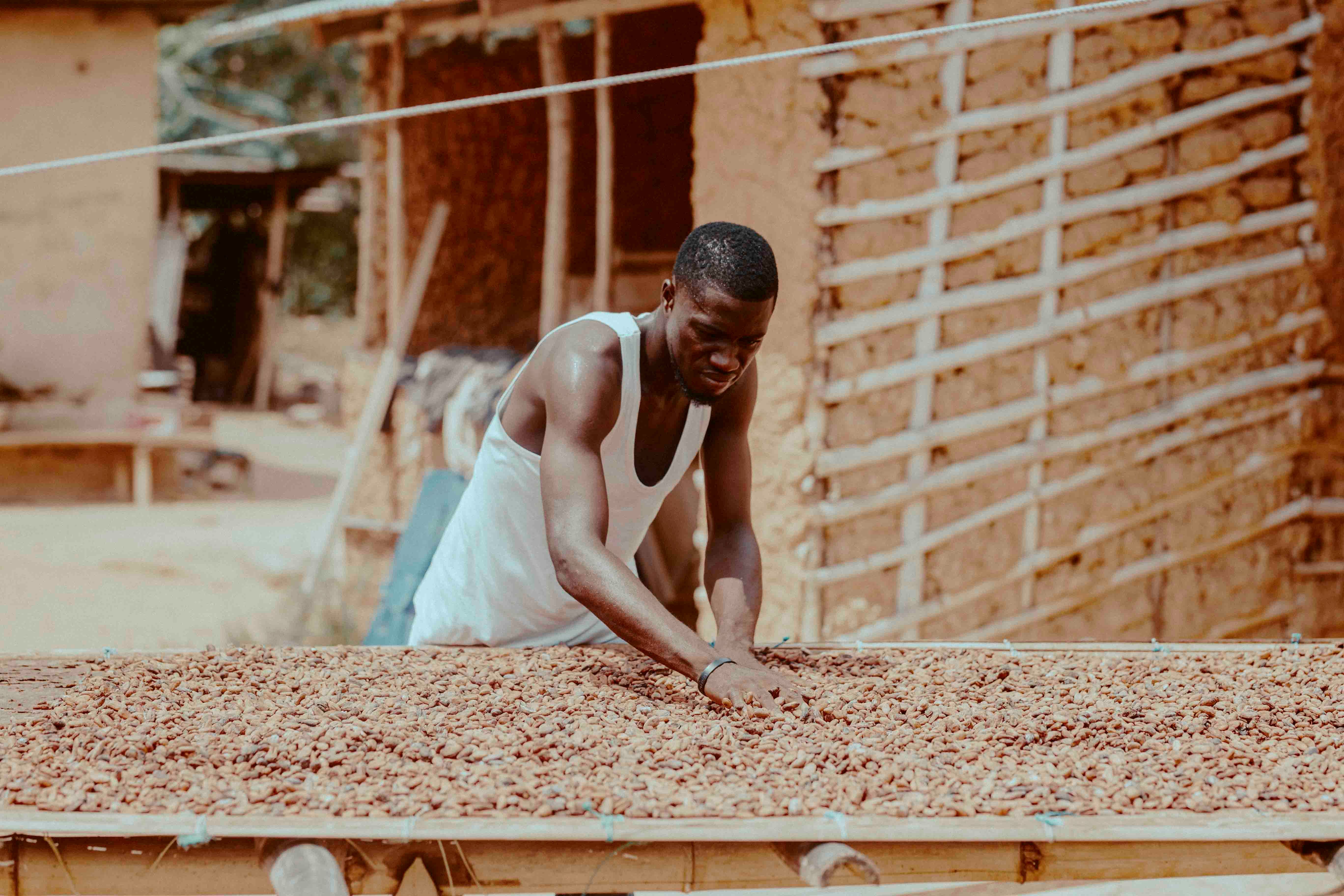
For these countries, the regulation presents both real challenges and genuine opportunities. On the challenge side, many smallholder farmers, who produce the bulk of Africa’s cocoa and coffee, lack the technology or resources to collect precise geolocation data. Without support, these farmers risk exclusion from EU supply chains altogether, not because their farming practices are unsustainable, but because they cannot yet document compliance.
On the other hand, the EUDR also creates opportunities. Countries and companies that invest early in traceability infrastructure can position themselves as preferred, trusted suppliers to European buyers. Moreover, this push toward transparency could accelerate broader improvements in land governance, farmer registration systems, and rural infrastructure, benefits that extend well beyond EU trade compliance alone. Several African governments and industry bodies are already piloting geolocation mapping projects specifically to help farmers meet these new requirements.
What Businesses Should Do Now
Given the scale of change required, businesses across the supply chain should act now rather than waiting for enforcement to begin. Several practical steps stand out.
To begin with, companies should map their entire supply chain, identifying every farm, cooperative, or intermediary involved in producing their raw materials. Next, they should prioritize collecting geolocation data, ideally working directly with suppliers to gather accurate coordinates rather than relying on secondhand estimates. Building strong, collaborative relationships with suppliers therefore becomes essential, since farmers and cooperatives are the ultimate source of the data companies need.
In addition, businesses should invest in improving traceability systems, whether through digital platforms, blockchain tools, or simpler mobile-based data collection methods suited to smallholder contexts. Strengthening sustainability reporting also matters, since EUDR compliance data often overlaps with broader ESG disclosure requirements. Companies should likewise invest in responsible sourcing practices that go beyond minimum legal requirements, and they should actively support smallholder farmers through training, technical assistance, and fair pricing structures.
Finally, businesses need to prepare internal compliance systems well before deadlines arrive. This includes assigning clear ownership of EUDR compliance within the organization, training relevant staff, and testing due diligence statement submissions through the EU’s information system once it reopens for wider use.
CSR, ESG and Sustainability Implications
The EUDR reinforces several principles that CSR and ESG professionals have long championed. Responsible business practices, corporate sustainability, and supply chain transparency all sit at the regulation’s core. By requiring verified proof of deforestation-free sourcing, the law strengthens biodiversity protection and supports meaningful climate action, since intact forests remain among the most effective natural carbon stores available.
Beyond environmental outcomes, the regulation also touches human rights considerations, since due diligence requirements often overlap with concerns about land rights, labor conditions, and community consent in producing regions. Sustainable procurement practices, once considered a competitive differentiator, are increasingly becoming a baseline expectation for market access.
Therefore, businesses should view EUDR compliance as more than a legal obligation. Companies that align their sourcing practices with the regulation’s spirit, not merely its letter, are better positioned to build resilient supply chains, strengthen stakeholder trust, and support long-term ESG reporting goals that increasingly matter to investors and consumers alike.
Challenges Ahead
Despite its ambitious goals, the EUDR faces real implementation challenges. Cost remains a significant concern, particularly for smaller operators who must invest in new technology and processes without the economies of scale larger companies enjoy. Smallholder farmer readiness represents another pressing issue, since many farmers across Africa lack smartphones, internet access, or formal land documentation needed to generate accurate geolocation data.
Data collection difficulties compound these problems. Mapping millions of small, often informally held plots across diverse terrain requires substantial time, funding, and technical capacity that many producing countries currently lack. Technology gaps further complicate matters, as reliable digital infrastructure remains uneven across rural regions.
Capacity building will therefore prove essential, requiring coordinated investment from governments, development organizations, and private companies alike. International cooperation matters just as much, since the EU cannot achieve its deforestation goals without genuine partnership with producing countries. Enforcement challenges also loom, given that verifying millions of due diligence statements will strain both EU authorities and national governments in exporting countries. A balanced perspective suggests that success will depend less on the regulation’s ambition and more on whether adequate support reaches the farmers and businesses expected to comply.
How Does the Future Look?
The EUDR is likely to influence future sustainability regulations well beyond Europe. Other major economies are already studying its structure, and similar deforestation-linked trade measures could emerge in the coming years. As global supply chains grow increasingly interconnected, businesses that build strong traceability systems now will find themselves better prepared for whatever regulatory landscape follows.
Between now and the compliance deadlines, African businesses, policymakers, and exporters should focus on three priorities: strengthening farmer support systems, investing in digital traceability infrastructure, and deepening cooperation with EU authorities and technical partners. Governments, in particular, can play a pivotal role by supporting national geolocation mapping initiatives and providing technical assistance to smallholder-dependent sectors.
Ultimately, the EUDR represents a turning point in how global trade treats environmental accountability. Businesses that prepare early, invest in transparency, and build genuine partnerships across their supply chains will be far better positioned to remain competitive in international markets, regardless of how the regulatory landscape continues to evolve.
Frequently Asked Questions
What is the EUDR in simple terms? The EUDR is an EU law requiring companies to prove that certain commodities sold in Europe, such as cocoa, coffee, and rubber, were not grown on land deforested after December 31, 2020.
When does the EUDR take effect? Large and medium companies must comply by December 30, 2026, while micro and small enterprises have until June 30, 2027, for non-timber products.
Which African countries are most affected by the EUDR? Ghana, Côte d’Ivoire, Nigeria, Cameroon, Liberia, and Kenya face significant exposure due to their cocoa, rubber, timber, and coffee export sectors.
[give_form id="20698"]



3 thoughts on “EUDR Explained: Why it Matters For Africa”