From Grants to Growth: Building Women-Owned Businesses That Can Stand on Their Own
 ONYINYECHI NWAIGBA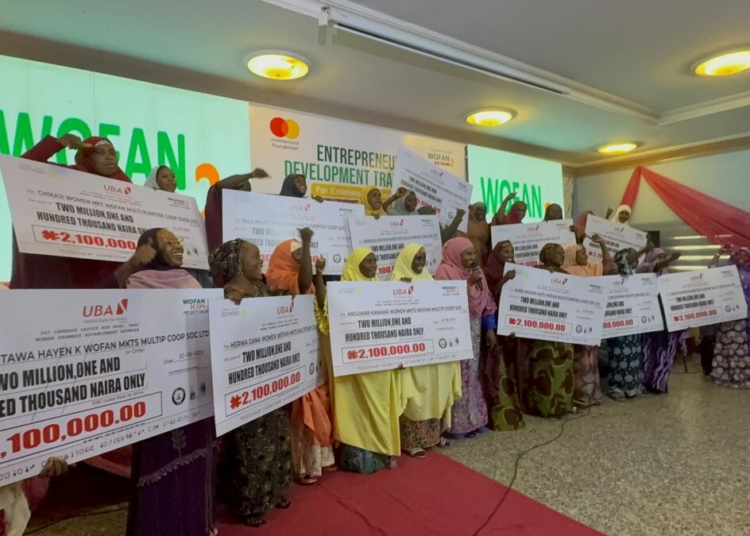
For many women running small businesses in Nigeria’s agricultural communities, the biggest challenge is not always the willingness to work.
It is having enough capital to grow.
A woman may have a viable food business, process agricultural products, trade farm produce or cultivate crops, yet remain trapped at a small scale because access to affordable finance is limited.
And when finance does become available, another question follows: does the funding create a sustainable business, or does it simply provide temporary relief?
This is where the latest intervention by the Women Farmers Advancement Network (WOFAN) offers an interes ting perspective on what women’s economic empowerment can look like when financial support is combined with skills, savings and accountability.
WOFAN has disbursed ₦25.2 million to 12 women-led cooperative clusters, with each cluster receiving ₦2.1 million to expand existing agribusinesses and strengthen their economic activities across the agricultural value chain.
On the surface, it is another funding story.
Look closer, however, and there is a more important CSR conversation underneath.
The intervention is built around a performance-based model in which cooperatives demonstrate savings discipline, business growth and collective economic activity before receiving additional support.
That changes the conversation from simply asking how much money was given to asking a more important question:
What are women being enabled to build with the money?
Beyond Giving Women Money
Financial support is one of the most common approaches to economic empowerment.
But capital alone does not guarantee that a business will survive.
A woman can receive funding and still struggle with bookkeeping, pricing, customer retention, inventory management, business planning or understanding how to separate business finances from household finances.
These gaps can determine whether a small enterprise grows or remains vulnerable.
WOFAN’s latest intervention therefore stands out because the financial support is being accompanied by entrepreneurship development.
The organisation’s training covers business pitching, crowdfunding, marketing, financial management, bookkeeping, sales strategies and business planning. Participants are also being exposed to customer care, enterprise sustainability monitoring and investor engagement.
The underlying idea is straightforward.
If women are expected to manage larger amounts of capital, they also need the knowledge and systems required to manage that capital responsibly.
That is where empowerment begins to move beyond a cheque.
The Savings Culture Matters
One of the most interesting elements of WOFAN’s model is its emphasis on savings.
The 12 beneficiary clusters were selected for additional support after demonstrating savings discipline, enterprise performance and their ability to work collectively.
This introduces an element of accountability into the intervention.
Instead of treating beneficiaries as passive recipients, the model creates an expectation that they will contribute to their own financial growth.
That matters because savings can provide businesses with a financial cushion while also demonstrating the ability to manage money over time.
For women who have historically had limited access to formal financial services, developing a consistent savings culture can also serve as a bridge towards greater financial inclusion.
The goal, therefore, is not simply to distribute money.
It is to create businesses that can eventually stand on stronger financial foundations.
From Grants to Formal Finance
Perhaps the most important part of the model is what happens next.
According to WOFAN, the intervention is designed to help women gradually transition from grant support to formal financial services.
That is a significant shift.
Grants can provide businesses with a much-needed starting point. But sustainable businesses eventually need access to a broader range of financial products, including savings accounts, credit facilities and investment opportunities.
WOFAN Business Development and Coordination Manager Taiwo Olawale said the training was intended to prepare beneficiaries for this transition, noting that women who demonstrate the ability to manage grants responsibly can develop the capacity to obtain and repay loans from financial institutions.
This is where financial inclusion becomes part of the CSR story.
The objective is not to keep women dependent on external funding.
It is to help them build the financial capacity to participate more confidently in the formal economy.
That distinction is important.
When Agribusiness Becomes Economic Independence
The beneficiaries are not all starting from the same place.
WOFAN Global Advocate and Executive Board Chair Dr Salamatu Garba said some women who previously worked as roadside food vendors and farm labourers, including widows and heads of female-headed households, now control between ₦4 million and ₦5 million when their previous support, savings and latest funding are combined.
The figure itself is noteworthy.
But its significance goes beyond the amount.
It demonstrates what can happen when different forms of support are accumulated over time.
Initial assistance provides a foundation.
Savings build internal capital.
Training strengthens business management.
Additional funding provides room for expansion.
And eventually, a woman who started with a small livelihood activity can begin to operate an enterprise with greater capacity.
That progression is closer to the meaning of sustainable empowerment than simply measuring how much money was distributed.
Women’s Economic Empowerment Is Also Community Development
The impact of women-led businesses rarely stops with the business owner.
When a woman earns more, she can potentially increase her household’s ability to pay for food, education, healthcare and other necessities.
When her business expands, she may also employ others, purchase from suppliers, pay for transportation and participate more actively in local markets.
This creates a multiplier effect.
A small agribusiness can become part of a wider local economic network.
That is particularly important in rural and underserved communities, where women’s economic participation can be closely connected to household resilience and community livelihoods.
WOFAN’s approach therefore sits at the intersection of several CSR priorities: women’s empowerment, financial inclusion, enterprise development, agriculture and poverty reduction.
The strength of the model is that these issues are not treated as completely separate.
They are connected through the business itself.
The Agricultural Value Chain Needs Women
There is also a broader agricultural dimension to the intervention.
Women participate across Nigeria’s agricultural economy, from production and processing to trading and food distribution.
Yet access to finance, technical knowledge and productive resources can remain a major constraint.
The Food and Agriculture Organization has highlighted financial and technical constraints, limited access to services and education, and other structural barriers affecting women in agrifood systems. The United Nations has designated 2026 as the International Year of the Woman Farmer, drawing greater attention to the role women play in food systems and the need for investments that support their participation.
Against that backdrop, initiatives that combine capital with enterprise development become particularly relevant.
The question is no longer simply whether women are participating in agriculture.
It is whether they have the resources and capabilities to move further up the value chain.
Processing.
Packaging.
Marketing.
Distribution.
Storage.
Finance.
These are areas where additional value can be created.
The Risk of Calling Every Grant an Impact Story
There is, however, an important distinction that should not be lost.
Receiving funding is an output.
It is not automatically an impact.
The ₦25.2 million disbursement tells us how much money was provided.
It does not, by itself, tell us how much additional revenue the businesses will generate, how many jobs will be created, how many women will transition to formal financial services or how many businesses will remain operational over the next few years.
Those are the measures that will ultimately determine the depth of the intervention’s impact.
This is why WOFAN’s emphasis on monitoring, business planning, bookkeeping and enterprise sustainability is significant.
If beneficiaries are expected to grow, there must be systems for determining whether they actually are.
Impact should eventually be visible in business performance.
Accountability Makes Empowerment More Sustainable
Another important element is the performance-based nature of the support.
Additional funding is linked to savings discipline, enterprise performance and collective action.
That creates a form of accountability between the organisation and the beneficiaries.
It also sends an important message about empowerment.
Support does not have to mean unlimited dependence.
A well-designed intervention can provide an initial push while simultaneously creating expectations around responsibility, growth and sustainability.
This approach is particularly valuable in enterprise development because businesses ultimately have to survive beyond the lifespan of a particular grant programme.
The objective should be to build businesses that can continue operating when the external funding ends.
The Bigger CSR Question
There is a broader lesson here for organisations designing social-impact programmes.
The most effective interventions may not always be the ones with the biggest headline figures.
Sometimes, the more meaningful question is what happens after the money is disbursed.
Does the beneficiary acquire a new skill?
Does the business become more profitable?
Does the entrepreneur begin keeping proper financial records?
Does she build savings?
Can she access formal credit?
Can she employ another person?
Can she eventually support another woman?
Those outcomes tell a much richer story about empowerment.
WOFAN’s model is particularly interesting because it attempts to connect these stages rather than treating funding as the final destination.
From Beneficiaries to Business Owners
The language used around social interventions matters.
Calling people beneficiaries can sometimes unintentionally frame them as passive recipients of assistance.
But women running agribusinesses are not simply beneficiaries.
They are entrepreneurs.
They are traders.
They are processors.
They are farmers.
They are employers.
And they are participants in Nigeria’s food economy.
The purpose of financial and technical support should therefore be to strengthen that agency.
WOFAN’s latest intervention reflects this approach by combining capital with training, savings and accountability, while preparing women for eventual engagement with formal financial institutions.
That is a more sustainable way to think about empowerment.
What Happens Next Matters Most
The ₦25.2 million disbursement is an important milestone, but it should be viewed as a step rather than the conclusion.
The real test will be what happens to the 12 cooperative clusters over the coming years.
Do their businesses expand?
Do their savings continue to grow?
Do they access formal loans?
Do they create employment?
Do their members become more financially resilient?
And can some of the women who have benefited eventually become mentors and sources of support for others?
WOFAN is already positioning successful agri-entrepreneurs as potential peer mentors for women entering the sector.
If that cycle works, the impact becomes larger than the original funding.
One woman receives support.
Her business grows.
She employs another person.
She shares knowledge with another entrepreneur.
That entrepreneur grows too.
And gradually, what began as financial assistance becomes part of a wider local economic ecosystem.
The Real Meaning of Empowerment
Women’s empowerment is sometimes reduced to access to money.
But sustainable empowerment requires more.
It requires knowledge.
It requires access to markets.
It requires financial literacy.
It requires savings.
It requires networks.
It requires the confidence and capacity to make business decisions.
And, importantly, it requires opportunities to participate in formal economic systems.
WOFAN’s latest intervention provides an example of what that broader approach can look like.
The ₦25.2 million matters.
But the more important story is what sits behind it: 12 cooperative clusters being rewarded for savings and enterprise performance, women receiving additional capital to grow their businesses, and entrepreneurs being trained to manage finances, understand markets and prepare for formal finance.
That is where the CSR conversation becomes more meaningful.
Because the ultimate measure of empowerment is not how much support a woman receives.
It is how much stronger she becomes because she received it.
And if that strength enables her to build a business, support her household, create opportunities for others and eventually stand on her own financial feet, then the intervention has moved beyond a grant.
It has become an investment in economic agency, community resilience and sustainable development.
[give_form id="20698"]