NIGERIA’S CSR BILLIONS: What Companies Spend, What Communities Receive — and What Nobody Is Measuring
 CSR Reporters Editorial Team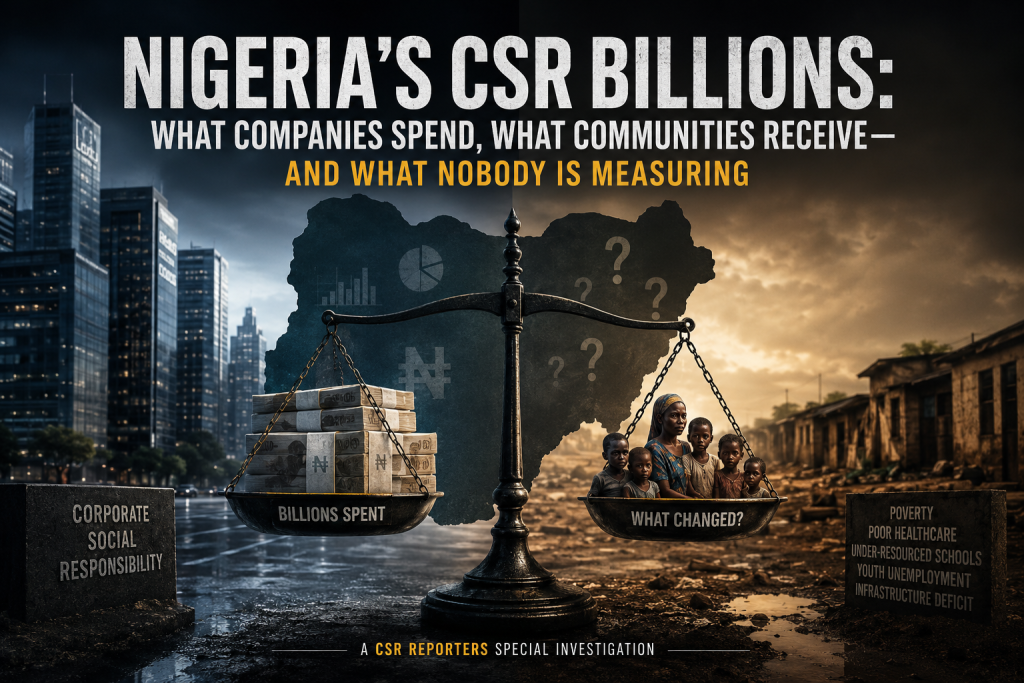
NIGERIA'S CSR BILLIONS: What Companies Spend, What Communities Receive — and What Nobody Is Measuring
A CSR REPORTERS Special Investigation: An evidence-led examination of corporate social investment, disclosed expenditure, programme reach, impact claims and accountability gaps across 20 major companies in Nigeria.
THE BIG QUESTION
For years, corporate Nigeria has been telling us how much it gives back. Billions of naira in CSR expenditure. Millions of beneficiaries. Thousands of scholarships, schools, healthcare interventions, empowerment programmes and community projects.
Yet there is a question that rarely accompanies those announcements: what, exactly, has changed?
Nigeria’s social problems have not disappeared. In many communities that have received years of corporate intervention, poverty remains entrenched, schools remain under-resourced, healthcare remains inadequate and economic opportunities remain scarce.
This does not mean corporate CSR has failed. It means something more fundamental: we have not done enough to measure whether it is succeeding.
Nigeria can count the billions. It can count the beneficiaries. It can count the projects. But can it count the change?
And perhaps the more uncomfortable question: who independently verifies whether the promised impact actually happened?
These are questions that rarely receive the same attention as the announcement of a new CSR programme, the unveiling of a school, the distribution of relief materials or the publication of a sustainability report.
CSR REPORTERS set out to examine the evidence.
This investigation looks at 20 major corporate actors across Nigeria, examining what they disclose about their social investment, who their programmes reportedly reach, what impact they claim and how much of that information can actually be independently verified.
It is deliberately not a ranking.
It is not a list of the “best” CSR companies in Nigeria.
Nor is inclusion an endorsement of any company’s social performance.
It is an evidence check.
Because a billion naira spent is important.
But knowing what happened to the billion naira is more important.
HOW WE LOOKED AT THE EVIDENCE
CSR REPORTERS reviewed publicly available audited financial statements and NGX filings, company and foundation communications, sustainability and ESG disclosures, programme documentation and financial and business press coverage.
Where a hard naira figure for CSR, donations or related social investment expenditure was available in a public filing, that figure is reported.
Where a company did not disclose a consolidated CSR budget, CSR REPORTERS did not estimate one. Instead, the analysis considers documented programmes and their reported scope.
This distinction matters.
Corporate social investment is not reported uniformly in Nigeria. Some companies disclose CSR or donation expenditure directly in financial statements. Others operate through foundations. Oil and gas companies may report community investment through host-community development structures or joint-venture arrangements rather than a single CSR budget line.
Each company was considered across five dimensions:
SPEND
What financial commitment can be documented?
REACH
Who is reported to have benefited, and how many people or communities were reached?
AREA OF IMPACT
What social, environmental or community-development issues are being addressed?
IMPACT
What evidence exists that the intervention produced a meaningful outcome?
VERIFIABILITY
How readily can the expenditure, reach and impact claims be independently checked?
A critical principle runs through the entire investigation:
Reported activity is not the same thing as verified impact.
THE 20 COMPANIES
BANKING & FINANCIAL SERVICES
ACCESS HOLDINGS PLC
Disclosed investment: ₦6.74 billion in 2024
Access Holdings reported ₦6.74 billion in sponsorships and donations across 114 separate interventions in 2024.
Its documented areas of social investment include disaster relief, education, women’s entrepreneurship, healthcare and security-related interventions. Among the most significant was a ₦1 billion contribution towards the Borno flood response.
The scale of expenditure is significant. The harder question is what proportion translated into measurable community outcomes.
The research found that programme-level reach was not sufficiently disaggregated in public filings, while much of the impact reporting remains narrative.
The research also identified that more than half of the disclosed total—₦3.49 billion—went to the recurring Chukker Polo Tournament sponsorship.
That is a legitimate area for scrutiny, not an accusation of wrongdoing.
The question is whether stakeholders can clearly distinguish between expenditure that constitutes direct community investment and expenditure primarily associated with sponsorship and brand visibility.
WHAT WE KNOW:
₦6.74 billion was disclosed across 114 sponsorships and donations.
WHAT WE DON’T KNOW:
The public disclosure does not sufficiently establish programme-by-programme beneficiaries and outcomes.
WHAT SHOULD BE DISCLOSED:
Programme-level expenditure, beneficiaries, outcomes and a clearer distinction between direct social investment and sponsorship expenditure.
ZENITH BANK PLC
Disclosed investment: ₦4.93 billion in 2024
Zenith Bank disclosed ₦4.93 billion in CSR expenditure in 2024, representing a 14.6% decline from ₦5.77 billion in 2023, despite the bank recording a profit of ₦1.03 trillion.
Its interventions included state infrastructure and security trust funds, which accounted for ₦2.55 billion, alongside investments in sports, education and health.
The largest part of the disclosed expenditure therefore went into state-level infrastructure and security-related interventions.
The expenditure is auditable.
What remains less visible is programme-level reach and outcome measurement.
WHAT WE KNOW:
₦4.93 billion was disclosed and the expenditure is supported by audited financial reporting.
WHAT WE DON’T KNOW:
The number of direct beneficiaries and measurable outcomes are not published in aggregate.
THE ACCOUNTABILITY QUESTION:
How much measurable social value is generated by the expenditure, particularly the significant allocation to infrastructure and security?
UNITED BANK FOR AFRICA (UBA)
Disclosed investment: ₦1.98 billion in 2024
UBA reported ₦1.98 billion in CSR expenditure in 2024, a 225% increase from ₦608 million in 2023.
Education, environment and economic empowerment are among the bank’s principal areas of intervention.
Its National Essay Competition reaches secondary school students across Nigeria and other African markets in which UBA operates. The top prize includes a ₦7.5 million university grant.
The financial expenditure is audited, but the broader pan-African reach claims are not independently quantified in the evidence reviewed.
WHAT WE KNOW:
A significant increase in disclosed CSR expenditure and an established education intervention.
WHAT WE DON’T KNOW:
The full programme-level beneficiary count and independently measured outcomes.
FIDELITY BANK PLC
Disclosed investment: ₦1.55 billion in 2024
Fidelity Bank reported ₦1.55 billion in CSR expenditure in 2024, with education and community development among its principal intervention areas.
The expenditure figure is audited.
However, programme-level details on beneficiaries and outcomes remain thin in the available disclosure.
This is one of the recurring themes emerging from the research: the existence of an audited top-line number does not necessarily mean there is sufficient information to evaluate the effectiveness of individual interventions.
WHAT WE KNOW:
₦1.55 billion in disclosed expenditure.
WHAT WE DON’T KNOW:
Detailed programme-level reach and measurable outcomes.
WHAT SHOULD BE DISCLOSED:
A breakdown of expenditure and impact by programme.
WEMA BANK PLC
Disclosed investment: ₦1.27 billion in 2024
Wema Bank disclosed ₦1.27 billion in CSR expenditure in 2024, a notable amount relative to its balance-sheet size compared with larger tier-one banking peers.
Youth and community programmes are identified as major areas of intervention.
The expenditure is audited, but public programme-level information on beneficiaries and outcomes is limited.
THE ACCOUNTABILITY QUESTION:
What measurable social outcomes resulted from the ₦1.27 billion expenditure?
STANBIC IBTC HOLDINGS
Disclosed investment: ₦1.03 billion in 2024
Stanbic IBTC Holdings disclosed ₦1.03 billion in CSR expenditure in 2024.
Its interventions included university scholarships, disability support and state police infrastructure. Individual grants—including scholarships and prosthetics or clinical partnerships—are itemised, although aggregate beneficiary numbers are not published.
This provides somewhat stronger visibility into individual interventions than a purely narrative CSR disclosure.
However, the impact stories remain largely recipient-based rather than independently evaluated at scale.
WHAT WE KNOW:
Audited expenditure and identifiable categories of beneficiaries.
WHAT WE DON’T KNOW:
The broader outcome of the interventions across the portfolio.
GUARANTY TRUST HOLDING COMPANY (GTCO)
Disclosed investment: ₦962.6 million in 2024
GTCO reported ₦962.6 million in CSR expenditure in 2024.
Its social investment areas include financial literacy and inclusion, particularly in Northern Nigeria, sports sponsorship and education infrastructure.
The expenditure is audited.
However, programme-level reach and outcome data are not publicly presented in aggregate.
The research also identified a disclosure-timing issue: GTCO reported no CSR line in its Q1 2024 filing, with expenditure appearing later in the year.
That is not itself evidence of a problem. It is, however, a disclosure pattern worth monitoring.
FCMB GROUP
Disclosed investment: ₦495.2 million in 2024
FCMB disclosed ₦495.2 million in CSR expenditure in 2024.
The available disclosure identifies community development as the broad intervention area but provides little programme-level information about beneficiaries or measurable outcomes.
The expenditure is audited.
The social impact evidence, however, remains comparatively difficult to assess.
THE ACCOUNTABILITY QUESTION:
Can stakeholders determine what changed because of the ₦495.2 million investment?
JAIZ BANK PLC
Disclosed investment: ₦112.5 million in 2024
Jaiz Bank reported ₦112.5 million in CSR expenditure in 2024, the smallest disclosed figure among the banks reviewed in this research.
Its documented areas of intervention include community and religious-institution giving.
The expenditure is audited, but programme-level reach and impact information is limited.
INDUSTRIAL, MANUFACTURING & CONGLOMERATES
DANGOTE CEMENT / ALIKO DANGOTE FOUNDATION
Disclosed investment: ₦13.19 billion in 2024
The largest disclosed CSR-related expenditure identified in the research came from Dangote Cement/Aliko Dangote Foundation, with ₦13.19 billion recorded in 2024, up from ₦2.36 billion in 2023. ₦12.4 billion reportedly ran through the Foundation.
The Foundation’s areas of intervention include education, child nutrition and disaster relief, with historical involvement in polio eradication.
The scale is considerable.
The Foundation has also announced a new ₦1 trillion/$689 million, 10-year education pledge targeting approximately 1.33 million students.
But the scale of a pledge is not the same as the delivery of an outcome.
The research found that the expenditure figure is strongly supported by audited filing information, while impact claims around malnutrition and education remain Foundation-reported and have not yet been independently evaluated.
At this scale, independent verification becomes increasingly important.
THE BIG QUESTION:
Can the social outcomes generated by this level of investment eventually be independently demonstrated?
BUA GROUP / BUA FOODS
Disclosed investment: No standalone consolidated CSR budget identified
Unlike companies with a clearly disclosed CSR expenditure line, the research did not identify a standalone CSR budget relative to BUA’s commercial scale.
The company’s social-development narrative includes food security, local milling capacity, education and community giving.
However, the research found that public disclosure is limited at programme and expenditure level.
There is also an important conceptual issue: commercial investments such as flour mills and sugar-refinery expansion may contribute to national development and food security, but they should not automatically be classified as CSR.
That distinction matters.
WHAT WE KNOW:
Documented community and development-related activity.
WHAT WE DON’T KNOW:
A consolidated CSR/social investment figure and detailed programme-level impact.
WHAT SHOULD BE DISCLOSED:
A clear distinction between commercial investment, shared-value initiatives and genuine CSR/community investment.
FLOUR MILLS OF NIGERIA PLC
Disclosed investment: No consolidated CSR figure identified
Flour Mills did not disclose a consolidated CSR expenditure figure in the research reviewed.
However, it provides a more concrete example of programme-level reach.
Its fish-farmer initiative reportedly trained 1,436 farmers between 2018 and 2025 in aquaculture, processing and export readiness, alongside a poultry initiative in Lagos State.
The documented beneficiary number is useful because it provides more substance than a general statement about “supporting farmers.”
But the reported figures remain company-reported, and no third-party evaluation was identified in this research pass.
WHAT WE KNOW:
A defined programme, a defined timeframe and a stated beneficiary count.
WHAT WE DON’T KNOW:
How participants’ incomes, productivity or long-term economic conditions changed.
That is the difference between reach and impact.
HBM PLC
Disclosed investment: No consolidated Nigeria-specific CSR figure identified
HBM’s parent, Holcim, reports sustainability metrics, but those disclosures do not always disaggregate neatly to the Nigerian entity.
The company’s documented intervention areas include sustainable construction practices and education and healthcare access in cement-producing host communities.
The major limitation is programme-level disclosure.
THE ACCOUNTABILITY QUESTION:
What has actually changed in the Nigerian communities affected by these interventions?
TRANSNATIONAL CORPORATION (TRANSCORP) PLC
Disclosed investment: ₦2.56 billion in 2024
Transcorp disclosed ₦2.56 billion in 2024, representing a 104% increase from ₦1.25 billion in 2023.
But there is an important distinction: only ₦23 million of the 2024 figure was direct donation, with the balance channelled through subsidiaries.
Its named beneficiaries include the Daughters of Charity, School for the Blind, Ace Charity, Lagos Business School Alumni Association, Government Senior College Maroko and Kuchingoro Old People’s Home.
The itemisation of recipients makes Transcorp unusual among the companies examined.
It allows stakeholders to see where at least part of the reported expenditure went rather than relying entirely on an aggregate number.
The portfolio also covers disability support, education, elderly care and food security.
WHAT WE KNOW:
A substantial audited figure and a relatively specific list of recipients.
WHAT WE DON’T KNOW:
The longer-term outcomes generated by the interventions.
NIGERIAN BREWERIES PLC
FY2024 disclosed CSR expenditure identified: ₦0
Nigerian Breweries also presents a significant disclosure question.
The research identified no reported CSR expenditure for FY2024, a loss year for the company, following years of stated commitments in education, health and environmental sustainability. The company returned to profitability in 2025.
Again, this should not be reduced to the claim that the company did nothing socially during the year.
The finding concerns what was identifiable as CSR expenditure in the financial disclosure reviewed.
The more interesting question is what happens to CSR expenditure and reporting when a company moves from a loss-making period back into profitability.
WHAT SHOULD STAKEHOLDERS WATCH:
The 2025 and 2026 disclosure cycle.
OIL, GAS & ENERGY
SEPLAT ENERGY PLC
Disclosed investment: No consolidated CSR budget identified
Seplat’s social investment is delivered largely through the NNPC/Seplat Joint Venture rather than a single consolidated CSR expenditure line.
But the company provides some of the more specific programme-level numbers in this review.
Its STEP teacher-training programme reportedly graduated 623 teachers and inspectors in its 2026 cohort.
Its Eye Can See programme has reportedly screened 23,447 patients, performed 797 surgeries and distributed 13,525 free eyeglasses.
These numbers make the programme easier to understand than a generic claim of “supporting healthcare.”
Yet they remain self-reported.
No independent third-party audit of the beneficiary figures was identified in this research.
That makes Seplat a useful example of an important middle ground:
Detailed reporting is better than vague reporting. Independent verification is better still.
NIGERIA LNG LIMITED (NLNG)
Disclosed investment: No single consolidated donations figure identified
NLNG’s community investment operates largely through its Global Memorandum of Understanding (GMoU) cluster model.
The company also launched a ₦1 billion MSME matching fund with the Bank of Industry in 2025.
Its GMoU structure covers 110 host communities, with interventions including infrastructure, market renovation, scholarships and local enterprise financing.
The GMoU model is significant because it is designed around community-led prioritisation: communities determine development priorities rather than NLNG simply prescribing projects.
The research identifies the model as comparatively well studied by external development researchers.
The limitation remains that NLNG’s total social investment cannot easily be reduced to a single disclosed top-line figure.
THE ACCOUNTABILITY QUESTION:
Can the outcomes generated across 110 communities be consistently measured and compared over time?
RENAISSANCE AFRICA ENERGY
Disclosed investment: No current independently disclosed figure identified
Renaissance Africa Energy, following the transition from Shell’s onshore Nigeria assets, inherited a substantial host-community footprint across the Niger Delta.
The ownership transition was completed in March 2025.
The research found that current CSR/community investment disclosure under the new ownership remains limited.
This makes Renaissance less a case of established impact measurement than an open accountability file.
It is too early to draw strong conclusions about the company’s current social performance.
What is clear is that historical references to “Shell Nigeria” should not automatically be treated as evidence of current Renaissance Africa Energy activity.
THE QUESTION FOR THE NEW OPERATOR:
What commitments, expenditure and community outcomes will be disclosed under the new ownership?
CHEVRON NIGERIA
Disclosed investment: No current consolidated figure identified
The research did not identify a current consolidated CSR expenditure figure for Chevron Nigeria.
Its long-standing community-development framework has historically covered infrastructure and livelihood support in the Niger Delta.
However, recent programme-level reach and outcome information was not sufficiently available in this research pass.
Chevron’s long history in the Niger Delta makes this particularly significant.
THE ACCOUNTABILITY QUESTION:
How much is currently being invested, where is it going and what measurable outcomes are being achieved?
TELECOMMUNICATIONS, FMCG & CONSUMER INDUSTRIES
MTN NIGERIA / MTN FOUNDATION
FY2024 disclosed CSR/donation expenditure identified in NGX filing analysis: ₦0
This is perhaps the most provocative finding in the entire investigation—and therefore one that requires the greatest precision.
The research identified no CSR/donation expenditure in MTN Nigeria’s FY2024 NGX financial disclosure analysis, despite the company’s historically significant CSR presence.
MTN Foundation has historically operated major programmes in education, healthcare and economic empowerment.
The research therefore identifies a potential gap between Foundation-level CSR messaging and the financial expenditure identified in the relevant filing analysis.
The finding should not be interpreted to mean that MTN Nigeria carried out no sustainability or social programmes whatsoever during the year.
The issue is narrower and more important:
What social expenditure was actually recognised and disclosed in the financial reporting reviewed?
That is a question of disclosure and accountability.
THE ACCOUNTABILITY QUESTION:
Can stakeholders reconcile the company’s social-impact narrative with its disclosed financial commitment for the period?
THE NUMBERS TELL A STORY — BUT NOT THE WHOLE STORY
Across the 20 companies reviewed, one pattern is difficult to ignore:
Financial disclosure is generally stronger than impact disclosure.
Some companies can tell stakeholders exactly how much they spent.
Far fewer can demonstrate exactly what changed because they spent it.
This is not necessarily evidence that the interventions failed.
It is evidence that the public measurement architecture is incomplete.
And that distinction matters.
A CSR programme can be valuable even if it has not been independently evaluated.
A company can make a genuine social contribution even if its sustainability report does not provide perfect outcome data.
But without evidence, stakeholders cannot reliably distinguish between:
activity and impact;
reach and outcome;
commitment and delivery;
or
social investment and sponsorship.
That is the central accountability challenge.
WHAT NIGERIA’S CSR BILLIONS REVEAL
1. WE CAN COUNT THE MONEY MORE EASILY THAN WE CAN COUNT THE CHANGE
The banks and some large corporates provide relatively strong audited expenditure data.
But expenditure alone tells us only what was spent.
It does not tell us whether a school improved learning outcomes, whether a healthcare intervention reduced disease burden, whether a livelihood programme increased household income or whether infrastructure remained functional years after construction.
As the research demonstrates, audited spend and real accountability are not the same thing.
2. REACH IS NOT IMPACT
This may be the most important distinction in the report.
Seplat can report thousands of patients screened.
Flour Mills can report 1,436 farmers trained.
A foundation can report hundreds of thousands of people reached.
Those numbers matter.
But they answer only one question:
How many people did you touch?
They do not necessarily answer:
What changed for them?
A beneficiary count is an output.
Impact is an outcome.
The Nigerian CSR conversation needs to become much better at distinguishing the two.
3. DISCLOSURE IS FRAGMENTED
There is no uniform approach to reporting CSR expenditure across the companies examined.
Some companies disclose a CSR line in audited accounts.
Some report foundation expenditure.
Some report programmes without a consolidated budget.
Oil and gas companies may operate through joint ventures or host-community structures.
This makes comparisons difficult.
It also creates the possibility that two companies doing broadly similar levels of social investment may appear radically different simply because they report differently.
4. INDEPENDENT VERIFICATION REMAINS RARE
Where specific beneficiary figures exist, they are predominantly company-reported.
The research identified Seplat and Flour Mills as notable examples of companies providing specific beneficiary numbers, but neither set of figures was externally audited for accuracy in this research pass.
That does not make the figures false.
It simply means stakeholders should understand their evidentiary status.
There is a fundamental difference between:
“The company says 23,447 people were reached.”
and
“An independent evaluator verified that 23,447 people were reached and assessed the outcomes.”
Both are information.
They are not the same level of evidence.
5. THE BIGGEST SPENDER IS NOT NECESSARILY THE BIGGEST IMPACT CREATOR
The largest disclosed expenditure in this review is not automatically the programme with the greatest social return.
Nor should it be.
A ₦100 million intervention that transforms a community may create greater social value than a ₦1 billion intervention whose outcomes are poorly measured.
This is why CSR should not become a competition over expenditure.
The important question is not:
Who spent the most?
It is:
Who can demonstrate the most meaningful change?
And then:
Who can prove it?
THE MISSING NUMBER
There is one number that is conspicuously absent from much of Nigerian CSR reporting:
THE OUTCOME NUMBER
We routinely see:
₦1 billion spent.
10,000 people reached.
50 schools supported.
500 farmers trained.
20 communities covered.
But what about:
How many children improved their learning outcomes?
How many patients experienced improved health outcomes?
How many farmers increased their income?
How many businesses survived or expanded?
How many communities experienced measurable improvements?
How long did the benefit last?
These are harder numbers.
They require baseline studies.
Follow-up measurement.
Independent evaluation.
Long-term monitoring.
And sometimes the uncomfortable admission that a programme did not achieve everything it promised.
But that is precisely what credible accountability requires.
WHAT SHOULD CORPORATE NIGERIA DISCLOSE?
CSR REPORTERS believes Nigeria’s next phase of corporate social investment should move beyond expenditure and activity reporting towards outcome accountability.
For every significant CSR or social-investment programme, companies should ideally disclose:
INVESTMENT
How much was committed and how much was actually spent?
PURPOSE
What problem was the intervention designed to address?
BENEFICIARIES
Who was intended to benefit?
REACH
How many people or communities were actually reached?
OUTPUT
What was delivered?
OUTCOME
What measurable change occurred?
DURATION
Was the intervention one-off or sustained?
EVIDENCE
How were the results measured?
INDEPENDENT VERIFICATION
Has anyone outside the implementing organisation assessed or validated the results?
LONG-TERM VALUE
Did the intervention continue producing benefits after the corporate intervention ended?
This should not be viewed as an unreasonable demand.
If companies are increasingly expected to disclose financial performance, environmental risks and governance practices, there is a strong case for social investment to receive a similar level of seriousness.
THE CASE FOR A NEW CSR STANDARD
Corporate Nigeria has become increasingly sophisticated at announcing CSR initiatives.
The next frontier should be becoming equally sophisticated at demonstrating outcomes.
The industry should move from:
“We built a school.”
to:
“We built the school, enrolled X children, improved attendance by X%, and after three years learning outcomes improved by X%.”
From:
“We trained 1,000 entrepreneurs.”
to:
“We trained 1,000 entrepreneurs; X% remained in business after 12 months and average income increased by X%.”
From:
“We provided healthcare to 20,000 people.”
to:
“We provided healthcare to 20,000 people and measured the resulting health outcomes.”
That is the difference between CSR communication and CSR accountability.
WHAT THE 20 COMPANIES SHOW
After examining the disclosures of 20 major corporate actors, one conclusion stands out: Nigeria’s CSR conversation has become much better at counting money and activity than measuring outcomes.
The question is no longer simply who is spending. It is what that spending is changing.
The billions matter. But the change matters more.
This investigation does not conclude that Nigerian companies are not doing enough.
It shows something more nuanced.
Corporate Nigeria is spending significant resources on social and community interventions.
Some companies disclose those resources more clearly than others.
Some provide specific programme and beneficiary information.
Some have stronger external evidence.
Others provide broad narratives that are difficult to independently test.
The result is an uneven landscape in which stakeholders can sometimes determine how much was spent, sometimes determine who was reached, but far less frequently determine what changed.
That is the gap.
And it is a gap that cannot be solved by bigger CSR budgets alone.
THE CSR ACCOUNTABILITY TEST
CSR REPORTERS proposes a simple test for corporate social investment:
MONEY
Did you spend it?
PURPOSE
Did you spend it on a clearly defined problem?
REACH
Did it reach the intended people?
OUTCOME
Did their circumstances improve?
EVIDENCE
Can you demonstrate that improvement?
INDEPENDENCE
Can someone outside your organisation verify it?
The closer a programme gets to answering all six questions, the stronger its accountability.
A FINAL WORD: THE BILLIONS MATTER. BUT THE CHANGE MATTERS MORE.
Nigeria does not necessarily need companies to spend more money simply for the sake of spending more money.
It needs companies to become better at demonstrating what their money achieves.
The billions matter.
The schools matter.
The hospitals matter.
The scholarships matter.
The farmers matter.
The communities matter.
But the ultimate measure of responsible business is not the size of the cheque, the number of photographs taken at a project launch or the number of beneficiaries listed in a sustainability report.
It is what changed because the investment was made.
And increasingly, companies should be prepared to show the evidence.
Because the real question after the cameras leave, the speeches end and the project is handed over is a simple one:
WHAT CHANGED?
COMPANIES PROFILED
Banking & Financial Services:
Access Holdings Plc; Zenith Bank Plc; United Bank for Africa; Fidelity Bank Plc; Wema Bank Plc; Stanbic IBTC Holdings; Guaranty Trust Holding Company; FCMB Group; Jaiz Bank Plc.
Industrial, Manufacturing & Conglomerates:
Dangote Cement/Aliko Dangote Foundation; BUA Group/BUA Foods; Flour Mills of Nigeria Plc; HBM Plc; Transnational Corporation (Transcorp) Plc.
Oil, Gas & Energy:
Seplat Energy Plc; Nigeria LNG Limited; Renaissance Africa Energy; Chevron Nigeria.
Telecommunications, FMCG & Consumer Industries:
MTN Nigeria/MTN Foundation; Nigerian Breweries Plc.
EDITORIAL NOTE
This investigation is a CSR REPORTERS editorial compilation based on publicly available information reviewed for this edition. It is not a ranking of companies by CSR performance and inclusion should not be interpreted as an endorsement or adverse finding.
Where CSR expenditure was not publicly disclosed as a consolidated figure, CSR REPORTERS has not estimated one.
Where impact or beneficiary figures are company-reported and have not been independently evaluated, this is expressly identified.
CSR REPORTERS welcomes additional evidence, clarification and corrections from companies profiled in this investigation. Where credible documentary evidence materially changes a finding, the relevant entry may be updated and the amendment clearly identified.
Sources are available for editorial fact-checking on request.
[give_form id="20698"]