CSR REPORTERS Unveils Technical Framework for Nigeria CSR Impact Ranking 2026, Puts Evidence at the Centre of Corporate Accountability
 Gloryann Osang
CSR REPORTERS Unveils Technical Framework for Nigeria CSR Impact Ranking 2026, Puts Evidence at the Centre of Corporate Accountability
New methodology introduces weighted scoring, evidence assessment, verification protocols and safeguards against commercial influence
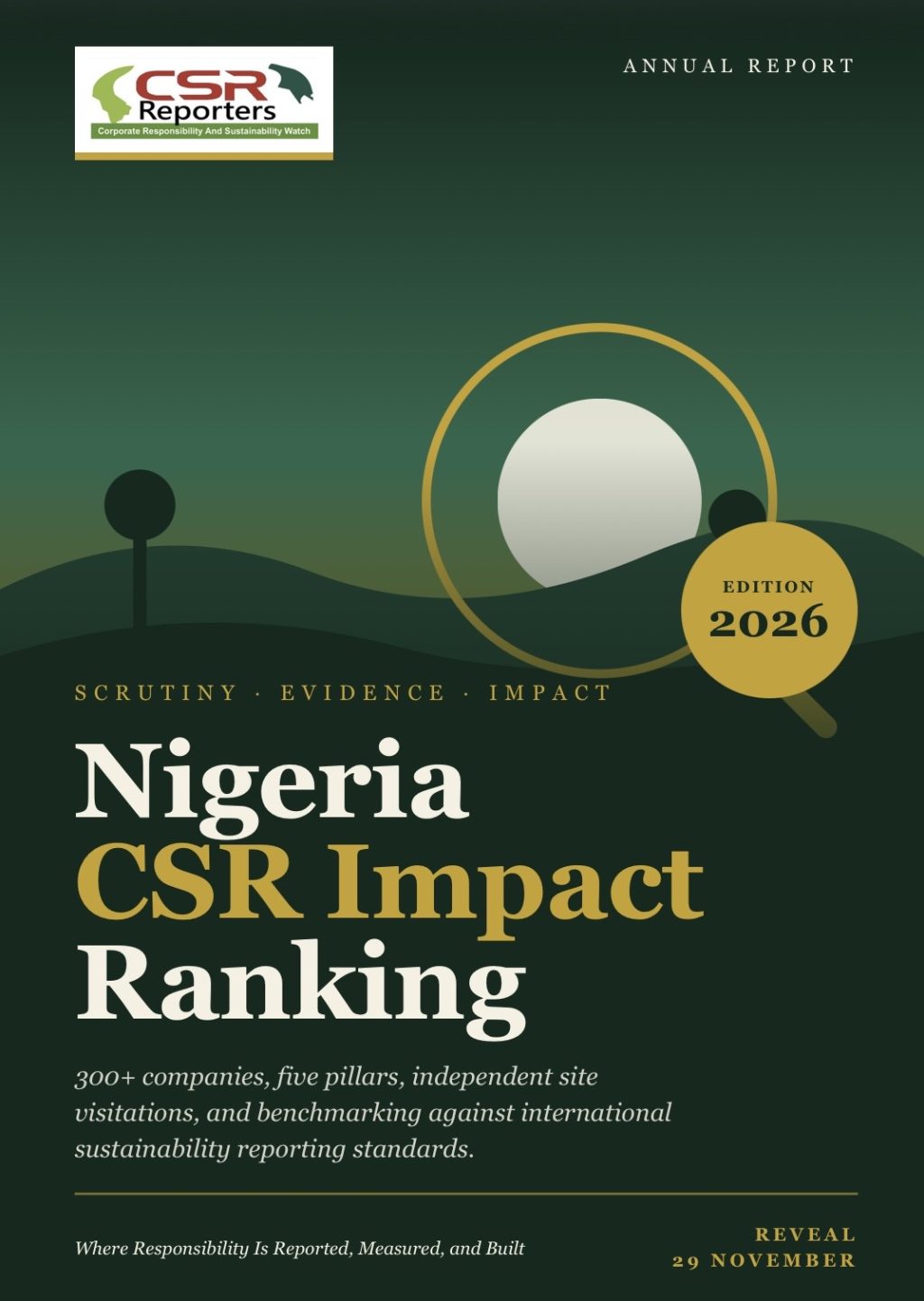
CSR REPORTERS, Africa’s independent corporate responsibility and sustainability news and intelligence platform, has unveiled the Methodology and Technical Framework for the Nigeria CSR Impact Ranking 2026, laying the foundation for an evidence-led assessment of corporate social impact and sustainability performance in Nigeria.
The new methodology puts evidence at the centre of corporate accountability, seeking to move corporate responsibility assessment beyond publicity, expenditure and self-reported claims to a more structured examination of what organisations actually do, the evidence supporting their claims, the outcomes they achieve and the extent to which those outcomes can be substantiated. Its guiding principle is simply designed to move the needle from Claim to Evidence, Outcome, and Verification.
Eche Munonye, Founder and CEO of CSR REPORTERS, said the distinction has become increasingly important as sustainability reports and CSR announcements gain greater prominence, while independently verifiable evidence of lasting impact remains uneven. The main objective of the Nigeria CSR Impact Ranking 2026 seeks to answer a fundamental question: What can a company actually demonstrate about its social impact and sustainability performance?
The methodology establishes a weighted scoring framework for assessing organisations operating in Nigeria across five dimensions. Impact carries the highest weighting at 30 per cent, while Strategic Alignment and Measurement & Evaluation each account for 20 per cent. Sustainability & Scale and Transparency & Accountability account for 15 per cent each.
Together, the five dimensions examine the relevance of corporate responsibility initiatives, their measurable outcomes, their alignment with organisational priorities, their durability and potential for scale, as well as the level of transparency and accountability surrounding them.
The framework also provides for structured scoring, evidence classification, stakeholder validation and field verification where appropriate. It incorporates quality assurance measures and conflict-of-interest safeguards, as well as procedures for dealing with missing or non-applicable information. The aim is to ensure that organisations are assessed against a consistent standard rather than allowing publicity, media visibility or the sophistication of corporate communications to determine outcomes.
A defining feature of the Nigeria CSR Impact Ranking methodology is the emphasis it places on the quality of evidence behind corporate claims. Relevant evidence may include sustainability and annual reports, documented programme data, public disclosures, independent publications, stakeholder information and third-party assessments. Where necessary and appropriate, direct field verification may also be undertaken to corroborate information relating to selected initiatives.
The framework distinguishes between different levels of evidentiary strength, recognising that independently corroborated information does not carry the same evidential value as an unverified corporate statement. It also introduces an Evidence Confidence Indicator, which is designed to communicate the strength of the available evidence separately from an organisation’s numerical ranking score.
The difference is important because reported achievements and the strength of evidence supporting those achievements are not necessarily the same thing. Building a school, for instance, represents a measurable output. Establishing whether the school remains functional, addresses an identified need and continues to deliver meaningful benefits requires further evidence. The methodology therefore seeks to make the distinction between activities, outputs and demonstrable impact much clearer.
The framework provides for stakeholder validation and, where appropriate, field verification. This may involve examining programme records, considering stakeholder perspectives and reviewing available evidence relating to implementation and outcomes.
Munonye said this is particularly important for community-based interventions, where the number of projects executed or beneficiaries reported may not, on its own, demonstrate the quality, relevance or durability of the impact achieved.
The methodology also establishes safeguards intended to protect the independence and credibility of the ranking. Participation in CSR REPORTERS events, advertising, sponsorships, partnerships, consultancy engagements or any other commercial relationship with the organisation does not guarantee inclusion in the ranking or a particular ranking position, and such relationships will not influence assessment outcomes.
The ranking is therefore kept separate from CSR REPORTERS’ commercial, media and recognition activities.
“Maintaining that separation is critical to building confidence in a benchmarking exercise intended to serve companies, investors, researchers, policymakers, development organisations and sustainability professionals,” Munonye said.
Although developed specifically for Nigeria’s corporate and sustainability environment, the methodology draws on international benchmarking principles that support structured assessment, transparency and comparability. Rather than reproduce any single international framework, however, it establishes an approach designed to reflect the realities of operating in an emerging-market economy while retaining clearly defined assessment criteria, weighted scoring, evidence requirements, documented limitations and procedures for corrections and revisions.
The 2026 edition is designated Methodology Version 1.0, providing a documented foundation on which future editions can be refined and comparisons made across assessment cycles.
Commenting further on the framework, Munonye said the methodology behind any corporate ranking with the potential to shape public perception should itself be open to scrutiny.
“If a ranking is going to influence how companies are perceived and discussed, people should be able to understand how it was produced.
“Corporate responsibility is often discussed through activities, announcements and expenditure. Those things matter, but they do not automatically tell us what changed. The question we are asking is: what can an organisation demonstrate?
“We want to understand the distance between a claim and the evidence behind it: what was done, what changed, whether the change can be measured, whether it can be sustained and who can independently confirm it.
“This framework is our commitment to making that process more transparent, rigorous and accountable.”
Munonye added that the methodology would continue to evolve as the evidence base and sustainability landscape develop, with future improvements documented and explained so that users can clearly understand what has changed and why.
The Nigeria CSR Impact Ranking 2026 is not simply a measure of how much a company spends on CSR, the number of initiatives it announces or the number of beneficiaries it claims to have reached. Rather, it assesses corporate responsibility and sustainability performance within a defined assessment universe, using established criteria and the evidence available for evaluation.
The exercise is not intended to constitute a comprehensive audit of every aspect of a company’s operations, and a ranking position does not automatically mean that every reported outcome attributed to an organisation has been independently verified.
CSR REPORTERS intends the ranking to become a credible reference point for understanding corporate sustainability and social impact in Nigeria, supporting journalism, research, policy discussions and more informed stakeholder engagement.
The inaugural edition will assess organisations across major sectors of the Nigerian economy and culminate in the publication of the Top 50 corporate sustainability and social impact performers within the defined 2026 assessment universe.
The Nigeria CSR Impact Ranking 2026 is scheduled to be unveiled in Lagos in November 2026 as part of CSR REPORTERS’ wider sustainability programme.
By publishing the technical framework ahead of the ranking, CSR REPORTERS is putting forward a clear principle: corporate responsibility should be judged not only by what organisations say they have done, but also by the evidence supporting those claims, the outcomes achieved and the accountability behind them.
| DON’T JUST ANNOUNCE YOUR IMPACT. PROVE IT. CSR REPORTERS helps organisations verify, assess, document and communicate the real impact of their CSR and sustainability initiatives. Project Verification | Beneficiary Feedback | Impact Assessment | Impact Storytelling | Stakeholder Engagement Have an initiative worth documenting? Let us verify it. Document it. Tell the story. Talk to CSR REPORTERS enquiries@csrreporters,com Call/WhatsApp: 0803 401 2198 | 0903 329 6374 | 0905 024 4468 | 0803 209 8499 |