

France-Nigeria Agribusiness Deals: Can Three New Partnerships Strengthen Local Farmers and Businesses?
 ONYINYECHI NWAIGBA
Three agreements covering crop protection, baking industry development and professional agricultural training could strengthen important parts of Nigeria’s food value chain. But their real impact will depend on implementation, access and opportunities for local businesses.
Nigeria’s agricultural sector does not lack potential. It has farmers, agricultural entrepreneurs, food processors and a large domestic market. Yet many businesses operating across the sector continue to face challenges that limit their ability to grow.
Farmers struggle with crop pests, expensive inputs and limited access to technical support. Small food-processing businesses face rising operating costs and difficulties improving product quality. Agricultural entrepreneurs also need specialized knowledge, modern production techniques and stronger business networks to compete.
These challenges explain why international technical cooperation can be important to the development of local industries.
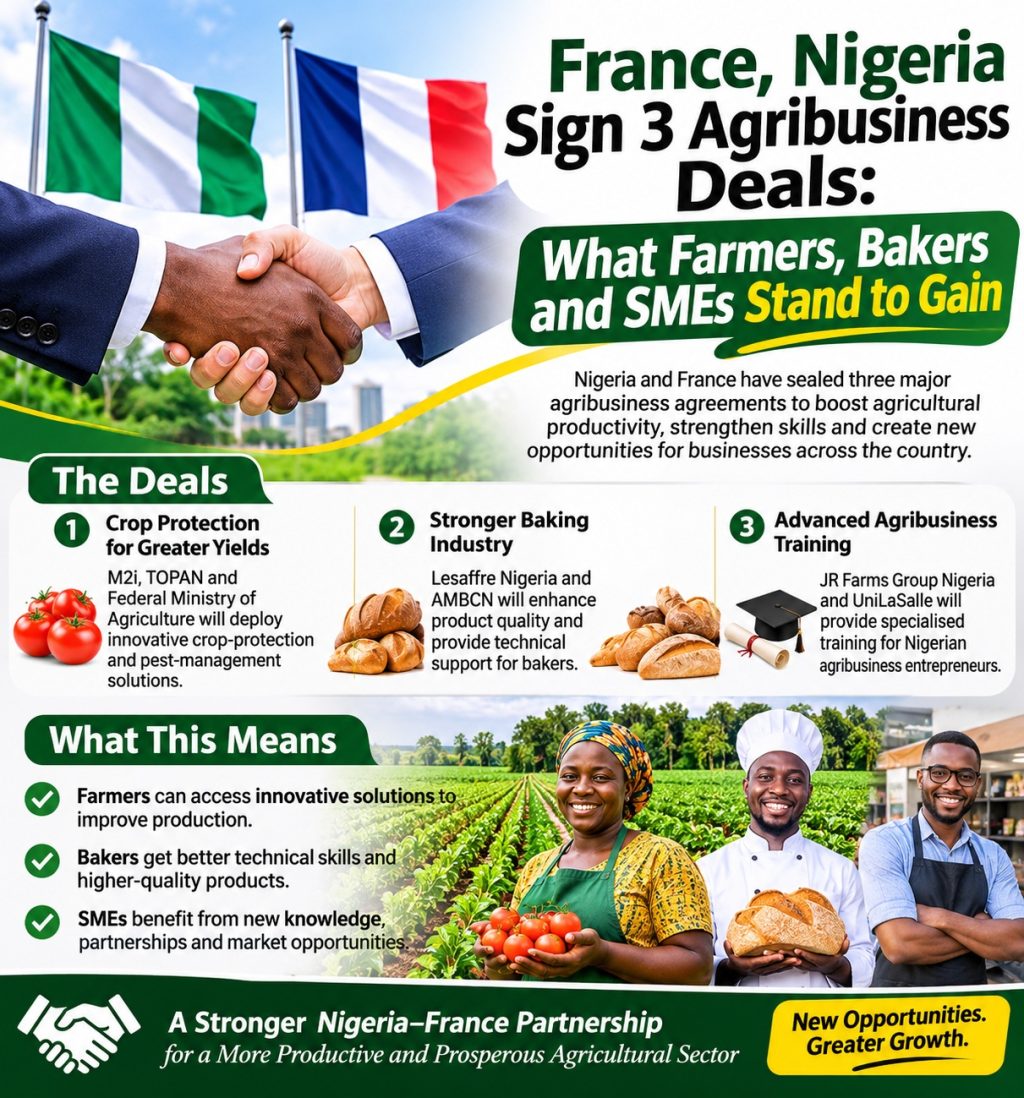
Three new agreements between Nigerian and French organisations are seeking to address some of these gaps through crop-protection solutions, technical cooperation in the baking industry and professional agribusiness training.
The agreements were signed during French Week 2026 at the France-Nigeria Agri-Business Summit, organized by the Franco-Nigerian Chamber of Commerce and Industry (FNCCI) in Lagos.
The partnerships involve French company M2i, the Tomatoes and Orchard Producers Association of Nigeria (TOPAN), the Federal Ministry of Agriculture and Food Security, Lesaffre Nigeria, the Association of Master Bakers and Caterers of Nigeria (AMBCN), JR Farms Group Nigeria and France’s UniLaSalle.
Beyond strengthening commercial relations between both countries, the agreements raise an important question: can international expertise translate into better opportunities for Nigerian farmers, food businesses and agricultural entrepreneurs?
1. Helping Farmers Manage Crop Pests and Reduce Losses
The first agreement involves M2i, TOPAN and the Federal Ministry of Agriculture and Food Security. It focuses on introducing innovative crop-protection and pest-management solutions to support agricultural production.
This is particularly relevant to Nigerian farmers who regularly contend with pests and crop diseases that can reduce harvests, increase production costs and threaten their incomes.
Tomatoes, for example, are an important part of Nigeria’s food supply and agricultural trade. Their production supports farmers, traders, transporters, food vendors and processing businesses.
However, tomato farming can be vulnerable to pest infestations and post-harvest losses. When crops are damaged before reaching the market, farmers lose income while consumers and businesses may face supply shortages and higher prices.
Access to effective crop-protection solutions and the technical knowledge to use them appropriately could help farmers manage these risks.
The agreement creates an opportunity to introduce relevant technologies and improve knowledge-sharing across the agricultural value chain.
However, the real benefit will depend on whether smallholder farmers can access the solutions at affordable prices. Training must also help farmers understand correct application, safe handling and environmental considerations.
Crop protection should not simply be about increasing yields. It should also support responsible farming practices, protect agricultural workers and minimize unnecessary harm to surrounding ecosystems.
For the partnership to make a meaningful difference, its reach should extend beyond large commercial farms to smaller producers who may have fewer resources to manage crop losses.
2. Strengthening Nigeria’s Baking Industry Through Technical Cooperation
The second agreement brings together Lesaffre Nigeria and the Association of Master Bakers and Caterers of Nigeria.
The partnership focuses on technical cooperation aimed at improving product quality and strengthening professional skills within the baking industry.
This is an important area of cooperation because bakeries form a significant part of Nigeria’s food-processing economy.
From neighborhood bakeries to larger commercial producers, the industry supports employment for bakers, production assistants, delivery workers, distributors and suppliers of ingredients and packaging materials.
However, operating a bakery has become increasingly challenging. Energy costs, expensive ingredients, equipment maintenance and other operating expenses continue to place pressure on businesses.
Technical knowledge is another important part of business sustainability.
Improving baking skills, production processes and product consistency can help businesses reduce avoidable waste, maintain quality standards and compete more effectively.
The agreement could therefore create opportunities for professional development within the sector, particularly if technical support reaches independent bakeries and smaller operators rather than remaining concentrated among larger businesses.
It also highlights the importance of skills development in food manufacturing. Supporting a business to remain competitive requires more than access to capital. Workers and business owners need the knowledge to use equipment effectively, maintain quality and adapt to changing consumer expectations.
For Nigeria’s baking industry, stronger technical capacity could contribute to better products, more resilient businesses and improved employment opportunities.
The challenge will be ensuring that smaller bakeries can participate in the training and benefit from the expertise being introduced.
3. Giving Agribusiness Entrepreneurs Access to Advanced Training
The third agreement involves JR Farms Group Nigeria and France’s UniLaSalle, with a focus on providing advanced agribusiness training for Nigerian entrepreneurs.
Agricultural entrepreneurship requires more than understanding how to grow crops or manage a farm.
Entrepreneurs must also understand production planning, financial management, technology adoption, supply chains, market development and the business risks associated with agricultural investment.
Many agricultural businesses struggle to scale because they lack access to the technical and managerial knowledge needed to move from small operations to more structured enterprises.
Professional training can help address some of these gaps by exposing entrepreneurs to improved production methods, business management practices and opportunities for innovation.
The involvement of UniLaSalle also creates an opportunity for knowledge exchange between Nigerian entrepreneurs and a French institution with expertise in agriculture and food-related education.
However, the value of such training should be measured by what participants can apply after completing the programme.
Are entrepreneurs able to improve production efficiency? Can they develop stronger businesses, access new markets or create employment? Are the skills relevant to the realities of Nigerian agriculture?
These are important questions because training programmes should not be measured only by the number of participants who attend. Their longer-term value lies in the practical improvements they enable.
Beyond the Three Agreements: Building a Lasting Business Relationship
The French Week 2026 engagements also produced the inauguration of the France-Nigeria Agribusiness Club (FNABC).
The club is intended to provide a continuing platform for technical cooperation, business networking and investment between agricultural stakeholders in both countries.
This could be important because agricultural development requires relationships that extend beyond individual events and agreements.
Nigerian businesses need access to technology, expertise, financing and markets. International companies and institutions, meanwhile, need reliable local relationships to understand the Nigerian market and identify viable investment opportunities.
A platform that encourages regular engagement could help connect these interests and create opportunities for collaboration across different parts of the agricultural value chain.
Plans were also announced for a Nigerian Pavilion at the 2027 Salon International de l’Agriculture in Paris.
The proposed pavilion could give Nigerian agricultural producers an opportunity to showcase their products to international buyers and investors, potentially opening doors to export markets and new commercial relationships.
However, participating in an international exhibition is only the beginning.
Businesses seeking to export must also meet relevant quality standards, demonstrate consistent production capacity, understand international market requirements and establish reliable distribution arrangements.
Without these preparations, international exposure may generate interest without translating into lasting commercial opportunities.
What Must Happen for Nigerian Businesses to Benefit?
The three agreements address important areas of agricultural development, but their success will depend on how effectively they are implemented.
First, the participating organisations must establish clear implementation plans. Businesses and farmers need to know what support will be available, when it will begin and how they can participate.
Second, access must extend to small and medium-sized businesses. Farmers, independent bakeries and emerging agribusiness entrepreneurs should not be excluded because they lack the resources or connections available to larger companies.
Third, knowledge transfer must be practical. Introducing technology or providing training is valuable only when local businesses can afford, understand and apply what they have learned.
There must also be a clear system for measuring results. Crop losses reduced, farmers trained, businesses supported, production improvements, employment created and new market opportunities are more meaningful indicators than the number of agreements signed.
Government institutions, industry associations and private-sector participants all have responsibilities in ensuring that the partnerships deliver their intended benefits.
The Federal Ministry of Agriculture and Food Security, for example, has an important role in ensuring that crop-protection cooperation aligns with national agricultural priorities and responsible farming practices.
Industry associations must also help connect their members to relevant opportunities and communicate their needs during implementation.
For international partners, the opportunity goes beyond introducing expertise. It involves working with local institutions to develop solutions that remain useful and accessible after the initial cooperation period.
The Real Measure of Partnership Is Its Impact on People
France and Nigeria’s three agribusiness agreements provide an opportunity to strengthen important parts of the country’s food production and processing system.
Better crop protection could help farmers reduce losses. Technical cooperation could improve the skills and competitiveness of local bakeries. Advanced training could help agricultural entrepreneurs build stronger businesses.
But none of these outcomes should be assumed simply because agreements have been signed.
Nigeria’s agricultural sector has seen numerous programmes, partnerships and investment announcements over the years. What remains important is whether these initiatives translate into lasting improvements for the people and businesses they are designed to support.
For farmers, success should mean better access to practical solutions, reduced production risks and more reliable incomes.
For bakers and food processors, it should mean improved skills, stronger businesses and opportunities to sustain employment.
For agricultural entrepreneurs, it should mean access to knowledge, technology and markets that allow them to grow beyond their current limitations.
Ultimately, the value of international cooperation should not be measured by the number of agreements signed or the prominence of the organisations involved.
It should be measured by what changes on Nigerian farms, in local businesses and across the communities that depend on agriculture for their livelihoods.
[give_form id="20698"]