csrreporters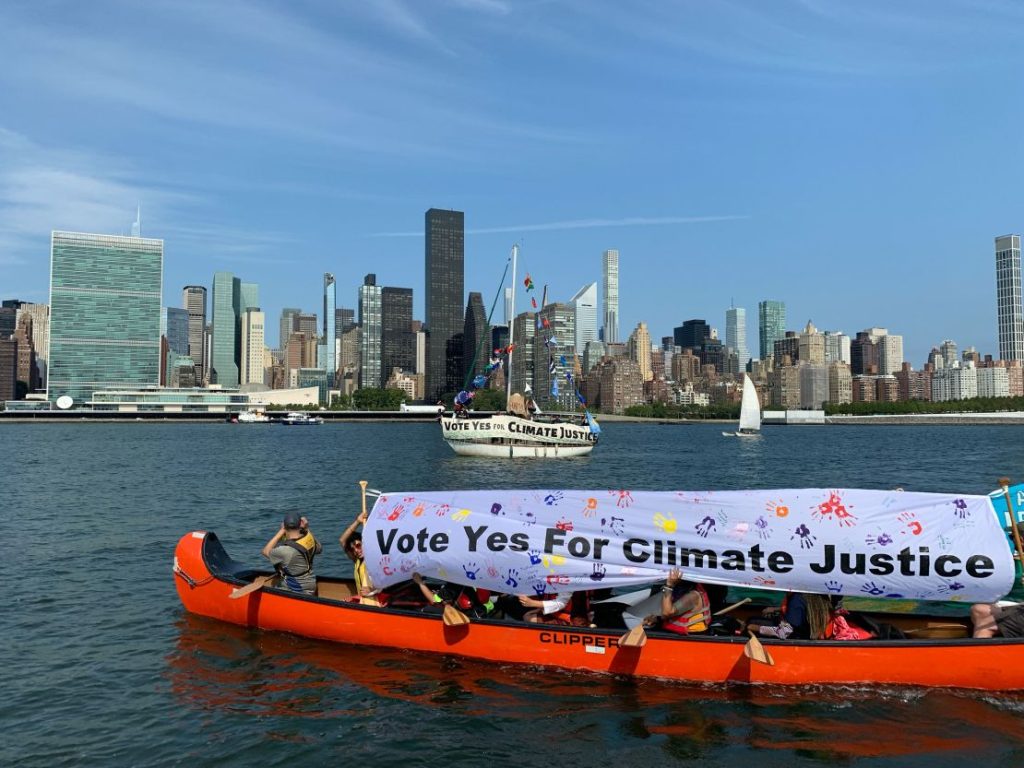
A Historic UN Vote Could Redefine GlobalClimate Accountability
On 20 May 2026, the United Nations General Assembly votes on a resolution that could transform climate obligations from diplomatic aspiration into enforceable legal accountability — with profound implications for Africa.
When the World’s Highest Court Speaks
For decades, the global climate debate has been trapped in the fog of voluntarism. Countries made pledges. Companies issued targets. Summits produced communiqués. But accountability — real, enforceable, legally grounded accountability — remained elusive.
On 23 July 2025, the International Court of Justice (ICJ) delivered something the world had never seen before: a unanimous advisory opinion confirming that states are legally obligated under international law to address the climate crisis. The ruling did not merely affirm political commitment. It established legal duty — one grounded in climate treaties, customary international law, and human rights instruments.
Climate action is no longer only a political commitment. It is a legal obligation. And on 20 May 2026, the United Nations General Assembly votes on a resolution that could turn that opinion into a practical roadmap for accountability.
“For Vanuatu, climate change is national security.” — Ralph Regenvanu, Vanuatu’s Minister of Climate Change
From a Student Campaign to a Global Moment
The backstory matters. In 2019, a group of law students in Vanuatu — a Pacific island nation that contributes a fraction of global emissions yet faces potential submersion from rising seas — began exploring whether international law could be used to compel climate action.
Their campaign evolved into a diplomatic crusade. Vanuatu lobbied the United Nations for 18 months. In 2023, a resolution co-sponsored by 132 countries passed by consensus at the UN General Assembly, formally requesting the ICJ’s advisory opinion. The court proceedings that followed became the most participatory in ICJ history: representatives of nearly 100 countries gave oral statements.
The unanimous opinion delivered in July 2025 clarified, for the first time in legal history, what international law demands of states in responding to the climate crisis. It confirmed that obligations are not limited to participation in the Paris Agreement — they extend to all countries under customary international law, regardless of whether they remain signatories to any particular treaty.
Now, Vanuatu is leading the next step: a UN General Assembly resolution that seeks to operationalise the ICJ’s findings — turning legal clarity into a concrete framework for compliance, finance, and accountability.
What the Resolution Contains — and What Was Removed
The final resolution text, released on 1 May 2026, endorses the ICJ advisory opinion and calls on states to fulfil their legal obligations. It reinforces four core principles: legal accountability for climate inaction, the need for just and equitable fossil fuel phase-out, the centrality of climate finance as a legal obligation rather than voluntary generosity, and the indivisibility of human rights and environmental protection.
But the resolution arrived after significant compromise. An earlier draft called explicitly for a phase-out of fossil fuels — a formulation familiar from COP28 negotiations in Dubai. Powerful states, particularly the United States, pushed back aggressively. The final text retreated to the softer language of “transitioning away” from fossil fuels.
More significantly, an initial provision for an International Register of Damage — a transparent, global record of climate-related loss and damage to strengthen accountability — was dropped entirely from the final version. This was, by any honest assessment, a concession extracted by high-income, high-emission states seeking to limit their financial exposure.
“The resolution attempts to turn the ICJ’s interpretation of key legal standards into a practical roadmap for state accountability — which is likely to trigger political pushback from higher-income, high-emitting countries wary of their historical responsibility and financial liability.” — Candy Ofime, Climate Justice Researcher, Amnesty International
Amnesty International’s Climate Justice Researcher Candy Ofime captured the tension plainly: the resolution is both a milestone and a site of resistance. Higher-income states who have benefited from fossil fuels for generations face growing pressure to accept financial obligations proportional to the damage caused. Some have pushed back precisely because they fear what accountability actually costs.
Africa: Most Exposed, Least Responsible — and Now Legally Armed
Africa contributed less than four percent of global greenhouse gas emissions. Yet it is already suffering some of the most severe climate consequences — recurrent droughts, rising temperatures, intensifying floods, threats to food security, water systems, and public health. Climate change is not a future risk for Africa. It is a daily reality.
More than 45 African states and the African Union made written and oral submissions to the ICJ advisory proceedings. Their submissions emphasised Africa’s disproportionate vulnerability and the legal case for holding high-emission states accountable for historical emissions. In November 2025, the African Union validated a Post-Advisory Opinion Action Plan outlining how African states should translate the ICJ’s findings into domestic legislation, continental policy frameworks, and global negotiations.
The ICJ’s legal framework — confirming that developed countries bear heightened obligations to act, and that climate finance, technology transfer, and adaptation support must be treated as legal obligations rather than voluntary commitments — strengthens Africa’s negotiating hand in ways no political declaration previously had.
As CIFOR-ICRAF researchers have noted, the opinion reframes climate change as more than an environmental crisis: it is a legal, economic, development, and human rights issue. For Africa, this creates a legal platform to demand accountability, access climate resources, and push for equitable arrangements on loss and damage.
There are, however, important nuances to acknowledge. Africa’s emissions profile is far from uniform. South Africa, Egypt, and Algeria together account for over 60% of the continent’s carbon footprint. Nigeria’s continued dependence on oil revenues, the Democratic Republic of Congo’s vast forest assets, Ethiopia’s near-negligible emissions — these divergent realities mean that the ICJ’s framework will apply differently across the continent. The forthcoming advisory opinion from the African Court on Human and Peoples’ Rights, requested by African civil society organisations, could clarify these differentiated obligations with Africa-specific precision the ICJ opinion lacked.
What Accountability Actually Requires
Advisory opinions are not legally binding in the narrow technical sense. But they carry authoritative weight. They shape domestic court decisions. They inform diplomatic fora and international negotiations. They shift the frame of what is legally defensible.
The ICJ found that failure by a state to take appropriate action to protect the climate system — including through fossil fuel production, consumption, the granting of exploration licences, or the provision of subsidies — may constitute an internationally wrongful act. That is not the language of aspiration. That is the language of liability.
The resolution before the General Assembly seeks to extend that weight: to ensure the ICJ’s opinion informs state compliance strategies, climate negotiation positions, and — through a UN Secretary-General report — pathways for advancing international obligations. Even where specific provisions were removed under political pressure, the resolution calls on the Secretary-General to report on “ways to advance compliance with all obligations” from the ICJ ruling. Climate advocates see this as an opening to revive the damage registry concept and other accountability mechanisms in future multilateral processes.
What is at stake is not simply a UN resolution. It is the question of whether the international community is prepared to close the gap between rhetoric and responsibility — between the commitments states make and the consequences they accept.
What African Governments and Corporates Must Do Now
For African governments, the resolution is an instrument, not an endpoint. The African Union’s Post-Advisory Opinion Action Plan outlines the immediate, medium-term, and long-term priorities: integrating climate obligations into AU and regional economic community frameworks; strengthening national legislation and judicial capacity; and building coalitions to ensure the ICJ opinion shapes global climate finance and negotiation outcomes.
For African businesses — especially those in extractive industries, financial services, and sectors with significant environmental footprints — the legal terrain is shifting. The ICJ opinion demands that states regulate and hold the private sector accountable through compliance mechanisms, emissions accounting, and risk mitigation. Companies operating in Africa’s fossil fuel sector, and those financing them, cannot treat the advisory opinion as abstract international law. It has direct implications for project licences, ESG risk assessments, and the growing landscape of climate litigation.
At CSR REPORTERS, we have long argued that accountability is not a moral virtue reserved for large companies or moments of crisis. It is a structural business imperative. The ICJ’s opinion confirms what accountability-first organisations have always known: the cost of responsibility is always lower than the cost of recklessness.
The gap between what states have promised and what communities have experienced is not a gap in ambition. It is a gap in accountability. This vote is about whether the world has the political will to close it.
The Vote Is Tomorrow. The Work Begins After.
On 20 May 2026, the world will watch whether UN member states affirm a legal framework for climate accountability — or protect the political cover that has allowed high-emission states to delay consequences while low-emission countries absorb the damage.
A strong majority vote will not resolve the climate crisis. But it will signal something important: that the international community is prepared to treat climate change not as a negotiating inconvenience but as an enforceable obligation.
For Africa, the stakes are existential. The continent did not cause this crisis. It must not be left to absorb it without legal recourse, climate finance, or the accountability architecture its people are owed.
The ICJ has spoken. The General Assembly votes. Now the harder work begins: translating legal clarity into institutional change, policy coherence, and corporate accountability across every corner of this continent and beyond.
[give_form id="20698"]