


 csrreporters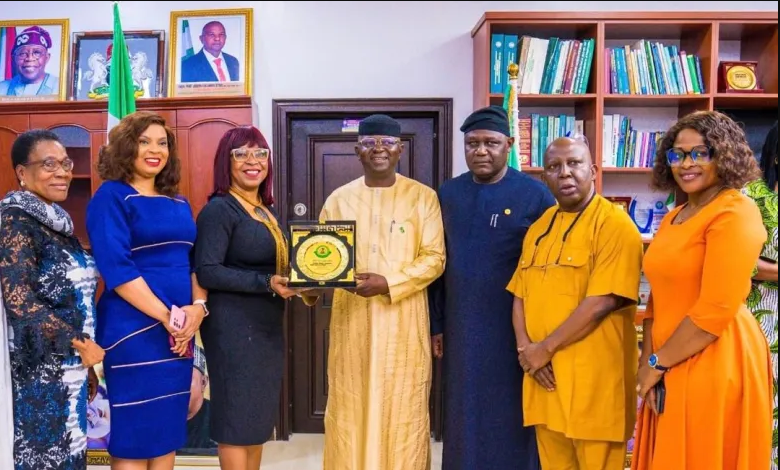
Another smart water partnership that goes beyond CSR rhetoric
If there was ever a time to stop romanticizing CSR and begin treating it as a life-saving necessity, it is now. And Nestlé Nigeria, in collaboration with the Federal Ministry of Water Resources and Sanitation (FMWRS), appears to be making that effort.
Nigeria is a country where cholera outbreaks routinely make the news; floods wash away homes as well as dignity and communities still celebrate the arrival of a borehole like it’s Independence Day. This then translates this partnership is more than just another entry into a CSR newsletter. It is an intervention whose potential runs deep.
The strategic alliance was formalized in Abuja during a courtesy visit by senior executives of Nestlé Nigeria, alongside the Organized Private Sector in Water, Sanitation and Hygiene (OPS-WASH), to the office of the Honourable Minister, Engr. Prof. Joseph Terlumun Utsev. And from the moment the minister took the floor, one thing was clear: this was not your usual photo-op CSR handshake. This was about purpose, people, and public health.
Professor Utsev didn’t speak in vague bureaucratic language. His words were sharp and grounded in reality. Water management, he said, isn’t just about access, but about quality. The kind of quality that saves lives. The kind that prevents diarrhea, cholera, and other waterborne diseases from stealing children’s futures. And critically, the kind that also shields vulnerable communities from the deeper consequences of flooding. These aren’t abstract problems. These are the very issues that wake people in Nigeria’s rural belt long before the sun does.
At the heart of this new collaboration is Nestlé Nigeria’s National Water Quality Advocacy Campaign, a project that aims to do what many CSR gestures fail to even imagine change the mindset of the people, not just the optics of the corporation. Victoria Uwadoka, who leads Corporate Communications and Sustainability at Nestlé Nigeria, drove this point home. She cautioned that “not all clear water is clean.” That single statement alone cuts to the core of the problem. In many communities across Nigeria, the assumption that water clarity equals safety has cost lives. Uwadoka and her team are set on closing that dangerous knowledge gap.
The campaign is being built around three pillars: Awareness and education, stakeholder engagement, and sustainable action. And each of those words matters. Awareness on its own can be fleeting. It becomes transformational when fused with local ownership and consistent follow-through. That’s where stakeholder engagement steps in, bringing along local leaders, government officials, community influencers, and yes, the people drawing water from the wells themselves. Sustainable action, then, becomes the proof of promise.
But what elevates this initiative above the usual CSR fare is its tangible community reach. This isn’t just a campaign stuck in boardroom strategy decks or buried under the jargon of ESG. OPS-WASH National Coordinator, Dr. Nicholas Igwe, was quick to point out where the boots-on-the-ground impact would be felt. In Abaji, within the Federal Capital Territory, 16 communities are on the roadmap. In Agbara, Ogun State, another 8 will receive attention. And crucially, two farming communities will get water harvesting systems, an overlooked but powerful intervention that speaks directly to the nexus of agriculture, climate resilience, and water security.
It’s a small but significant move that suggests this campaign isn’t merely focused on urban filters and PR. It understands that rural Nigeria lives or dies by water availability, not only for drinking but for growing food. In those farming communities, a rainwater harvesting system could mean the difference between harvest and hunger. And it’s telling that such solutions are being delivered not just by aid agencies, but through a partnership between corporate Nigeria and government.
The Ministry’s Permanent Secretary, Mr. Richard Pheelangwah, rightly applauded Nestlé’s work, noting that the company wasn’t just handing out water but investing in advocacy. This subtle shift from donation to disruption is where real sustainability begins. Because a community that understands water safety becomes a first responder in its own right. It doesn’t wait for cholera to hit. It checks the source. It treats. It teaches. It takes responsibility.
The partnership also echoes the broader goals of President Bola Tinubu’s Renewed Hope Agenda. And whether or not Nigerians feel that agenda in their daily lives, a project like this gives it texture. It is one thing to proclaim hope from the corridors of Aso Rock; it is another for that hope to arrive in the form of clean water in a jerry can. That is where federal policy meets community dignity.
Yet the most promising part of this initiative may not even be what it does but what it sets the tone for. It sends a clear message that CSR is no longer about random acts of corporate kindness. It is about co-creation, foresight, and survival. Nestlé has done well to recognize that the social license to operate in Nigeria’s volatile development environment now comes with real expectations: show up, stay consistent, and scale.
And the ministry, for its part, has done well to throw open its doors not just to donors, but to true partners. Because water is not a luxury. It is infrastructure. It is a right. And most importantly, it is a shared responsibility.
If this partnership delivers even half of what it promises, then perhaps one day, a child in Abaji will grow up never knowing what a waterborne disease feels like. Not because of luck, but because public and private hands decided that clarity isn’t enough, cleanliness is the standard. That is the CSR Nigeria now needs.
[give_form id="20698"]