csrreporters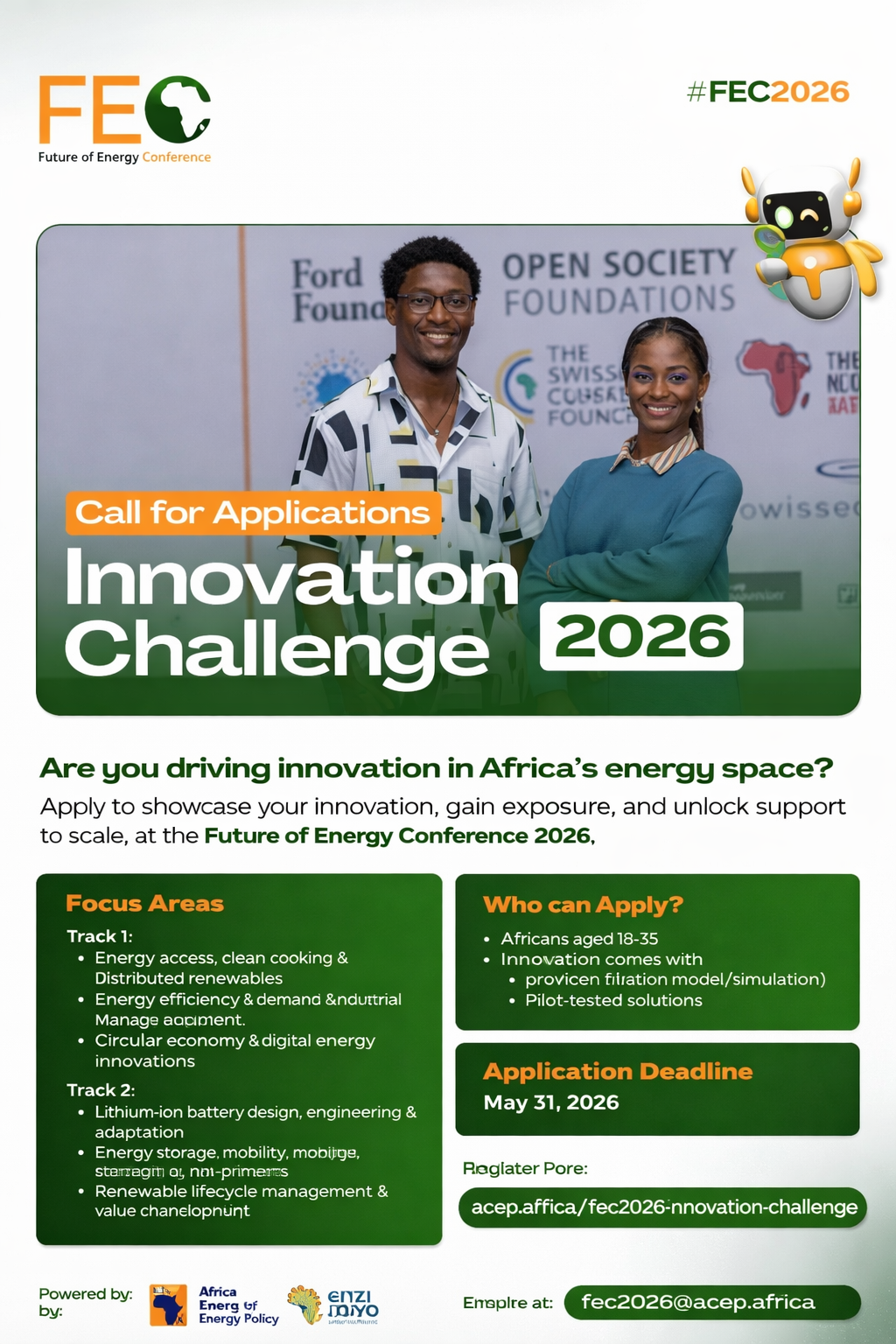
Applications are now open for the Future Energy Leaders Innovation Challenge 2026, a continental initiative designed to identify, support, and scale young African innovators building solutions to address the region’s growing energy and climate challenges.
The programme targets early-stage and growth-stage energy innovations across renewable energy, clean cooking systems, battery technology, and climate-smart infrastructure. Selected participants will receive up to $5,000 in equity-free grants, alongside structured mentorship, incubation support, and access to high-level investor and policymaker networks.
The final stage of the programme will culminate in a live pitch event at the Future of Energy Conference (FEC 2026) in Accra, Ghana, where shortlisted innovators will present their solutions to global stakeholders in the energy sector.
Why It Matters
Africa stands at a striking paradox. The continent holds some of the world’s richest renewable energy resources and a rapidly expanding youth demographic advantage, yet it continues to grapple with persistent energy poverty and heavy dependence on imported clean technologies.
Despite growing global investment in green innovation, Africa accounts for less than 0.05% of global patents in critical energy storage and battery technologies. This reflects a deeper structural imbalance in the global innovation ecosystem, where technology is largely developed outside the contexts in which it is deployed.
As a result, many energy solutions introduced across African markets are not designed for local realities. Weak grid infrastructure, widespread off-grid communities, affordability constraints, and rural energy demands often limit the effectiveness of imported systems.
The Future Energy Leaders Innovation Challenge is designed to respond to this gap by shifting Africa from a consumption-based energy market to a production-driven innovation hub. The focus is not only on funding ideas, but on enabling African innovators to develop intellectual property rooted in local context and real-world constraints.
Beyond energy access, the implications are structural. Strengthening local innovation ecosystems can deepen industrial capacity, accelerate manufacturing value chains, and support long-term economic transformation. In this sense, energy innovation becomes both a climate solution and an economic development strategy.
Core Focus Areas
The challenge welcomes scalable and practical innovations, ranging from conceptual models to pilot-tested prototypes, across the following domains:
- Renewable Energy and Clean Technology Systems
- Sustainable Energy Access and Clean Cooking Solutions
- Climate-Smart Energy Innovation and Grid Efficiency
- Battery Technology Development and Value Chain Innovation, including lithium-ion systems
- Circular Economy Integration within Energy Infrastructure
- Community-Based Energy Poverty Reduction and Climate Resilience Solutions
Applicants must meet the following requirements:
Eligibility Criteria
- Age: Open to African innovators aged 15–35 (18–35 for primary grant eligibility)
- Geography: Applicants must be citizens or residents of African countries, including those in the diaspora
- Team Structure: Individuals or teams of up to five members may apply
- Only the primary applicant will be sponsored to attend the final pitch event in Accra if selected
- Project Stage: Open to all stages, including conceptual designs, digital simulations, early prototypes, and pilot-tested solutions
Prize Details & Programme Benefits
Selected finalists will progress through a structured innovation and acceleration journey culminating in a live presentation at the Future of Energy Conference (FEC 2026) in Accra, Ghana.
Benefits include:
- Up to $5,000 Equity-Free Grants to support development, testing, or scaling of innovations
- Global Pitch Opportunity before more than 1,000 policymakers, investors, development partners, and energy industry leaders
- Mentorship and Incubation Support through technical experts and the ACEP Climate Innovation Hub
- Intellectual Property Ownership Retention, allowing innovators to maintain full rights to their solutions
- Access to Strategic Networks across Africa’s energy policy, research, and investment ecosystems
How to Apply
Applicants are required to submit a clear and structured project summary of no more than 500 words, outlining:
- The energy challenge being addressed
- The technical feasibility of the proposed solution
- The expected environmental and social impact
Submit applications HERE
Supporting Materials
Applicants must also provide:
- A visual representation of the innovation (prototype image, diagram, digital mock-up, or concept map in PDF or JPEG format)
- Optional: A short 2-minute pitch video link