


 csrreporters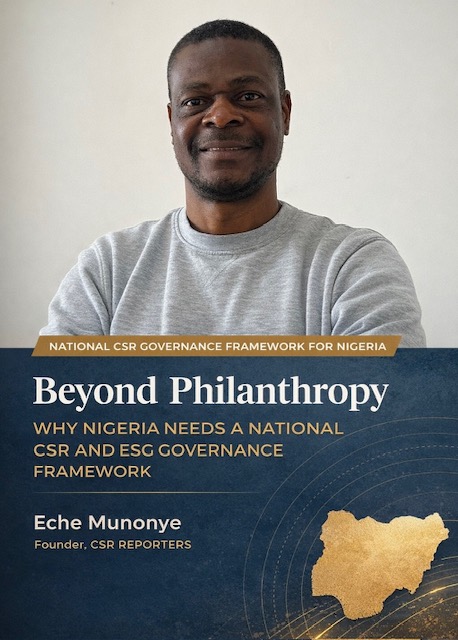
Beyond Philanthropy: Why Nigeria Needs a National CSR and ESG Governance Framework Now
For decades, corporate social responsibility in Nigeria has been defined by generosity. Cheque presentations. Boreholes. School renovations. Medical outreaches.
Philanthropy has played a role — and in many communities, an important one. But Nigeria’s development challenges have grown more complex, systemic, and urgent. Climate risk, governance failures, inequality, biodiversity loss, energy transition pressures, and investor scrutiny demand more than goodwill. They demand structure.
Nigeria no longer needs scattered CSR. It needs a coherent national CSR and ESG governance framework.
The Limits of Philanthropy
Philanthropy is reactive. ESG is structural.
Traditional CSR in Nigeria often operates outside core business strategy. It sits in corporate affairs departments, disconnected from capital allocation, risk management, supply chains, or board oversight. Projects are episodic and personality-driven. When leadership changes, priorities shift.
This approach creates three persistent gaps:
- Impact Fragmentation – Projects are not aligned with national development plans.
- Measurement Deficit – Few standardized metrics exist to evaluate long-term outcomes.
- Accountability Weakness – Reporting is inconsistent and rarely independently verified.
The result is visibility without systemic change.
Meanwhile, global capital has moved on.
The Global Shift to ESG Governance
International markets increasingly demand structured ESG disclosure and governance alignment. The European Union’s Corporate Sustainability Reporting Directive (CSRD), climate disclosure rules across G20 economies, and investor-led initiatives like the Task Force on Climate-related Financial Disclosures have elevated ESG from optional branding to regulatory expectation.
Nigerian companies operating globally — or seeking foreign investment — already feel this pressure.
Institutions such as the Nigerian Exchange Group have introduced sustainability disclosure guidelines. The Securities and Exchange Commission Nigeria has issued corporate governance codes. The Central Bank of Nigeria has embedded sustainability principles within parts of the financial system.
Yet these efforts remain fragmented. There is no unified national ESG governance architecture that harmonizes reporting standards, enforcement, incentives, and development alignment.
Why Nigeria Needs a National Framework Now
1. To Align Corporate Capital With National Priorities
Nigeria faces enormous development financing gaps — from renewable energy expansion to climate resilience and inclusive industrialisation. A national CSR and ESG governance framework would:
- Direct private capital toward priority sectors
- Link corporate sustainability investments with national development plans
- Create structured incentives for long-term impact
Without alignment, CSR projects continue to operate parallel to national transformation agendas.
2. To Protect Communities and Reduce Conflict
In extractive, manufacturing, and infrastructure-heavy sectors, weak ESG oversight has contributed to environmental degradation, community tensions, and reputational crises.
A standardized governance framework would:
- Clarify environmental and social accountability expectations
- Strengthen community engagement requirements
- Mandate impact documentation and grievance mechanisms
This is not merely ethical; it is risk management.
3. To Improve Investor Confidence
Global investors are increasingly applying ESG screens before deploying capital. Inconsistent sustainability reporting creates uncertainty premiums.
A national ESG governance framework would:
- Standardize disclosure requirements
- Improve comparability across sectors
- Reduce information asymmetry
- Strengthen Nigeria’s attractiveness to long-term institutional investors
Credibility lowers capital costs.
4. To Move Boards From CSR Oversight to ESG Governance
True ESG transformation occurs at board level. A national framework would require:
- Board-level ESG responsibility
- Integrated risk reporting
- Executive performance metrics linked to sustainability outcomes
- Independent assurance of disclosures
This shifts sustainability from marketing to fiduciary responsibility.
The Cost of Delay
Delaying a national CSR and ESG governance framework carries consequences:
- Continued greenwashing risks
- Missed climate finance opportunities
- Weak integration into global supply chains
- Regulatory shocks when international partners impose compliance requirements
As climate-related risks intensify and global trade standards tighten, Nigerian firms without structured ESG systems will face exclusion.
What a Nigerian Framework Should Include
A credible national CSR and ESG governance framework must go beyond guidelines. It should include:
1. Unified Reporting Standards
Harmonized ESG disclosure metrics aligned with global best practice but adapted to Nigerian realities.
2. Sector-Specific Requirements
Oil and gas, banking, agriculture, manufacturing, and telecom sectors face distinct risks. One-size-fits-all rules will not work.
3. Independent Oversight
Clear institutional authority for monitoring compliance, reviewing disclosures, and enforcing penalties for misrepresentation.
4. Incentives for Compliance
Tax benefits, public procurement advantages, and preferential access to development finance for high-performing ESG actors.
5. Public Transparency Portal
A central ESG disclosure database enabling citizens, investors, and researchers to evaluate corporate impact.
Beyond Compliance: A Competitiveness Strategy
This conversation is not about regulation for its own sake. It is about competitiveness.
Countries that integrate ESG governance into national economic planning position themselves for:
- Climate transition funding
- Green industrialization
- Sustainable supply chain integration
- Innovation in renewable energy and circular economy sectors
Nigeria’s demographic scale, entrepreneurial capacity, and regional influence make it uniquely positioned to lead ESG governance reform in Africa. But leadership requires intentional architecture.
A Moment of Strategic Choice
Nigeria stands at an inflection point.
The global economy is reorganizing around sustainability metrics. Capital is being repriced around climate risk. Trade relationships increasingly incorporate ESG conditions. Youth populations are demanding accountability. Communities are insisting on transparency.
Philanthropy cannot absorb these pressures.
Only a national CSR and ESG governance framework — coherent, enforceable, and development-aligned — can convert corporate goodwill into measurable national impact.
The choice is clear:
Continue with fragmented CSR that delivers short-term visibility,
or build a governance framework that secures long-term credibility, investment confidence, and sustainable growth.
For Nigeria, the time to move beyond philanthropy is now.
[give_form id="20698"]