csrreporters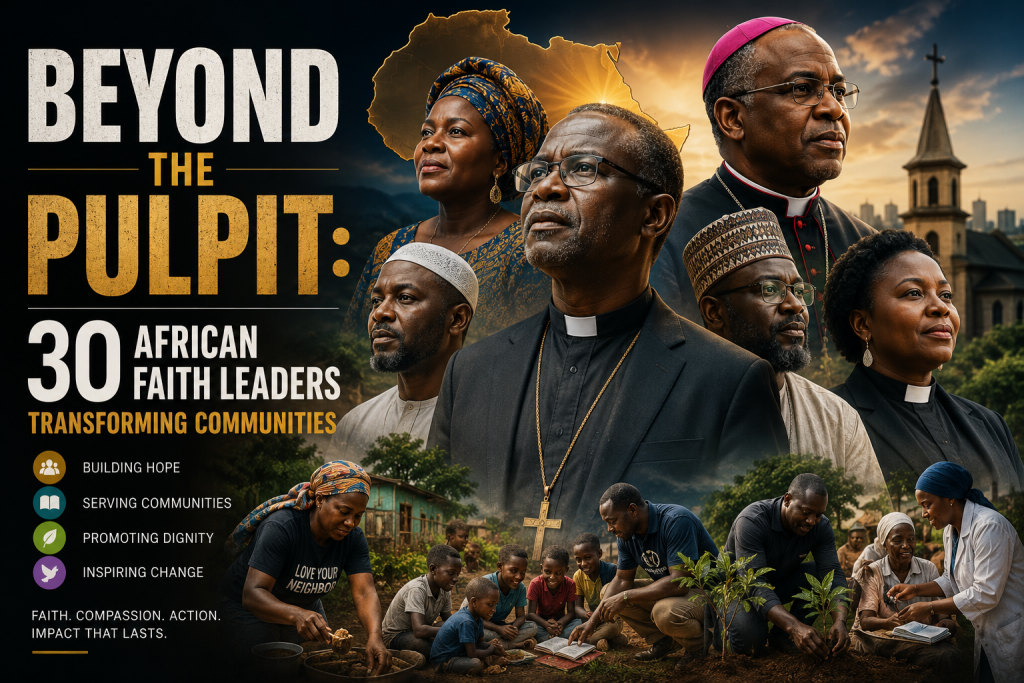
BEYOND THE PULPIT: 30 African Faith Leaders Transforming Communities
A CSR Reporters Special Feature
Africa is the world’s most religious continent. Whether measured by attendance, belief, or the degree to which faith permeates daily life, public discourse, and communal identity, no region on earth has a deeper or more pervasive relationship with the spiritual. Christianity and Islam — the two faiths that claim the majority of Africa’s 1.4 billion people — are not merely private convictions here; they are public architectures that shape how communities organise, how children are educated, how the sick are cared for, and how the dead are mourned.
But Africa’s faith landscape has always been more complex than its headlines suggest. Alongside the megachurches and the grand mosques, there are Sufi brotherhoods that built cities, imams and pastors who once tried to kill each other and built peace instead, archbishops who told truth to apartheid’s power, and bishops whose Christmas homilies make presidents sweat. These are the faith leaders who understood that spiritual authority carries an obligation — not only to tend the soul, but to serve the community in which the soul lives.
This CSR Reporters special feature — Beyond the Pulpit — celebrates 30 African faith leaders whose social impact reaches far beyond their congregations. From Pastor Adeboye’s vast RCCG social infrastructure to Bishop Kukah’s prophetic governance advocacy; from the extraordinary peacebuilding partnership of Imam Ashafa and Pastor Wuye to Archbishop Tutu’s truth and reconciliation legacy; from Sheikh Al-Tayyeb’s historic human fraternity declaration with Pope Francis to the Mouridiyya Brotherhood’s city built from faith — these are the leaders who prove that the most transformative sermon is not delivered from a pulpit. It is lived in a community.
1. Pastor Enoch Adeboye | Nigeria | Christian
Enoch Adeboye — Daddy G.O. to millions — is one of the most consequential Christian leaders in Africa’s history. Under his leadership, the Redeemed Christian Church of God has grown from a small Lagos congregation to a global movement with churches in over 190 countries, making it one of the most expansive church networks on earth. But it is what RCCG has built on the ground that distinguishes Adeboye’s social impact. RCCG’s Christian Social Responsibility arm operates free hospitals and clinics, hundreds of schools, scholarship programmes, vocational training centres, and food banks across Nigeria and beyond. Redeemer’s University, established under his leadership, has become one of Nigeria’s most respected private institutions. Boreholes providing clean water have been sunk in underserved communities across the country. Feeding programmes operate in areas of acute food insecurity. Adeboye’s annual Holy Ghost Congress draws millions — but his most durable legacy is not in the crowd, but in the clinic, the classroom, and the community that RCCG has quietly, persistently served for over four decades.
| Initiative | RCCG Christian Social Responsibility — Free Hospitals, Schools, Scholarships, Feeding Programmes, Boreholes, Vocational Training |
| Beneficiaries | Millions across Nigeria and 190+ countries; free hospital patients; scholarship recipients; vocational training graduates; communities receiving clean water |
| Investment | RCCG’s CSR arm operates across all 36 Nigerian states and internationally; free medical clinics, Redeemer’s University, hundreds of primary and secondary schools, food banks, skill acquisition centres |
2. Bishop David Oyedepo | Nigeria | Christian
Bishop David Oyedepo founded Winners’ Chapel in 1981 during an 18-hour vision in which he received what he describes as a divine mandate to liberate the world through faith. Four decades later, he leads one of Africa’s most structurally impactful ministries — one that has built two universities, 156 schools across all 36 Nigerian states, hospitals, maternity homes, and a vast social development infrastructure that serves millions. Covenant University — his flagship educational institution — is consistently ranked among Nigeria’s best private universities, producing thousands of graduates annually, 80% of whom find employment within six months. Landmark University, established in 2011, focuses on agricultural education as a pathway to food security, a deeply strategic investment in a continent that feeds itself inadequately. The David Oyedepo Foundation provides scholarships and supports tens of thousands of students who would otherwise have no access to quality education. In 2024 alone, he committed a $10 million education grant benefiting 5,000 students. Forbes named him Nigeria’s richest pastor — but it is what he has built with that wealth, not the wealth itself, that defines his legacy.
| Initiative | Covenant University / Landmark University / Social Development Missions — Hospitals, Maternity Homes, Schools, Scholarships |
| Beneficiaries | 15,000+ students annually at Covenant and Landmark Universities; 10,000+ children supported by David Oyedepo Foundation; communities served by hospital and school networks across Nigeria |
| Investment | $10M education grant in 2024 supporting 5,000 students; $5M to Nigerian orphanages; 156 Kingdom Heritage Model Schools across all 36 states; Crown University under construction in Calabar |
3. Pastor Chris Oyakhilome | Nigeria | Christian
Pastor Chris Oyakhilome is one of Africa’s most globally connected Christian leaders — his Christ Embassy ministry operates in over 100 countries, and his daily devotional Rhapsody of Realities has been translated into more than 3,000 languages, making it one of the most widely distributed Christian publications in history. But behind the media empire is a deeply personal commitment to Africa’s most vulnerable children. The InnerCity Mission for Children, which he founded in 2005, provides free primary schooling, daily meals, and 100% academic scholarships to over 2,000 indigent children in Nigeria, South Sudan, and Cambodia — children who were living as destitute with no access to education or nutrition before the mission reached them. The Chris Oyakhilome Foundation International extends this work into disaster relief and healthcare across Africa and beyond. His Future Africa Leaders’ Award — an annual celebration of outstanding young Africans — reflects his conviction that Africa’s transformation begins with investing in its youth. Oyakhilome’s most enduring social contribution may be the most personal: the belief, embodied in every InnerCity Mission child who goes to school, that every child is worth educating.
| Initiative | InnerCity Mission for Children / Chris Oyakhilome Foundation International (COFI) / Rhapsody of Realities |
| Beneficiaries | 2,000+ indigent children in Nigeria, South Sudan, and Cambodia receiving free schooling, meals, and 100% academic scholarships; communities across Africa receiving disaster relief and healthcare support |
| Investment | InnerCity Mission operational since 2005; COFI established 2020; Rhapsody of Realities translated into 3,000+ languages; Future Africa Leaders’ Award recognising youth annually |
4. Imam Muhammad Ashafa & Pastor James Wuye | Nigeria | Muslim & Christian
The story of Imam Muhammad Ashafa and Pastor James Wuye is one of the most extraordinary narratives of redemption and courage in contemporary Africa. They were once mortal enemies — leaders of opposing armed religious militias in northern Nigeria’s interreligious conflicts of the early 1990s. Wuye’s group killed Ashafa’s spiritual teacher and two cousins. Ashafa’s fighters cut off Wuye’s right hand. Each man harboured a sincere desire to kill the other. Then, in 1995, a chance meeting arranged to resolve a public health misunderstanding planted the seed of an improbable reconciliation. What emerged from that meeting was the Interfaith Mediation Centre — a grassroots peace-building organisation that has gone on to train tens of thousands of people across Nigeria and beyond in conflict resolution without violence. They brokered the Kaduna Peace Declaration in 2002 and the Yelwa Shendam Peace Affirmation, bringing an end to communal violence that had claimed thousands of lives. Their documentary The Imam and the Pastor premiered at the United Nations and has been translated into 14 languages. In 2025, they were awarded the inaugural Commonwealth Peace Prize. Their story is not merely inspirational — it is proof that the most irreconcilable divisions can be transformed into the deepest partnerships, when two people choose courage over hatred.
| Initiative | Interfaith Mediation Centre — Peace-Building, Conflict Resolution and Interfaith Reconciliation Across Nigeria and Africa |
| Beneficiaries | Tens of thousands trained in conflict resolution; communities across Kaduna, Plateau, Taraba, Benue, and Borno; influence extended to Kenya, Iraq, Sri Lanka, and globally |
| Investment | Founded 1995; 10,000+ members trained; brokered Kaduna Peace Declaration (2002) and Yelwa Shendam Peace Affirmation; documentary The Imam and the Pastor premiered at the UN; winners of inaugural Commonwealth Peace Prize 2025 |
5. Archbishop Desmond Tutu | South Africa | Christian (Anglican)
Archbishop Desmond Tutu — who passed from this world in December 2021 but whose legacy grows rather than fades — is without question one of the greatest faith leaders Africa has ever produced. As Anglican Archbishop of Cape Town, his fearless opposition to apartheid gave the anti-apartheid movement a moral voice that the South African government could not silence and the international community could not ignore. His Nobel Peace Prize in 1984 was recognition not just of his personal courage but of the power of faith as a force for political transformation. As the Chair of South Africa’s Truth and Reconciliation Commission from 1996 to 1998, he presided over one of the most extraordinary experiments in national healing in history — a process that chose restorative justice over retribution and gave a traumatised nation the opportunity to confront its past without being destroyed by it. A champion of LGBTQ+ rights, HIV/AIDS patients, and the poor, Tutu consistently challenged his own church and his own government when he believed they were on the wrong side of human dignity. He called God a ‘God of surprises,’ and his own life was precisely that — a continuous demonstration that faith, when it is serious, always takes the side of the oppressed.
| Initiative | Truth and Reconciliation Commission / Desmond & Leah Tutu Legacy Foundation / Lifelong Human Rights Advocacy |
| Beneficiaries | South African nation through post-apartheid reconciliation; LGBTQ+ community; HIV/AIDS patients; global human rights beneficiaries |
| Investment | Chaired South Africa’s Truth and Reconciliation Commission (1996–1998); Nobel Peace Prize (1984); Desmond & Leah Tutu Legacy Foundation continues his work posthumously; decades of advocacy for the marginalised |
6. Sheikh Ahmad Abubakar Gumi | Nigeria | Muslim
Sheikh Ahmad Abubakar Gumi occupies a uniquely controversial and yet uniquely courageous position in Nigeria’s public life. At a time when northern Nigeria’s banditry crisis has displaced millions and claimed thousands of lives, Gumi has repeatedly walked into bandit camps to negotiate — risking his own life in the conviction that dialogue, not only military force, is a necessary pathway to peace. His methodology is disputed; his courage is not. A prominent Islamic scholar and son of the late Sheikh Abubakar Gumi, one of Nigeria’s most revered Muslim leaders, he has used his religious authority to argue that many of Nigeria’s armed groups are driven as much by economic desperation and state neglect as by ideology — and that sustainable peace requires addressing those root causes. His interventions have facilitated the release of hostages and opened dialogue channels that security forces could not. Whether one agrees with his approach or not, his willingness to go where others will not in service of peace places him among Nigeria’s most active faith-based community leaders.
| Initiative | Mediation with Armed Bandits / Counter-Extremism Advocacy in Northern Nigeria |
| Beneficiaries | Communities in northwestern Nigeria affected by banditry and kidnapping; hostages released through mediation; families given alternatives to violent conflict |
| Investment | Personal peacebuilding missions into bandit camps; ongoing advocacy for dialogue-based solutions to northern Nigeria’s security crisis |
7. Pastor Paul Adefarasin | Nigeria | Christian
Pastor Paul Adefarasin leads one of Lagos’s most dynamic and socially engaged churches, and his social impact is expressed both in structured programmes and in cultural moments. The Experience — his annual Christmas concert held on Lagos’ Tafawa Balewa Square — is one of Africa’s largest Christian gatherings, drawing over half a million people annually and creating a moment of communal celebration that transcends denominational boundaries. The Daystar Skill Acquisition Programme (DSAP) is a more structural intervention: providing vocational training to youth and unemployed adults to equip them with skills that translate directly into economic opportunity. Adefarasin’s ministry reflects a theology of practical engagement — the conviction that the church’s responsibility to its city is not discharged through Sunday services alone but through investment in the economic and social conditions in which its members live.
| Initiative | Daystar Skill Acquisition Programme (DSAP) / The Experience Concert / Community Development Initiatives |
| Beneficiaries | Youth and unemployed adults trained in vocational skills; millions attending The Experience concert annually (one of Africa’s largest Christian gatherings) |
| Investment | DSAP operational across multiple years; The Experience concert draws 500,000+ annually to Lagos; community development programmes ongoing |
8. Bishop Margaret Wanjiru | Kenya | Christian
Bishop Margaret Wanjiru is a rare figure in African public life: a faith leader who took her mandate of service directly into the halls of legislative power. Born in poverty and a survivor of personal hardship that would have broken most, she founded Jesus Is Alive Ministries and built it into one of Kenya’s most vibrant Pentecostal churches. When she ran for and won a parliamentary seat representing Nairobi’s Starehe constituency, she became one of Kenya’s most prominent examples of faith leadership translating into direct political representation. Her advocacy in parliament focused on the urban poor — the same communities she had served through her ministry — bringing a pastoral sensibility and lived experience to legislative debates that many of her colleagues could not. Her life story itself is a form of social impact: a testimony that women from the poorest backgrounds can lead, legislate, and leave lasting change.
| Initiative | Community Development and Poverty Alleviation / Political Advocacy for Nairobi’s Urban Poor |
| Beneficiaries | Urban poor communities in Nairobi; Starehe constituents served through parliamentary work; women and children in Kenya’s underserved urban areas |
| Investment | Ministry-based community outreach; parliamentary service translating faith into public policy advocacy |
9. Sheikh Dr. Ahmad Al-Tayyeb | Egypt | Muslim (Sunni)
Sheikh Ahmad Al-Tayyeb, Grand Imam of Al-Azhar — Islam’s oldest and most prestigious seat of Sunni scholarship — occupies a position of religious authority that reaches over 1.5 billion Muslims worldwide. His most historically significant act of social leadership came in February 2019, when he co-signed the Document on Human Fraternity with Pope Francis in Abu Dhabi — a joint declaration by the heads of the world’s two largest Abrahamic faiths committing to peaceful coexistence, interfaith dialogue, and the rejection of violence done in God’s name. It is one of the most significant interfaith agreements in modern history. Al-Tayyeb has also been a consistent voice against religious extremism, using Al-Azhar’s global educational network — which spans more than 80 countries — to promote a theology of moderation, scholarship, and human dignity. In a world where religion is too often a pretext for division, his partnership with the Vatican stands as a declaration that the world’s great faiths have more to build together than to destroy.
| Initiative | Al-Azhar’s Global Interfaith Dialogue / Document on Human Fraternity (co-signed with Pope Francis, 2019) / Counter-Extremism Education |
| Beneficiaries | Muslim communities globally receiving moderate religious education; victims of extremism whose perpetrators’ ideology is countered by Al-Azhar’s teachings; interfaith communities worldwide |
| Investment | Al-Azhar institution budget; Document on Human Fraternity signed in Abu Dhabi with Pope Francis (2019); ongoing partnership with the Vatican; global influence through Al-Azhar’s educational network spanning 80+ countries |
10. Pastor David Ibiyeomie | Nigeria | Christian
Pastor David Ibiyeomie leads Salvation Ministries — one of Port Harcourt’s most influential churches and one of Nigeria’s fastest-growing ministries. His social investment is systematic and community-facing: the Salvation Medical Centre provides free and subsidised medical services to patients who could not otherwise afford care, while his annual scholarship programme supports hundreds of Nigerian students at secondary and tertiary levels. His vocational training initiatives equip young people with skills that translate directly into self-sufficiency. In the Niger Delta — a region whose resource wealth has not translated into community wellbeing — Ibiyeomie’s consistent investment in health, education, and skills represents a model of faith leadership that addresses the gaps left by government and corporations alike.
| Initiative | Salvation Medical Centre / Scholarship Programme / Skill Acquisition Initiatives |
| Beneficiaries | Scholarship recipients across Nigeria; patients at the free Salvation Medical Centre; youth trained in vocational skills |
| Investment | Ongoing scholarship sponsorship for hundreds of students; Salvation Medical Centre providing free and subsidised medical services; vocational training programmes operational |
11. Pastor Johnson Suleman | Nigeria | Christian
Apostle Johnson Suleman of Omega Fire Ministries International has built a philanthropic identity around one of the most direct forms of social intervention: giving. He is known throughout Nigeria for large, unscripted acts of generosity — purchasing homes and gifting them to widows, paying tuition fees in bulk for students in need, distributing cash to individuals in crisis, and responding rapidly and personally to humanitarian emergencies. His approach is deliberately unmediated: he goes directly to the point of need rather than filtering his giving through institutional structures. Critics may debate his theology; his beneficiaries debate nothing — they are housed, educated, and fed. In Nigeria’s social landscape, where systemic failures in housing, education, and welfare leave millions without a safety net, Suleman’s direct philanthropy fills gaps that the state has left open.
| Initiative | Apostle Suleman Foundation — Cash Donations, Housing for Widows, School Fees, Humanitarian Giving |
| Beneficiaries | Widows receiving homes; students having school fees paid; individuals in financial crisis; communities receiving emergency humanitarian support |
| Investment | Known for large cash donations; personal purchase and gift of homes to widows; bulk payment of school fees; ongoing humanitarian emergency responses |
12. Sheikh Abdullah Bin Bayyah | Mauritania/Global | Muslim
Sheikh Abdullah Bin Bayyah is one of the most respected Muslim scholars in the world, and he has dedicated much of his extraordinary scholarly career to a single urgent mission: countering the theological foundations of violent extremism in Islam. As Chair of the Forum for Promoting Peace in Muslim Societies — headquartered in Abu Dhabi — he convenes global Muslim scholars to produce authoritative religious counter-narratives to extremist ideology, providing the theological grounding that governments, communities, and individuals need to resist radicalisation. A Mauritanian-born scholar whose influence extends across the entire Muslim world, Bin Bayyah understands that the battle against religious extremism is fundamentally a battle of ideas — and that the most durable weapons in that battle are not bullets but scholarship, jurisprudence, and the patient work of building a theology of peace.
| Initiative | Forum for Promoting Peace in Muslim Societies — Countering Religious Extremism and Promoting Peaceful Coexistence |
| Beneficiaries | Muslim communities globally; societies at risk of religious extremism; faith leaders and scholars trained in peaceful theology |
| Investment | Forum based in Abu Dhabi; convenes global Muslim scholars annually; issues scholarly counter-narratives to extremist ideology; advises governments on de-radicalisation |
13. Pastor W.F. Kumuyi | Nigeria | Christian
Pastor William Folorunso Kumuyi founded Deeper Life Bible Church in 1973 as a small Bible study group of 15 students at the University of Lagos. It has grown into one of Nigeria’s largest churches, with a presence in over 80 countries and millions of adherents globally. Kumuyi’s social impact is deeply rooted in Deeper Life’s rural outreach model: the church has been particularly committed to reaching the most remote and underserved communities in Nigeria, establishing congregations and community development programmes in areas that mainstream religious and social institutions have overlooked. His ministry’s emphasis on holistic development — attending to spiritual, educational, and healthcare needs simultaneously — reflects a theology of total community engagement. In Nigeria’s religious landscape, Kumuyi represents a quieter, less commercially visible form of faith leadership whose social impact is measured not in celebrity but in communities transformed over five decades of patient, consistent service.
| Initiative | Deeper Life Community Development / Rural Outreach / Education and Healthcare Programmes |
| Beneficiaries | Millions of Deeper Life members across Nigeria and 80+ countries; rural communities served by church-based development programmes |
| Investment | Deeper Life operates in over 80 countries; church-based community development spanning education, healthcare, and poverty alleviation; annual convention draws millions |
14. Archbishop John Cardinal Onaiyekan | Nigeria | Catholic
Cardinal John Onaiyekan is one of Nigeria’s most respected public moral voices — a Catholic archbishop whose influence reaches far beyond his own denomination to shape the country’s broader religious and civic conversation. A consistent advocate for interfaith dialogue in one of Africa’s most religiously complex nations, he has worked for decades to build bridges between Nigeria’s Christian and Muslim communities, understanding that without religious peace, Nigeria’s other aspirations remain fragile. As a Cardinal of the Catholic Church, he has brought the weight of the world’s largest Christian institution to bear on Nigerian social issues — from human rights abuses to poverty, political accountability, and the rights of the marginalised. In a country where religious identity is politically weaponised with devastating frequency, Onaiyekan’s consistent advocacy for unity across faith lines represents a form of peacebuilding that is less dramatic than a peace declaration but no less important.
| Initiative | Interfaith Dialogue / Human Rights Advocacy / Catholic Social Teaching in Nigerian Public Life |
| Beneficiaries | Nigerian Catholics and broader society; interfaith communities; victims of human rights abuses; marginalised communities |
| Investment | Decades of public advocacy; leadership of Nigeria’s interfaith council; consistent moral voice in Nigerian public life; Catholic Church infrastructure serving millions in education and healthcare |
15. Bishop Dag Heward-Mills | Ghana | Christian
Bishop Dag Heward-Mills is one of Ghana’s most prolific and globally active Christian leaders — a pastor, author of over 100 books, and church planter whose Lighthouse Chapel International operates in over 100 countries. His social impact in Ghana is structured around education, with the Lighthouse Group of Schools providing quality Christian education to students across the country. His medical mission teams deploy to underserved communities that lack healthcare access, combining evangelism with practical medical care. Heward-Mills has also been one of the most active voices in African Christianity on the subject of ministerial integrity — writing and speaking extensively on the ethical responsibilities of church leaders. In a continent where faith leadership sometimes strays toward ostentation, his emphasis on servant leadership gives his social investment an added dimension of institutional integrity.
| Initiative | Lighthouse Group of Schools / Medical Missions / Church Planting in Under-Resourced Communities |
| Beneficiaries | Students in Lighthouse schools across Ghana and Africa; patients served by medical mission teams; communities in remote areas receiving church-based social services |
| Investment | Lighthouse Chapel International present in 100+ countries; Lighthouse schools operating across Ghana; medical missions deployed to underserved communities |
16. Pastor Mensa Otabil | Ghana | Christian
Pastor Mensa Otabil is one of Africa’s most celebrated preachers of African self-determination and continental pride. As the founder of the International Central Gospel Church and Chancellor of Central University in Ghana, his social impact is both institutional and ideological. Institutionally, Central University has given thousands of Ghanaians access to quality higher education rooted in values of excellence and service. Ideologically, Otabil’s decades of preaching on African dignity, black identity, and the continent’s potential have shaped a generation of African Christians to see themselves not as victims of history but as architects of their own future. His message — that Africans must take responsibility for their own development rather than waiting for external salvation — is as much a philosophy of social change as it is a theology. In Ghana’s faith landscape, Otabil is the pastor who asked his congregation to think.
| Initiative | Central University / ICGC Empowerment Programmes / African Renaissance Preaching |
| Beneficiaries | Thousands of Central University students; ICGC members and communities across Ghana and the diaspora; African youth through pan-African empowerment messaging |
| Investment | Central University established and developed over decades; ICGC present in multiple African countries; broadcasting through International Central Gospel Church media |
17. Sheikh Ismail Menk | Zimbabwe | Muslim
Sheikh Ismail Menk — Mufti Menk to his global audience — has achieved something remarkable in the digital age: he has made Islamic education, community, and mental health support accessible to millions of people who would never have entered a mosque or attended a lecture. With over 10 million followers across social media platforms, he is one of the world’s most followed Muslim clerics online, delivering daily messages of faith, practical wisdom, and — increasingly — mental health awareness and psychological wellbeing. As Zimbabwe’s Grand Mufti, his authority is institutional; as a digital educator, his reach is continental and global. He has integrated discussions of depression, anxiety, grief, and self-worth into his religious content at a time when mental health stigma in African Muslim communities remains significant. His approach — warm, accessible, and practically grounded — has made him a companion and counsellor to millions who needed both faith and frank conversation.
| Initiative | Digital Islamic Education / Youth Mental Health and Wellbeing Advocacy / Community Outreach Across Africa |
| Beneficiaries | Millions of Muslims globally through social media platforms (10M+ followers); Zimbabwean Muslim community; youth benefiting from mental health messaging integrated into faith content |
| Investment | One of the world’s most followed Muslim clerics on social media; consistent free educational content; regular charitable campaigns; mosque and community development in Zimbabwe |
18. Pastor Biodun Fatoyinbo | Nigeria | Christian
Pastor Biodun Fatoyinbo leads COZA — the Commonwealth of Zion Assembly — one of Nigeria’s most vibrant and youth-oriented churches, with significant congregations in Abuja and Lagos. His ministry has been particularly focused on young professionals and urban youth, creating a church community that engages seriously with the questions of career, purpose, identity, and social responsibility that define this demographic’s experience. COZA’s community development initiatives have extended into youth empowerment programming that supports members and non-members alike. In Nigeria’s youth ministry landscape, Fatoyinbo represents a generation of pastors who understand that reaching young Nigerians requires engaging their real lives — their ambitions, their uncertainties, and their desire to contribute to a better country.
| Initiative | COZA Community Development / Youth Empowerment Programmes / Corporate Social Responsibility Initiatives |
| Beneficiaries | Youth and young professionals in Abuja and Lagos; COZA community programme beneficiaries |
| Investment | Ongoing community and youth empowerment initiatives; church-based social programming |
19. Reverend Canon Gideon Byamugisha | Uganda | Christian (Anglican)
Reverend Canon Gideon Byamugisha of Uganda did something in 1992 that no African clergyman had ever done before: he publicly disclosed that he was HIV-positive. In a continent where HIV/AIDS carried catastrophic stigma — and where the church was often part of the problem, equating the disease with moral failure — Byamugisha’s disclosure was an act of extraordinary courage that changed the conversation permanently. By standing before his congregation and his continent and saying ‘I have HIV, I am a priest, and I will not be silent,’ he gave millions of HIV-positive Africans permission to exist without shame and gave the church a challenge it could not ignore. His subsequent decades of advocacy have transformed how many African faith communities approach HIV/AIDS — from condemnation to compassion, from exclusion to accompaniment. He has worked across Africa and globally to build faith-based responses to HIV that are rooted in dignity, science, and love. His act of disclosure was not just personal courage — it was one of the most impactful single moments in African public health history.
| Initiative | HIV/AIDS Destigmatisation and Faith-Based Healthcare Advocacy Across Africa |
| Beneficiaries | HIV-positive Africans facing stigma; faith communities equipped to support rather than exclude those living with HIV; healthcare systems across Africa benefiting from faith-based HIV advocacy |
| Investment | Decades of advocacy; pioneering Faith and AIDS programmes across Africa; international recognition as a faith leader who transformed the church’s response to HIV/AIDS |
20. Sheikh Dr. Khalid Aliou Cissé | Senegal | Muslim (Sufi)
The Mouridiyya Sufi Brotherhood — and its spiritual head, the Khalife — represents one of Africa’s most remarkable examples of faith-led community development at scale. Founded in Senegal by Sheikh Amadou Bamba in the late 19th century, the Brotherhood built the city of Touba from sand — a city that now houses hundreds of thousands of people and operates its own water, sanitation, education, and healthcare infrastructure. The annual Grand Magal pilgrimage, which draws millions, is organised entirely by the Brotherhood’s community infrastructure. Under the current Khalife, this tradition of faith-led social development continues, with the Brotherhood channelling enormous diaspora remittances — Mouride communities are present in cities from New York to Paris to Guangzhou — into community investment in Senegal. The Mouridiyya is proof that African faith institutions, built on spiritual capital, can create social infrastructure that rivals anything the state has achieved.
| Initiative | Mouridiyya Brotherhood — Community Development, Agriculture, Education and Social Solidarity in Senegal |
| Beneficiaries | Millions of Mouride followers across Senegal and the diaspora; communities in Touba and throughout Senegal served by Brotherhood infrastructure |
| Investment | Mouridiyya Brotherhood builds and maintains schools, hospitals, and social infrastructure; the city of Touba — built and governed by the Brotherhood — serves as a self-sufficient religious and social community; diaspora remittances channelled through Brotherhood networks for community development |
21. Archbishop Emmanuel Kolini | Rwanda | Christian (Anglican)
Archbishop Emmanuel Kolini led the Anglican Church of Rwanda through one of the most devastating periods in modern African history — the 1994 genocide in which approximately 800,000 Rwandans were killed in 100 days. In the aftermath of that catastrophe, Kolini dedicated his leadership to the hardest work a faith leader can undertake: reconciliation between survivors who had witnessed unimaginable horror and perpetrators who had committed it. His church became a space not only for worship but for the structured, painful, necessary work of building a society that had to live with its recent past. His ministry in Rwanda stands alongside Desmond Tutu’s work in South Africa as one of Africa’s most important examples of faith leadership in the service of national healing. That the church had in some places been complicit in the genocide made his work of restoring its moral authority all the more difficult — and all the more necessary.
| Initiative | Post-Genocide Reconciliation and Healing / Church Rebuilding and Community Restoration in Rwanda |
| Beneficiaries | Rwandan genocide survivors and perpetrators brought into reconciliation processes; communities torn apart by the 1994 genocide restored through church-led healing programmes |
| Investment | Decades of post-genocide ministry; church-based reconciliation programmes; international advocacy for Rwandan reconstruction |
22. Pastor Paul Enenche | Nigeria | Christian
Pastor Paul Enenche is a medical doctor by training — a fact that gives his social mission a distinctive dimension. Rather than choosing between a medical career and a pastoral one, he has integrated both: his Dunamis International Gospel Centre operates a medical centre in Abuja that provides healthcare services to communities at subsidised rates, reflecting his conviction that healing the body and healing the spirit are expressions of the same calling. Dunamis has also built schools and invested in infrastructure that extends its community impact beyond Sunday services. His Seeds of Destiny daily devotional, broadcast across Africa and the diaspora, reaches millions with messages of faith, purpose, and practical living. In Nigeria’s faith landscape, Enenche represents the pastors who bring professional expertise to ministry — understanding that the tools of medicine, education, and community development are as sacred as any sermon.
| Initiative | Dunamis Medical Centre / Seeds of Destiny Daily Devotional / School and Hospital Construction |
| Beneficiaries | Patients at Dunamis Medical Centre receiving subsidised healthcare; communities in Abuja and Nigeria served by church-built infrastructure; thousands through Seeds of Destiny daily devotional |
| Investment | Dunamis Medical Centre operational in Abuja; church schools and hospitals built; Seeds of Destiny broadcast reaching millions daily across Africa |
23. Sheikh Nuhu Sharubutu | Ghana | Muslim
Sheikh Nuhu Sharubutu — Ghana’s National Chief Imam — is one of West Africa’s most remarkable examples of faith leadership in service of national unity. In a continent where religious identity is frequently a source of tension and violence, Sharubutu has spent his long career building bridges. His attendance at Christian church services, his personal relationships with Christian leaders, and his consistent advocacy for Muslim-Christian harmony have made him a symbol of the Ghana that Ghanaians most aspire to be — a nation where faith differences do not preclude friendship, cooperation, and shared citizenship. He is particularly celebrated for his friendship with Christian pastors and his visits to churches during their services — acts of interfaith solidarity that have been widely celebrated and that reflect a depth of conviction about coexistence that goes far beyond diplomatic gesture.
| Initiative | Interfaith Harmony and National Unity / Community Development Across Ghana’s Muslim Communities |
| Beneficiaries | Ghana’s Muslim community; interfaith communities across Ghana; communities served by mosque-based social services |
| Investment | Lifetime of community leadership; advocacy for Muslim-Christian harmony that has made Ghana one of Africa’s most religiously peaceful nations; mosque-based education and community development |
24. Pastor Matthew Ashimolowo | Nigeria/UK | Christian
Pastor Matthew Ashimolowo founded the Kingsway International Christian Centre in London in 1992 and built it into one of the largest Pentecostal churches in the United Kingdom — a remarkable achievement that reflects both his pastoral gifts and the hunger of the African diaspora for a faith community that speaks their language and understands their experience. Through the Kingsway International Christian Charities arm, he has extended his social investment back to Nigeria, supporting schools and orphanages that serve communities his congregation in London is still spiritually connected to. KICC under Ashimolowo’s leadership has been a model of diaspora-connected philanthropy: a church that holds its members’ dual citizenship — in Britain and in Nigeria — as a resource rather than a tension, channelling the wealth and influence of the diaspora into community development at home.
| Initiative | Kingsway International Christian Charities / Community Outreach in Nigeria and UK / Schools and Orphanages |
| Beneficiaries | Communities in Nigeria and the UK; orphanages and schools supported by KICC’s charitable arm; diaspora communities served by KICC’s London congregation |
| Investment | KICC established in London 1992; Kingsway International Christian Charities operational; schools and orphanages supported in Nigeria; diaspora community built over three decades |
25. Bishop T.D. Jakes (African Heritage) | USA/African diaspora | Christian
Bishop T.D. Jakes — born of Caribbean heritage and deeply connected to the African diaspora — leads The Potter’s House in Dallas, Texas, one of the largest and most influential Black megachurches in the world. His inclusion in this series reflects both his African heritage and the profound influence his ministry has had on African and diaspora communities across the continent. His Woman Thou Art Loosed conference and book — which has sold millions of copies — has provided a framework of healing, dignity, and empowerment for women who have experienced trauma, abuse, and marginalisation. MegaFest, his annual faith-and-culture gathering, draws over 100,000 people and has become one of the most significant events in global Black Christianity. His economic empowerment work, supporting Black and minority entrepreneurs, addresses the structural wealth gaps that constrain Black communities globally — including in Africa. Jakes understands that the church’s mandate in the 21st century includes economic justice, not only spiritual salvation.
| Initiative | MegaFest / Woman Thou Art Loosed / Economic Empowerment and Community Development |
| Beneficiaries | African American and global Black communities; women experiencing trauma; entrepreneurs from underserved communities |
| Investment | MegaFest draws 100,000+ annually; Woman Thou Art Loosed has supported millions of women globally; entrepreneurship programmes for Black and minority business owners |
26. Reverend Dr. Beyers Naudé | South Africa | Christian (Reformed)
Reverend Beyers Naudé — who passed in 2004 but whose legacy remains one of South Africa’s most challenging — was an Afrikaner minister in the Dutch Reformed Church who, at the height of apartheid, made a choice that destroyed his career, his reputation among his people, and his social standing: he chose the Gospel over the system. In 1963, he founded the Christian Institute of South Africa, a multi-racial ecumenical organisation that provided theological opposition to apartheid’s claim to have a biblical foundation. The apartheid government banned him in 1977, preventing him from speaking, writing, or meeting with more than one person at a time for seven years. He endured it. His story is the story of faith as resistance — of a man who understood that the church’s silence in the face of injustice is not neutrality but complicity. In the history of faith-led social transformation in Africa, Naudé stands as evidence that the most courageous act of religious leadership is sometimes refusing to belong to the world that made you.
| Initiative | Christian Institute of South Africa — Theological Opposition to Apartheid / Racial Justice Ministry |
| Beneficiaries | South Africans of all races fighting apartheid; the theological integrity of South African Christianity; the post-apartheid nation that his courage helped build |
| Investment | Founded Christian Institute in 1963; banned by apartheid government (1977–1984); spent seven years under banning order for his faith-based opposition to apartheid; reconciliation work continued through post-apartheid era |
27. Pastor Sam Adeyemi | Nigeria | Christian
Pastor Sam Adeyemi has built one of Nigeria’s most intellectually credible platforms for faith-based leadership development. As the founder of Daystar Christian Centre and the Daystar Leadership Academy, he has invested in the conviction that Africa’s greatest deficit is not financial but leadership — and that changing the continent requires changing the quality of its leaders. A Harvard Kennedy School alumnus, Adeyemi brings frameworks of governance, ethics, and public leadership to an African audience that needs them urgently, grounding his teaching in both Christian faith and rigorous leadership theory. The Daystar Skill Acquisition Programme adds a practical economic dimension — equipping unemployed youth with the vocational skills to participate in the economy. His Success Power platform extends his reach internationally. In Nigeria’s often spectacle-driven faith landscape, Adeyemi represents the pastor who believes that thinking well is a form of worship.
| Initiative | Daystar Leadership Academy / Daystar Skill Acquisition Programme (DSAP) / Leadership and Governance Advocacy |
| Beneficiaries | Youth and young professionals trained at Daystar Leadership Academy; unemployed adults gaining vocational skills through DSAP; Nigerian leadership culture influenced by Adeyemi’s governance advocacy |
| Investment | Daystar Leadership Academy training thousands; DSAP operational for multiple years; Success Power international leadership platform; Harvard Kennedy School alumnus bringing leadership frameworks to Nigeria |
28. Archbishop Thabo Makgoba | South Africa | Christian (Anglican)
Archbishop Thabo Makgoba of Cape Town is the inheritor of Desmond Tutu’s moral mantle in the Anglican Church of Southern Africa — a position he occupies with a distinct voice that has made climate justice, land reform, and post-apartheid economic inequality his defining causes. As the Anglican Archbishop of one of the world’s most unequal countries, he has refused to allow the church to retreat into the spiritual and ignore the material conditions of the people it serves. His advocacy for climate justice — particularly for Africa’s most climate-vulnerable communities, who bear the least responsibility for climate change and the most devastating consequences — has given him a profile in global environmental discussions that few African faith leaders have achieved. In South Africa’s ongoing struggle to translate political freedom into economic transformation, Makgoba’s consistent challenge to the country’s elites — including its post-apartheid Black elite — reflects the prophetic tradition he inherited from Tutu.
| Initiative | Climate Justice Advocacy / Land Reform / Post-Apartheid Economic Justice |
| Beneficiaries | South African poor and marginalised communities; climate-vulnerable communities across Africa; communities affected by land inequality |
| Investment | Institutional advocacy through the Anglican Church of Southern Africa; international climate justice platforms; consistent moral voice in South African political discourse |
29. Pastor Agu Irukwu | Nigeria/UK | Christian
Pastor Agu Irukwu has built Jesus House London into one of the United Kingdom’s most prominent and socially engaged Black-majority churches, and leads the Redeemed Christian Church of God’s UK operation — one of the most significant African diaspora religious networks in Europe. His social impact is expressed both in London, where Jesus House’s community outreach programmes serve one of the UK’s most diverse urban populations, and in Nigeria, where his diaspora connections channel resources and advocacy into community development. Irukwu represents a generation of African faith leaders who have made the diaspora experience not a departure from Africa but an extension of it — building institutions in Europe that remain spiritually, socially, and philanthropically connected to the continent that sent them.
| Initiative | Jesus House Community Outreach / RCCG UK Social Impact / Diaspora Development |
| Beneficiaries | London’s African diaspora community; beneficiaries of Jesus House’s social outreach programmes; communities in Nigeria receiving diaspora-connected philanthropic support |
| Investment | Jesus House established as one of the UK’s largest Black-majority churches; RCCG UK network spanning hundreds of churches; community outreach across health, education, and social welfare |
30. Bishop Hassan Kukah | Nigeria | Catholic
Bishop Matthew Hassan Kukah of Sokoto is Nigeria’s most prominent Catholic public intellectual — a bishop whose moral authority derives not from institutional rank alone but from the consistent courage of what he has said and when he has said it. As a Catholic bishop in Sokoto — the heart of Nigeria’s predominantly Muslim North — his mere presence is an act of interfaith witness. As a public commentator, he has been a relentless voice against corruption, ethnic favouritism, governance failure, and the impunity that has made Nigeria’s poor poorer for decades. His Christmas and Easter messages have become national events — not because they offer comfort but because they offer challenge. He has named what others would not name, spoken what others would not speak, and done so from a position of faith that insists the church has no right to be silent when the poor are suffering. In Africa’s faith landscape, Kukah is the bishop who understands that prophecy is not primarily about the future — it is about speaking the truth in the present, regardless of consequence.
| Initiative | Good Governance Advocacy / Human Rights Promotion / Interfaith Peacebuilding in Northern Nigeria |
| Beneficiaries | Nigerian citizens benefiting from accountability and governance advocacy; interfaith communities in Nigeria’s Middle Belt and North; victims of human rights abuses given voice |
| Investment | Decades of public moral leadership; Centre for Democracy and Development engagement; consistent prophetic voice in Nigerian public discourse; Catholic Church social infrastructure in Sokoto Diocese |
About CSR Reporters
CSR Reporters is Africa’s leading independent accountability and sustainability intelligence platform. We help organisations move beyond rhetoric to measurable, verifiable impact. Our services include:
- Community Needs Assessments — ensuring your CSR investments target real, documented gaps
- CSR Impact Tracking — independent measurement of outcomes against stated objectives
- Social Investment Documentation — structured evidence for audits, reports, and stakeholder communication
- Transparent Independent Reporting — credible third-party validation that builds public trust
- Responsible Business Communications — authentic storytelling grounded in verified data
To partner with CSR Reporters or commission an impact intelligence report, visit www.csrreporters.com or email enquiries@csrreporters.com.
[give_form id="20698"]