Climate Innovators Can Apply for Up to $75,000 to Assess the Impact of New Climate Technologies
 ONYINYECHI NWAIGBA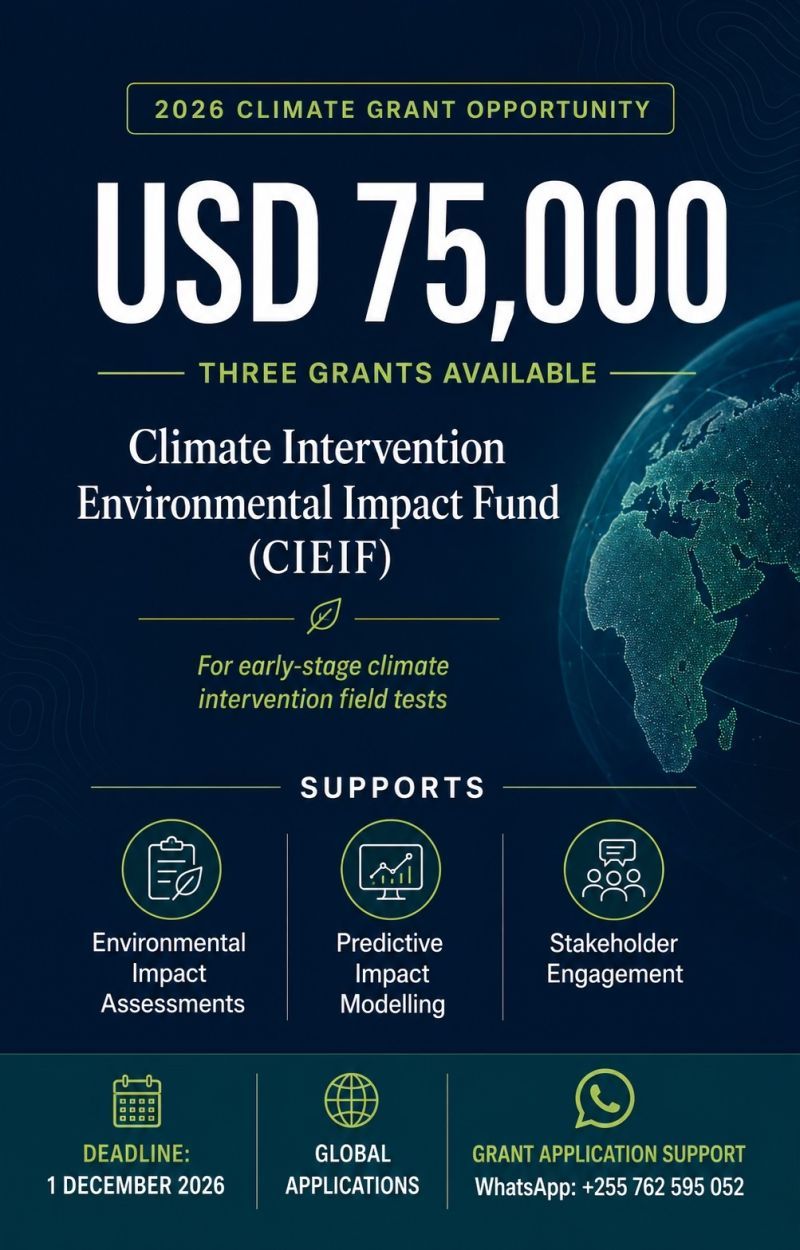
Climate innovation is moving quickly.
Around the world, researchers, startups and organizations are developing new ways to remove greenhouse gases, reduce the effects of global warming and potentially restore damaged climate systems.
But as these technologies move from research laboratories into the real world, another question becomes increasingly important: what happens when they are actually tested in communities, farms, oceans or other natural environments?
That is where the Climate Intervention Environmental Impact Fund (CIEIF) comes in.
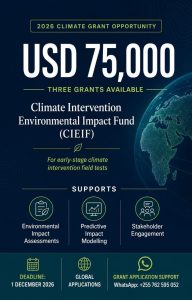
The fund has opened its sixth grant round, offering three grants of $75,000 each to investigators and organizations working on innovative climate-intervention technologies that are approaching small-scale field testing.
The funding is not designed to finance the development of a technology or pay for the entire field experiment.
Instead, it focuses on the work that needs to happen before testing begins: understanding possible environmental effects, modeling potential impacts and engaging the people and institutions that could be affected.
Applications for the 2026 round close on December 1, 2026, with grant decisions expected by February 1, 2027.
Why Is This Kind of Funding Important?
Climate solutions are often presented as if innovation itself is enough.
A new technology may promise to remove carbon dioxide from the atmosphere, reduce methane emissions or improve the ability of ecosystems to absorb carbon.
But a solution designed to address climate change can still have other consequences.
It could affect soil, water, biodiversity, agriculture, local livelihoods or public health. It could also raise questions about who has given permission for a project, who bears the risks and whether communities understand what is being proposed.
This is particularly important for climate-intervention technologies because some of them involve deliberately changing or influencing natural systems.
CIEIF says its grants are intended to support independent and objective environmental impact assessments, predictive impact modeling and stakeholder engagement for small-scale field tests of new technologies.
In simple terms, the fund is supporting the research that asks:
Before we test this climate solution, do we understand what it could change?
What Will the $75,000 Grants Support?
Each selected project will receive $75,000.
The funding must primarily support at least one of three areas.
The first is an environmental impact assessment, which can help identify potential environmental consequences of a proposed field test.
The second is predictive impact modeling. This involves using available information and scientific methods to estimate what could happen under different conditions.
The third is stakeholder engagement.
This could involve working with potentially affected communities, government agencies and other relevant stakeholders before a field test begins.
According to CIEIF’s grant guidelines, funding can also cover applicant staff time, consultants and closely related expenses associated with the assessment and modeling work.
This makes the opportunity different from a conventional innovation grant.
The question is not simply, “Can you build the technology?”
It is also, “Can you demonstrate that you have thought seriously about what happens when the technology leaves the laboratory?”
What Kind of Climate Technologies Are Eligible?
CIEIF is looking at a broad range of climate-intervention approaches.
Examples include biochar, enhanced weathering, carbon dioxide removal methods other than direct air capture, cloud brightening, ocean interventions and marine carbon removal.
The fund also lists methane removal, livestock methane capture, agricultural climate interventions, ice and land albedo enhancement, greenhouse-gas-removing coatings, black soot removal or mitigation, and nitrous oxide and chlorofluorocarbon removal among the areas it can consider.
The common thread is that the proposed technology should be innovative and approaching the stage where a small-scale field test is being considered.
CIEIF places particular importance on whether the innovation could eventually scale to a level that has meaningful global climate benefits.
That means an applicant needs to demonstrate more than an interesting idea.
There needs to be evidence that the technology is sufficiently developed for the proposed field test and that there is a clear reason to believe it could eventually matter at a much larger scale.
Who Can Apply?
The opportunity has a global scope.
Qualified investigators and organizations developing innovative climate-intervention technologies can apply, including private businesses.
However, CIEIF says it gives higher priority to nonprofit institutions, including academic institutions. For international projects, higher priority may also be given where a US nonprofit partner is available to accept the grant as a donation.
Individuals applying on their own are not eligible.
Applicants are also expected to provide substantial information about the proposed field test.
This includes explaining the technology, previous research supporting the proposed test, where the test would take place, potential technical and environmental challenges, foreseeable economic or social effects, public health or safety concerns and the permits or approvals that may be required.
They must also identify relevant previous publications and potential independent consultants who could assist with the impact assessment or modeling.
The Community Cannot Be an Afterthought
One of the most interesting parts of the funding opportunity is its emphasis on stakeholder engagement.
Climate projects do not exist in isolation.
A technology may look promising from a laboratory or engineering perspective, but the people living around a proposed test site may have different concerns.
Farmers may want to know how a technology could affect their land.
Coastal communities may have questions about interventions in marine environments.
Government agencies may need to understand permitting and regulatory implications.
Communities may also want to know who is responsible if something goes wrong.
CIEIF specifically expects applicants to consider engagement with potentially affected stakeholders, ranging from local communities to government agencies.
That approach reflects a broader lesson for climate action: a project cannot be considered responsible simply because its intention is environmental.
The process matters too.
Climate Action Also Needs Accountability
For CSR and sustainability, this distinction is important.
Companies and organizations increasingly want to demonstrate that they are contributing to climate action. But responsible environmental action is not only about announcing ambitious targets or investing in new technologies.
It also involves understanding unintended consequences.
A climate project that creates another environmental or social problem has not necessarily solved the original problem.
This is why environmental impact assessments and stakeholder engagement can be just as important as the technology itself.
They create an opportunity to identify risks before a project moves further, rather than waiting until those risks become expensive or difficult to reverse.
What Happens After the Grant?
CIEIF says selected applicants will work with its team to determine the expert consulting needs associated with their proposed field test.
After those discussions, the first third of the $75,000 grant will be provided upfront.
The remaining two payments will follow a schedule linked to agreed project milestones.
The fund also says repeated annual funding may be possible.
Another important requirement is transparency.
CIEIF says grantees must agree to be identified on its website and credit the fund on their own websites. It also places significant value on the publication of results through a peer-reviewed journal or an externally peer-reviewed report.
That requirement matters because climate innovation needs evidence that others can examine, question and build upon.
How to Apply
There is no standard online application form for the 2026 grant round.
Applicants are expected to prepare a grant request of no more than 20 single-spaced pages, excluding appropriate supplementary material.
The application must explain the proposed field test, the science behind it, expected environmental and social challenges, how the $75,000 would be used, other sources of funding, relevant insurance and the applicant’s willingness to publish results.
CIEIF also specifically warns applicants that the use of AI in cover letters and applications is not acceptable. According to its guidelines, applications are reviewed for AI use and applicants found to have used it may be rejected and barred from future applications.
Once the grant request is ready, applicants are instructed to contact Peter T. Jenkins, CIEIF’s Manager, at info@CIEIF.org to discuss how the application should be submitted.
The deadline is December 1, 2026, while decisions are expected by February 1, 2027.
The Bigger Question Behind the Funding
The most interesting thing about this opportunity may not be the $75,000 itself.
It is the principle behind the funding.
Climate change requires innovation. But innovation without careful assessment can create new problems while trying to solve old ones.
As more climate technologies move closer to real-world testing, there will be a growing need to understand their environmental, social, economic and health implications before they are deployed.
For researchers and organizations working on climate interventions, that preparation can determine whether an idea moves forward responsibly.
Because climate action is not only about finding new ways to fight climate change.
It is also about making sure that the solutions being developed today do not create bigger problems tomorrow.
[give_form id="20698"]