csrreporters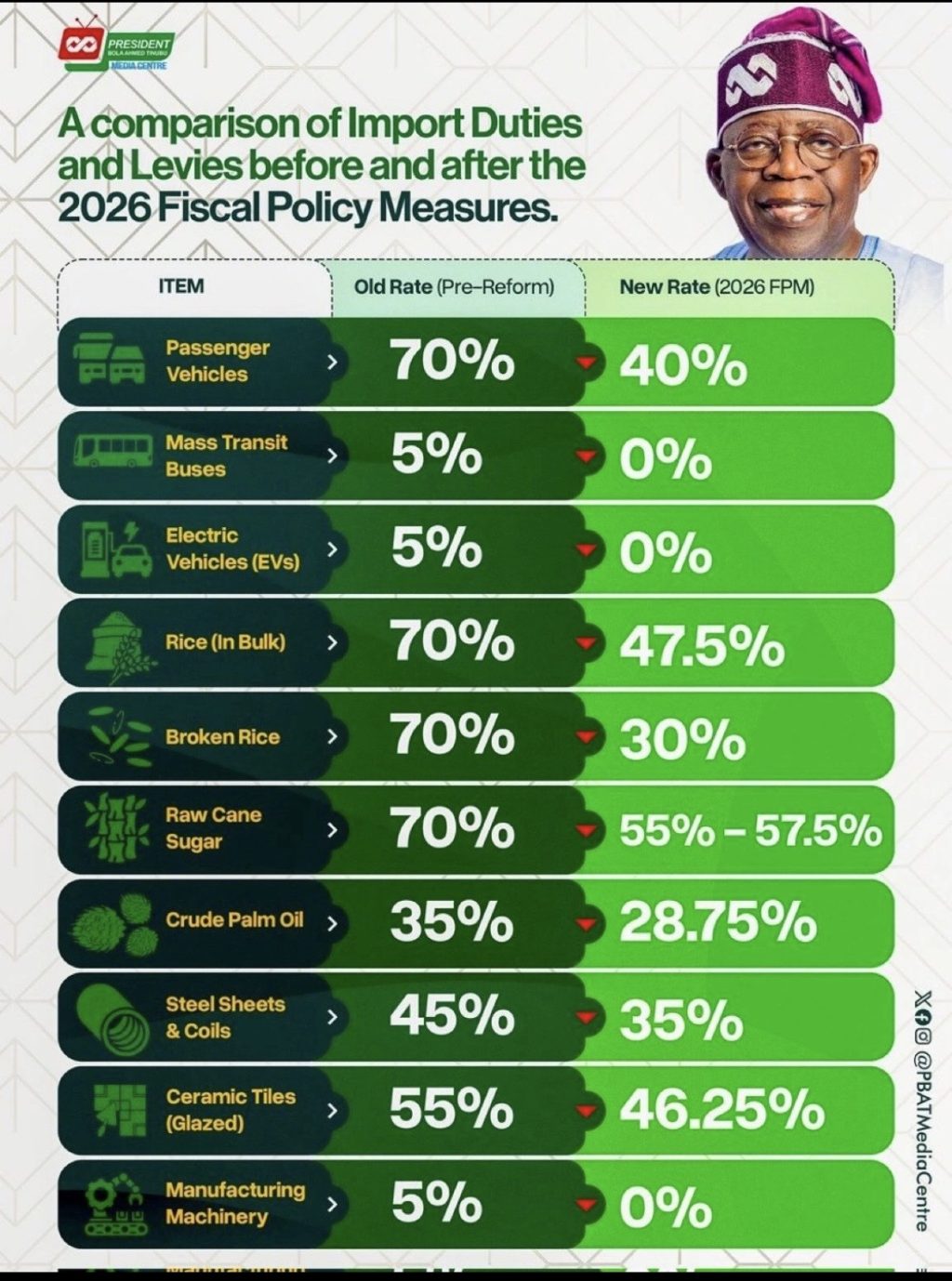
EDITORIAL - Pass It Down
The government has reduced import duties on essential goods — and that deserves real acknowledgement. But a policy concession means nothing if Nigerian traders pocket the savings and leave the people behind.
We will start with the credit, because credit is due. The 2026 Fiscal Policy Measures are a real policy intervention — not a press release, not a committee recommendation, not another white paper collecting dust somewhere in Abuja. The Federal Government looked at the state of this economy, looked at what ordinary Nigerians are dealing with at the market and the fuel pump and the mechanic’s yard, and made a set of decisions that could genuinely take some of the weight off. That deserves to be said clearly, without the usual asterisks and equivocations that pass for commentary in this country. We commend the administration. Full stop.
The numbers are not trivial. Passenger vehicle duties drop from 70% to 40%. Rice in bulk — the variety most Nigerians actually eat, not the premium parboiled versions — falls from 70% to 47.5%. Broken rice comes down from 70% to 30%. Mass transit buses come in at zero duty. Manufacturing machinery, zero. Electric vehicles, also zero. Raw cane sugar, which had been sitting at 70%, comes down to somewhere between 55% and 57.5% depending on grade. These are not incremental tweaks. They are, in several cases, wholesale recalibrations of Nigeria’s import tariff architecture — and they are aimed squarely at the categories that affect daily life most directly: food, transport, and production.
But here is what we have learned, painfully and repeatedly, about how economic relief works in Nigeria. Government can reduce a tariff. Government cannot force a trader to lower a price. And the distance between those two things — between what happens at the port and what happens at the market stall — is where Nigerians have been left stranded, time and time again.
Prices in this country move in one direction easily and the other direction with tremendous reluctance. Anyone who has watched the cost of tomatoes triple after flooding in Kaduna — and then refuse to come back down once the roads cleared — knows exactly what we mean. It is not just tomatoes, of course. We saw it with fuel. We saw it with cooking gas. We saw it with cement after every dry season construction rush. The pattern is consistent: costs pass through to the consumer at speed, and relief — when it eventually comes — arrives slowly, partially, and often only under public pressure.
There are structural reasons for this. Supply chains in Nigeria are long and fragmented, with multiple layers of middlemen each protecting their slice. The naira’s volatility means importers price in risk premiums as a matter of survival. Warehousing costs eat into margins in ways that are genuinely difficult to absorb. We know all of this, and we are not dismissing it.
But we also know that at this particular moment, in this particular year, Nigerians are not sitting comfortably waiting for market forces to gradually find equilibrium. People are making hard choices at the end of every month. Families that used to eat rice three times a week have cut to once. The commercial bus that used to cost two hundred naira now takes six hundred, and the driver will tell you with complete sincerity that he has no choice — and he is probably right. The weight of this economy is sitting directly on the shoulders of people who have no buffer left. This is not hyperbole. It is the weekly reality that market surveys and household reports keep confirming.
So when the government reduces the import duty on bulk rice by more than twenty percentage points, or cuts the levy on broken rice nearly in half, the question that follows immediately is this: who benefits? If the importer’s cost of landing a tonne of rice in Lagos drops significantly, that saving has to go somewhere. It either reaches the consumer through lower prices, or it stays with the importer as margin. There is no third option.
We are not making a blanket accusation against Nigerian importers. Many are themselves operating under tight conditions. The cost of trade finance, the dysfunction at some of our ports, the informal levies that never appear in any policy document but somehow find their way into every shipment — these are real burdens. We do not pretend the import business is a comfortable one. But there is a difference between structural cost and deliberate profiteering. And right now, the Nigerian public needs importers, distributors, and retailers to make a conscious choice to sit on the right side of that line.
Corporate social responsibility — and we say this as a platform that has covered CSR in Nigeria for years — is not fundamentally about the foundation you set up or the school block you commissioned in your company’s home state. At its core, it is about whether your business, in its daily operation, leaves the society around it better or worse. A food importer who quietly pockets a 40-percentage-point tariff reduction while their customers continue to pay last year’s prices is not a neutral actor. They are making a choice. And that choice has a moral weight that no amount of donations or CSR reports can offset.
So we are asking something specific and direct. Reduce your consumer prices now, and do it proportionately. Not when the current stock clears, not when your accountant completes the reconciliation — now, with the next shipment, at the next point of sale. And where you can, go further than the duty reduction requires. This is a moment that calls for something beyond the minimum. Compressing your margins voluntarily, even temporarily, is the kind of business decision that gets remembered — by customers, by communities, and by history.
Be open about your numbers. Publish your pre- and post-reform pricing. Show the public what you paid to land the goods and what you are selling them for. Transparency is not weakness — it is the foundation of trust that every business eventually needs. And coordinate through your trade associations. Individual goodwill is useful, but sector-wide commitments are transformative. Rice importers, vehicle dealers, sugar traders — bring your associations into this conversation and agree on pricing standards that reflect the new duty environment. Let Nigerians see that an entire sector moved, not just one or two companies looking for goodwill headlines.
The government also has further work to do. Announcing these reductions is the beginning, not the end, of the policy’s job. The Nigeria Customs Service needs to ensure swift and unimpeded processing of affected imports. The Federal Competition and Consumer Protection Commission has both the mandate and the authority to monitor whether savings at the port are reaching the market — and to act when they are not. The Ministry of Finance should set up a visible tracking mechanism, something the public can actually see, showing how prices have moved in the months following this policy change. Accountability cannot be one-directional. The government asked Nigerians to trust this reform. Now it must demonstrate that the reform is working.
And our colleagues across the Nigerian media have a role here too. Not just the business press, but the general news platforms, the radio stations that reach the markets and the motor parks, the community journalists in Kano and Port Harcourt and Onitsha. Track the prices. Go to Bodija in Ibadan, to Mile 12 in Lagos, to Wuse market in Abuja, to Ariaria in Aba. Ask the traders what they paid for their last shipment. Ask them what changed. If prices have not moved, that is the story. If they have, that is also the story. The gap between government policy and market reality is one of the most important reporting beats in this country right now, and it belongs to everyone who calls themselves a journalist.
We will close where we started: with genuine, unhedged acknowledgement of what the government has done here. In a fiscal environment as constrained as Nigeria’s, reducing tariff revenue is not a costless gesture. There are trade-offs that came with these decisions, and the administration made them in favour of the consumer. That is a policy choice worth recognising. We recognise it.
Now comes the harder part. The policy is only as good as its impact on the ground. A bag of rice in a market in Suleja, a danfo seat in Oshodi, a sack of sugar in a bakery in Enugu — that is where this reform will either prove itself or fail. The people of this country have absorbed enough. They deserve to feel the benefit of every single one of these reductions — not next quarter, not after the next budget cycle. Now.
Pass it down. Every kobo of it.
CSR Reporters is Nigeria’s dedicated corporate social responsibility and sustainability media platform. We track, verify, and report on the intersection of business conduct and social impact across Nigeria and Africa.
[give_form id="20698"]