ROSEMARY IMOBHIO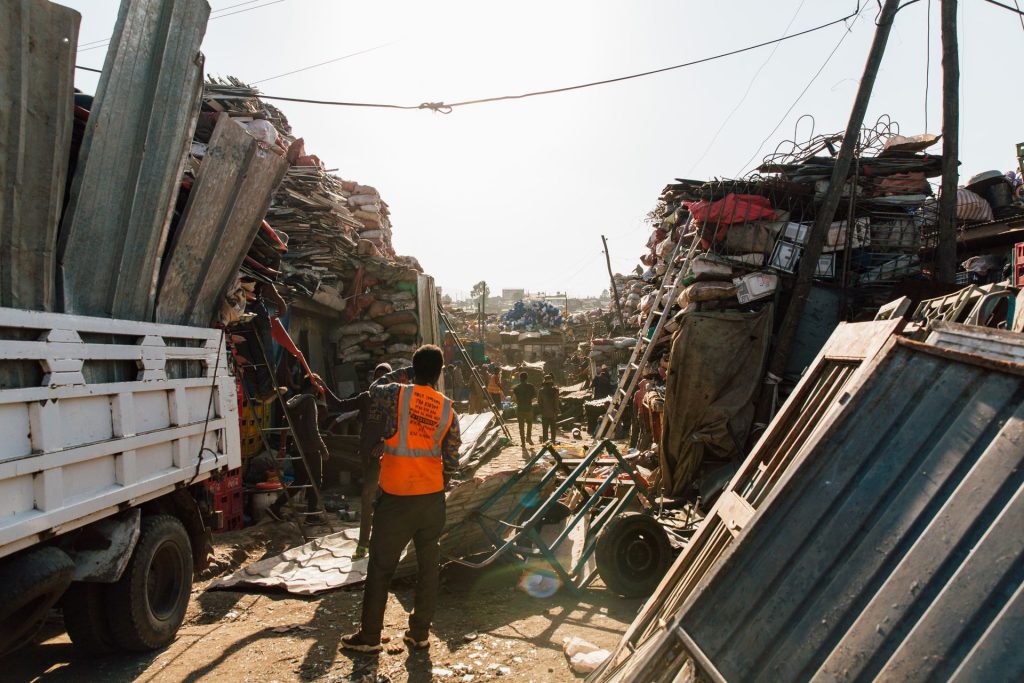
The National Association of Scrap and Waste Dealers Employers of Nigeria (NASWDEN) began a 15-day warning strike on October 1, It said members would stop supplying scrap metal to steel companies.
On October 8, the Ministry of Steel Development asked the association to suspend the action and return to the negotiation table. On the surface, this is a pricing dispute between suppliers and buyers. Underneath sits a bigger question: as Nigeria tries to rebuild its steel industry, who gets to take part in that revival, and who is left outside the factory gate?
The First Link In The Steel Chain
Scrap dealers are easy to overlook. Before any mill can melt metal, someone has to collect old roofing sheets, vehicle parts, machinery and workshop offcuts. That material must then be sorted, weighed, pooled and trucked to the factory. Small collectors, mid-sized aggregators and large suppliers each handle a stage of the journey.
In circular-economy terms, this is resource recovery in practice. Metal that might otherwise rust in a dump becomes feedstock again. This saves raw materials and keeps value inside the economy.
The ministry itself says scrap dealers play an important role in supplying raw materials to steel manufacturers. An association official claimed in 2024 that NASWDEN has about five million members. That figure is the association’s own and has not been independently verified.
The trade also carries real risks. Weighing and pricing need to be transparent, and buyers need to know where material comes from. Stolen cables and metal fittings from public infrastructure have long been a concern in scrap markets. NASWDEN has itself alleged that some steel companies buy from unregistered dealers and agents, and has called for stronger verification.
A Strike With Two Voices
As is usual with Nigeria, reporting on the dispute shows an association that does not speak with one voice. Deputy National President Aminu Hassan Soja announced the strike at a press conference. Days later, Joseph Onu Enemona, who described himself as Agent Chairman, said the leadership headed by National President Luke Uchechukwu Ogbu had not authorised any strike. He urged members to keep trading.
The ministry, speaking through Permanent Secretary Nura Abba Rimi, says the concerns reached it through the National Steel Council. Minister Shuaibu Abubakar Audu has directed that NASWDEN’s apex leadership be invited for mediation. He tied the matter to the government’s target of 10 million metric tonnes of annual steel production by 2030 and urged the association to “sheath its sword.”
NASWDEN’s list of complaints is long. Soja alleged that price cuts cost dealers between N3 million and N4 million on a single truckload. The association also protested deductions of one to five per cent that it calls “extra dust.” These remain allegations as efforts by CSR Reporters correspondents to reach steel companies has produced no response yet.

When The Customer Becomes The Competitor
The first complaint concerns steel companies buying scrap directly. For years, mills have relied on dealers to gather metal from thousands of small sources. However, a mill that opens its own collection points can skip that middle layer. This may lower costs and give it tighter control over quality and supply.
For dealers, the effect can be sharp. Aggregators invest in trucks, labour, storage and credit to serve mills, and those mills are often their main buyers. When the buyer starts collecting too, dealers lose volume, bargaining power. Sometimes they lose the ability to repay what they borrowed. Smaller collectors, who sell to aggregators rather than to mills, feel the squeeze further down the line.
This is a familiar industrial tension. Vertical integration is a normal business strategy, and mills will say reliable supply is essential to production. Yet where the supplier base is large, informal and thinly capitalised, the transition carries livelihood costs that markets alone rarely cushion.
Foreign Capital, Local Footing
The second complaint is that foreign-owned companies are opening dumpsites and scrap collection centres. Soja said this is pushing indigenous dealers out of business. He also asked government for intervention funds so Nigerian scrap traders can build companies like those set up by foreign investors.
Foreign investment is not the villain in this story. Steel is capital-intensive, and Nigeria needs furnaces, rolling mills and power infrastructure. Local balance sheets may struggle to fund these alone.
Foreign firms can also bring technology and jobs. The sharper question is design. Do investment terms and purchasing practices leave room for local suppliers to grow alongside the plants? Or do they let the largest operators absorb the whole chain?
Local content offers a useful lens here. Real inclusion goes beyond hiring Nigerian staff. It means access to finance, clear registration standards and fair contract terms. These are necessary for indigenous firms to compete as suppliers rather than merely survive as subcontractors.
Read Also: Nigeria Intensifies Efforts to Revive Steel Sector, Targets Industrial Growth and Investment
Billets: Steel That Skips The Scrap Yard
The third complaint, imported billets, needs a short explanation. A billet is a semi-finished block of steel, usually square in cross-section. Rolling mills heat it and shape it into reinforcement bars, the iron rods seen on construction sites across Nigeria.
There are two broad routes to those rods. In the scrap-based route, a mill melts scrap in a furnace, casts the molten steel into billets and rolls them into finished products. Each tonne of scrap bought supports collectors, aggregators and transporters. In the billet-based route, a mill buys billets made elsewhere and simply rolls them. That route needs far less scrap, so it sends little demand to local dealers.
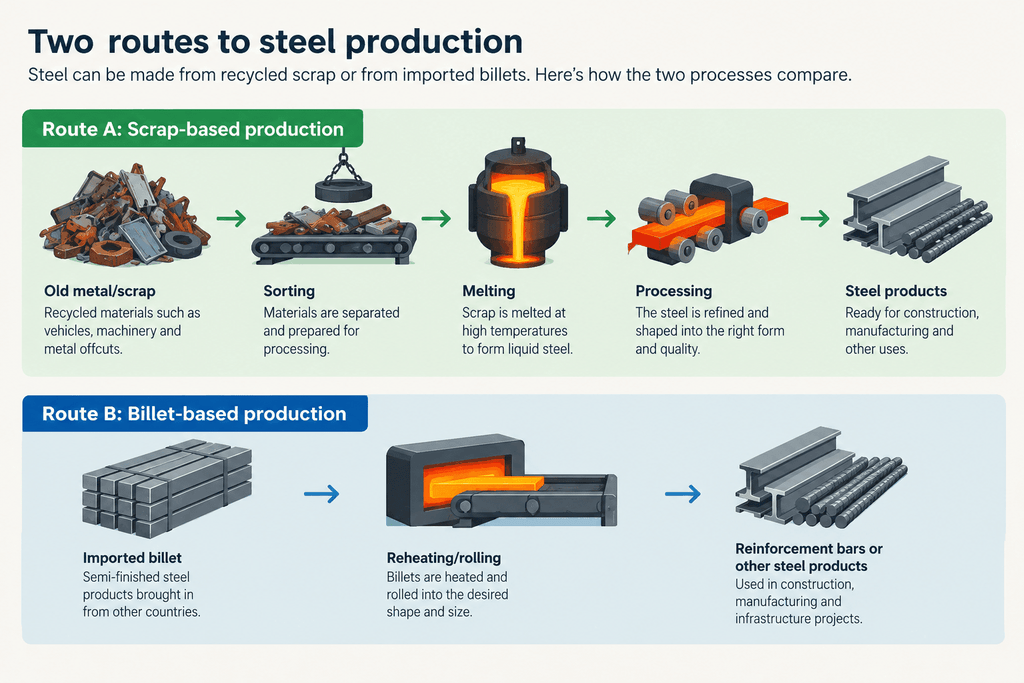
NASWDEN’s worry is therefore direct: more imported billets can mean less local scrap bought. The reports reviewed do not show where the ministry stands on billet imports, and the mills’ side is missing. Cost, power supply or reliability may explain some imports.
In our analysis, a 10-million-tonne target will probably need more than domestic scrap alone. The real debate is about balance and sequencing, and about how much of Nigeria’s steel growth should rest on local raw material.
Measuring A Steel Revival
Can Nigeria build a stronger steel industry without squeezing out the businesses that collect its raw material? The evidence so far suggests it can, but not by default.
Capital, scale and imported inputs naturally pull production toward the largest players. Inclusion has to be designed through fair pricing rules, transparent weighing, registered and traceable supply. It also requires access to finance for local dealers, and a deliberate place for domestic scrap in the production mix. Stronger controls against stolen materials belong on that list too.
A mill’s output can be counted in tonnes. A national steel strategy deserves a wider measure: how much economic opportunity stays at home, how many workers earn decent incomes, how much metal is recovered instead of wasted, and how many Nigerian firms are still in the chain when the furnaces run at full capacity.
For more analysis on inclusive industrialisation, the circular economy and responsible business across Nigeria and Africa, keep following CSR Reporters.
[give_form id="20698"]