Free Dialysis Sessions to Be Offered in Lagos, Ibadan and Akure as Cost Remains a Barrier to Kidney Care
 ONYINYECHI NWAIGBA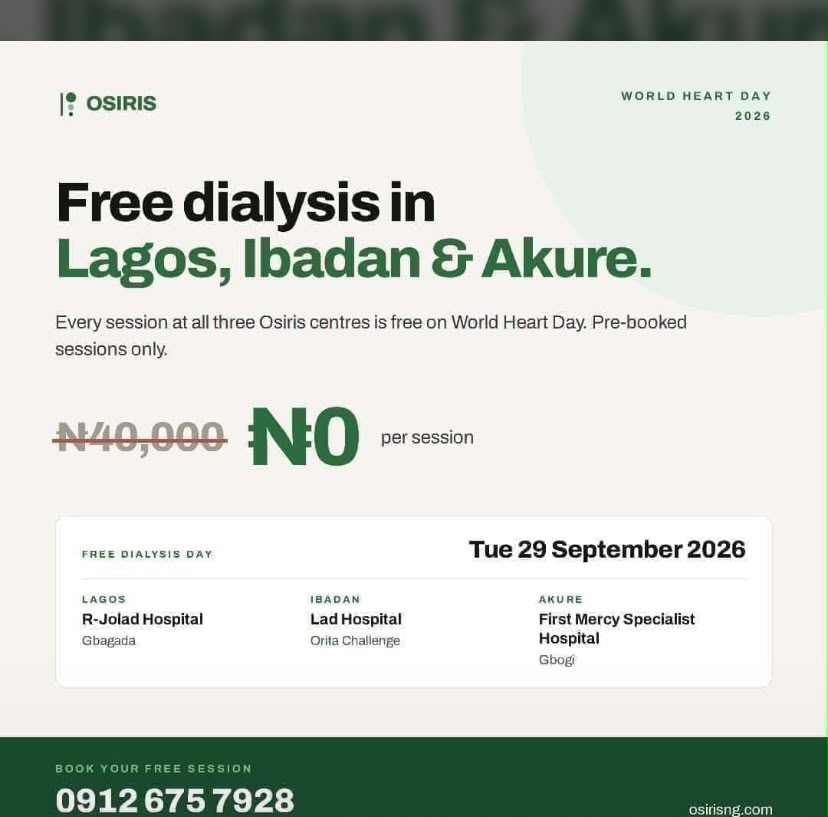
OSIRIS is offering free dialysis sessions on September 29 to eligible patients in three Nigerian cities, providing temporary relief for people who may struggle to afford the cost of treatment.
For people living with kidney failure, dialysis is not an occasional medical expense.
It can be a recurring part of life.
Patients whose kidneys can no longer adequately remove waste and excess fluid from the blood may require regular dialysis to stay alive while receiving other forms of treatment or awaiting a kidney transplant.
But access to dialysis in Nigeria can be difficult for another reason: cost.
A single session can represent a significant financial burden for patients and families who may already be dealing with medication, laboratory tests, transportation and other healthcare expenses.
Against this backdrop, OSIRIS is offering free dialysis sessions to eligible patients in Lagos, Ibadan and Akure on Tuesday, September 29, 2026.
The initiative is particularly relevant for people who have already been told they need dialysis but are struggling to afford treatment.
According to the announcement, patients with a Hepatitis B-negative status and recent test results are preferred, while available slots are limited.
Importantly, the sessions are available by pre-booking only, meaning interested patients are encouraged to make contact before September 29 rather than simply arriving at a facility without an appointment.
Why Free Dialysis Matters
Dialysis is a treatment that takes over some of the functions of damaged kidneys.
During haemodialysis, a machine filters waste and excess fluid from the blood before returning the cleaned blood to the body.
For people who require regular treatment, missing sessions can have serious health consequences.
That makes affordability more than a financial question.
It can become a question of whether someone is able to consistently access a treatment they depend on.
For households already dealing with reduced income because of illness, the pressure can be especially difficult.
A patient may need to pay for treatment several times a week while also managing transportation, medication, investigations and other household expenses.
A free dialysis session does not remove all of those challenges.
But for someone struggling to raise the money for treatment, it can provide immediate relief.
A Healthcare Intervention With a Wider Social Impact
Healthcare interventions are often measured by the number of people treated.
But the social impact can extend further.
When a patient is able to access treatment, family members may spend less time trying to raise emergency funds.
A caregiver may be able to return to work instead of spending the day searching for money for a dialysis session.
A household may be able to redirect money towards food, school fees or medication.
These effects can be difficult to capture in a simple patient count.
Yet they form an important part of what healthcare access means.
For families living with chronic illness, healthcare costs can affect almost every other aspect of household life.
The Cost Challenge Around Kidney Care
The need for dialysis is closely connected to the broader challenge of financing chronic healthcare in Nigeria.
Kidney disease can require long-term care, rather than a single intervention that resolves the condition.
This creates a different financial reality for patients.
Someone who needs dialysis repeatedly cannot simply treat the expense as a one-time medical bill.
The cost accumulates.
For low- and middle-income households, repeated healthcare expenses can create difficult choices between medical treatment and other essential needs.
That is why initiatives that reduce the cost of individual treatment sessions can matter, even when they do not solve the broader financing challenge.
They provide a point of support within a much larger problem.
Who Can Benefit From the Sessions?
The announcement specifically targets people who have been told they need dialysis and are struggling with the cost of treatment.
It also states that Hepatitis B-negative status with recent test results is ideal.
This is important because dialysis centres have infection-control requirements, and patients may need specific screening before treatment.
Anyone interested in accessing the free sessions should therefore confirm their eligibility and requirements directly with OSIRIS before making arrangements.
The initiative also has limited slots.
Patients should not assume that availability is guaranteed simply because they contact the organisers.
The announcement specifically states that only pre-booked sessions will be accepted.
That means early contact is important.
Why Health Information Matters
One of the useful aspects of initiatives like this is their ability to connect people with information as well as treatment.
Someone may know that a relative needs dialysis but not know where affordable treatment is available.
Another person may postpone treatment because the expected cost seems impossible to manage.
Sharing verified information about available support can therefore become an important part of community health.
This is particularly relevant for chronic conditions, where families may spend considerable time trying to understand treatment options, costs and available facilities.
A message shared through a WhatsApp group, community organisation, church, workplace or family network could potentially reach someone who needs it.
The Role of Community Networks
The request to share the announcement within personal networks may seem simple, but it highlights something important about healthcare access.
Not every patient will see an organisation’s social media post.
Someone may not be following OSIRIS.
They may not regularly use Instagram.
They may not know where to search for information about dialysis support.
Community networks can bridge that gap.
A relative can forward the information.
A healthcare worker can alert a patient.
A community leader can share it with members.
A friend can recognise that someone they know is struggling with treatment costs and pass the information along.
In situations involving limited slots, reaching the right people quickly can make a practical difference.
Free Treatment Is Relief, But Not a Complete Solution
There is also a larger issue worth considering.
Free dialysis sessions can provide immediate assistance, but they do not eliminate the underlying affordability challenge faced by people requiring long-term kidney care.
The sustainability of dialysis access depends on a wider healthcare system that includes early detection, prevention, diagnosis, treatment, health insurance, specialist care and long-term financing.
Kidney disease can also place significant pressure on families before dialysis even begins.
There may be costs associated with consultations, tests, medications, hospitalisation and transportation.
By the time dialysis becomes necessary, some households may already have spent significant amounts on healthcare.
This is why conversations about kidney care cannot focus only on dialysis machines.
They also need to consider prevention, early diagnosis and financial protection.
What This Says About Healthcare Access
The OSIRIS initiative also raises a broader question about how organisations can contribute to healthcare access.
Corporate social responsibility and social impact programmes are sometimes associated with large infrastructure projects or high-profile medical outreaches.
But access can also be improved through targeted interventions that address a very specific barrier.
In this case, that barrier is the cost of a dialysis session.
The intervention is limited in scale, but its value is potentially significant for the individual who would otherwise struggle to receive treatment.
That distinction matters.
Social impact does not always have to mean reaching millions of people at once.
Sometimes it means identifying a critical need and making access possible for the people directly affected.
What Patients Should Know
Anyone who believes they may qualify should contact the organisers before September 29 to confirm availability and booking requirements.
Patients should have their relevant recent medical information and test results available, including Hepatitis B status where applicable.
Because the announcement states that slots are limited and pre-booking is required, patients should not wait until the day of the session to make contact.
They should also confirm the exact location, appointment time and any other requirements directly with OSIRIS before travelling.
A Small Intervention Around a Big Need
For someone who depends on dialysis, one free session may represent more than a medical appointment.
It may mean one less payment to worry about.
One less day spent searching for money.
One less financial burden for a family already carrying the cost of chronic illness.
And that is why information about healthcare support matters.
The free dialysis sessions being offered in Lagos, Ibadan and Akure are limited, and they do not address every challenge associated with kidney care.
But they provide an opportunity for eligible patients who are struggling with treatment costs to access support.
For those who qualify, the most important step is simple: contact OSIRIS before September 29, confirm eligibility and secure a booking.
And for everyone else, sharing verified information could help ensure that one of the available slots reaches someone who genuinely needs it.
[give_form id="20698"]