


 csrreporters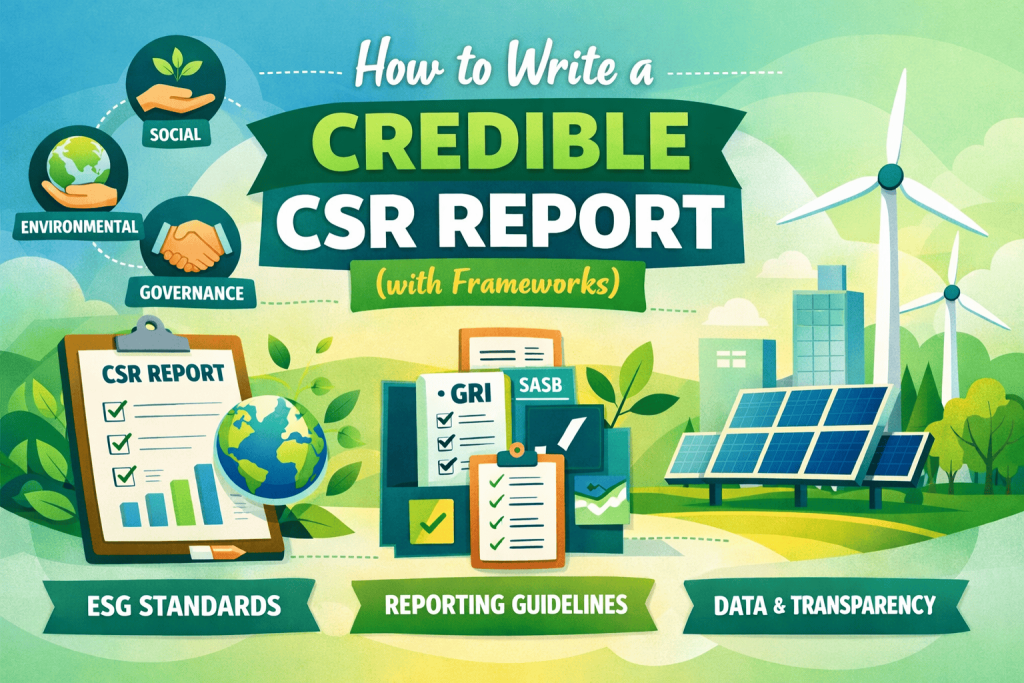
Materiality, ESG Frameworks, Data Collection, Stakeholder Engagement, & Transparency
A Comprehensive Guide for Companies Committed to Transparent, Impactful Corporate Social Responsibility
In today’s business landscape, a well-written CSR report is no longer optional. Stakeholders (investors and consumers to regulators and employees) expect companies to account for their impact on society and the environment. But writing a CSR report that people actually trust? In addition, that takes more than compiling data and filling in templates.
This guide walks you through every step of producing a credible, compelling CSR report. Whether you are publishing your first report or refining a process you have followed for years, you will find practical, actionable advice here. Advice that is grounded in internationally recognised frameworks and real-world best practice.
A credible CSR report does not just tell stakeholders what a company has done. It shows them why it matters, how it was measured, and what will happen next.
1. What Is a CSR Report and Why Does Credibility Matter?
A CSR report, also known as a sustainability report or corporate responsibility report, is a public document in which a company discloses its social, environmental, and governance (ESG) activities and performance. Companies typically publish it annually and address it to a broad audience: shareholders, customers, suppliers, NGOs, journalists, and the general public.
Credibility is the single most important quality a CSR report can have. A report that cherry-picks positive stories while burying failures is not a CSR report, it is marketing. Stakeholder sophistication is increasingly becoming better than that. Institutional investors use ESG data to make financial decisions. Journalists and civil society groups scrutinise CSR claims. Regulatory frameworks are tightening globally, from the European Union’s Corporate Sustainability Reporting Directive (CSRD) to the growing push for mandatory ESG disclosures in Nigeria and across Africa.
A credible CSR report builds trust, strengthens relationships with stakeholders, reduces reputational risk, attracts responsible investment, and helps a company hold itself accountable to its stated values. Done right, it is one of the most powerful communications tools a company has.
The Difference Between a Credible Report and a ‘Greenwashed’ One
Greenwashing (making vague, exaggerated, or misleading claims about environmental and social performance) is one of the biggest threats to CSR credibility. A greenwashed report typically:
- Uses aspirational language without measurable targets
- Highlights selective achievements while ignoring negative impacts
- Relies on unverified or internally generated data
- Avoids discussing failures or areas for improvement
- Makes comparisons that are difficult to verify
A credible CSR report, by contrast, is honest about challenges and shortcomings. It uses data from reliable sources, follows recognised frameworks, and is verified by an independent third party wherever possible.
2. Start With a Clear Purpose and Scope
Before writing a single word, every CSR team must ask: what is this report for, and who is it for? The answers to these questions shape every decision that follows, from the data you collect to the tone you adopt.
Define Your Reporting Purpose
Different organisations produce CSR reports for different reasons. Accordingly, common motivations include:
- Meeting regulatory requirements or investor expectations
- Communicating progress against voluntary sustainability commitments
- Positioning the company as a responsible business in a competitive market
- Demonstrating accountability to affected communities
- Attracting and retaining employees who care about social values
Knowing your primary purpose helps you make difficult trade-offs. For example, between depth and accessibility, or between comprehensive data disclosure and a narrative that non-specialist readers can follow.
Define Your Reporting Scope
Scope answers the question: which activities, subsidiaries, geographies, and time periods are in this report? A credible CSR report is explicit about its scope. It does not allow readers to assume that a claim about one part of the business applies to the whole organisation.
Therefore, common scope decisions include:
- Organisational boundary: which legal entities or business units did this report include
- Operational boundary: whether the report covers direct operations only or extends to the supply chain
- Time period: typically the previous calendar or financial year
- Topic coverage: which environmental, social, and governance issues did this report address
Always be clear about what your report does NOT cover. Transparency about the limits of your reporting is itself a sign of credibility.

3. Conduct a Materiality Assessment
A materiality assessment is the process of identifying which CSR topics are most significant to your business and your stakeholders. It is the foundation of a credible report. Without it, you risk producing a document that covers everything superficially — or that focuses on issues that matter to the company internally but not to the people outside it.
How to Conduct a Materiality Assessment
The process typically involves three stages:
- Identify potential topics. Draw up a long list of potential ESG issues relevant to your sector, geography, and business model. Use industry benchmarks, peer company reports, sustainability frameworks, and media analysis to build this list.
- Consult your stakeholders. Survey or interview key stakeholders — customers, employees, investors, community groups, suppliers, NGOs — to understand which issues they consider most important. This step is critical. A materiality assessment without genuine stakeholder input is not a materiality assessment; it is an internal priority-setting exercise dressing up as something more.
- Assess business significance. Evaluate each topic in terms of its potential impact on your business — financially, operationally, and reputationally — and on the external world, including society and the environment.
The result is a materiality matrix: a visual representation of the issues that rank highest on both axes. These are the topics your CSR report should focus on most deeply.
Why Materiality Matters for Credibility
Leading frameworks — including the Global Reporting Initiative (GRI) Standards — require companies to explain their materiality process and disclose which topics they consider material. When stakeholders can see the methodology behind your topic selection, it demonstrates rigour and reduces the suspicion that you have avoided difficult issues.
4. Choose the Right Reporting Framework
One of the most important decisions in writing a credible CSR report is selecting an appropriate reporting framework. Frameworks provide structure, define what data to collect, and allow stakeholders to compare your performance against peers and over time.
The Most Widely Used CSR Reporting Frameworks
Global Reporting Initiative (GRI) Standards
GRI is the most widely adopted sustainability reporting framework in the world. It offers a modular set of standards covering economic, environmental, and social topics. GRI is best for companies that want to demonstrate broad accountability to a wide range of stakeholders. It requires companies to explain their approach to each material topic, disclose specific data, and provide narrative context.
Sustainability Accounting Standards Board (SASB)
SASB standards are industry-specific and focus on financially material ESG information, that is, information most likely to be relevant to investors. There are 77 industry-specific standards, making SASB particularly useful for companies whose primary audience is the financial community.
Task Force on Climate-related Financial Disclosures (TCFD)
TCFD provides a framework specifically for disclosing climate-related risks and opportunities. Regulators and investors around the world now use its four pillars: governance, strategy, risk management, and metrics and targets, as a reference point for climate disclosure.
UN Sustainable Development Goals (SDGs)
Many companies align their CSR reporting with the United Nations’ 17 Sustainable Development Goals. While the SDGs are not a reporting framework per se, mapping your activities and outcomes to specific SDGs helps contextualise your contribution to global development priorities. Thus, your report speaks powerfully to a broad stakeholder audience.
Integrated Reporting Framework (IR Framework)
The IR Framework, by the International Integrated Reporting Council (IIRC), encourages companies to show the link between financial and non-financial value creation. It is particularly useful for companies seeking to connect CSR performance to long-term business resilience.
Which Framework Is Right for You?
There is no single correct answer. Many companies use multiple frameworks simultaneously. For example, GRI for broad stakeholder reporting and SASB for investor-facing disclosures. The key is to choose frameworks that match your stakeholder audience, your sector, and your level of reporting maturity. Consequently. if you are a Nigerian company reporting for the first time, GRI’s universal standards offer an accessible and widely recognised starting point. Whatever you choose, state your framework clearly in the report and explain why you selected it.
5. Collect Reliable, Verifiable Data
Data is the backbone of a credible CSR report. Without it, your report is a collection of good intentions — interesting, perhaps, but not credible. Hence, strong data collection requires clear systems, consistent methodology, and honest documentation of limitations.
Types of Data in a CSR Report
A comprehensive CSR report draws on both quantitative and qualitative data:
- Quantitative data: measurable metrics such as tonnes of CO2 emitted, number of employees trained, percentage of women in senior leadership, kilowatt-hours of energy consumed, litres of water used, injury rates, and charitable donations in naira or other currency
- Qualitative data: narrative information such as case studies, stakeholder testimonials, descriptions of community programmes, and explanations of governance processes
Both types are important. Numbers without context can mislead. Context without numbers can obscure performance. Accordingly, the strongest CSR reports combine rigorous data with compelling stories.
Building a Data Collection System
One of the most common complaints from CSR teams is that data collection is chaotic: different business units use different definitions, numbers come in late, and reconciling figures takes weeks. A reliable data collection system should include:
- Clearly defined metrics with consistent definitions across all reporting units
- Designated data owners in each department or subsidiary responsible for collecting and submitting their data
- A centralised collection platform — even a well-structured spreadsheet, used consistently, is far better than ad hoc email requests
- A documented methodology that explains how each metric is calculated, what is included and excluded, and what assumptions are made
- A quality control process that checks for obvious errors, inconsistencies, and gaps before data is finalised
Dealing With Data Gaps
Very few companies have perfect data. Supply chain emissions are notoriously difficult to measure. Small subsidiaries may lack reporting infrastructure. Some social metrics, such as the well-being of affected communities, are inherently complex to quantify. Even so, a credible report acknowledges these gaps honestly. Rather than omitting a metric because the data is imperfect, consider disclosing what you do have with appropriate caveats, explaining the limitations, and committing to improving your data quality over time.
Disclosing your data limitations honestly is not a weakness. It demonstrates the kind of transparency that stakeholders trust.

6. Set Meaningful Targets and Track Progress
A CSR report that describes only what has already happened is less credible than one that also commits to what the company will do next. Targets turn CSR reporting from a retrospective exercise into an accountability mechanism. This accountability is at the heart of credibility.
Characteristics of Credible CSR Targets
Good CSR targets are:
- Specific: they describe exactly what will be achieved, by whom, and in what area of the business
- Measurable: they are expressed in quantifiable terms that allow progress to be tracked
- Time-bound: they have a clear deadline, whether that is one year, three years, or ten years away
- Ambitious but realistic: they represent a genuine stretch beyond current performance without being so aspirational as to be meaningless
- Aligned with recognised benchmarks: additionally, where possible, targets should reference established science-based or industry-standard benchmarks, such as net-zero pathways aligned with the Paris Agreement.
Reporting Against Previous Targets
One of the strongest credibility signals in a CSR report is transparent reporting against targets set in previous years. Thus, if your company committed to reducing energy consumption by 20% by 2025 and achieved 17%, say so — and explain both why the target was not fully met and what you will do differently going forward. Companies that quietly drop targets they have not met, or that change how they define success without explanation, quickly lose stakeholder trust.
7. Structure Your Report for Maximum Impact
Even the most robust data and the strongest commitments will fail to land if the report structure is poor. Accordingly, a well-organised CSR report guides readers efficiently through complex material, making it easy to find the information most relevant to them.
Recommended Structure for a CSR Report
- CEO or Board Message. Open with a brief, personal message from senior leadership. This establishes tone, demonstrates genuine commitment from the top of the organisation, and gives context for the report. Secondly, avoid corporate boilerplate here, a message that sounds like it was written by a committee will undermine the credibility of everything that follows.
- Company Overview. A short section describing the company’s business, size, geographic footprint, and key sectors. This is particularly important for first-time readers who may not be familiar with your organisation.
- Sustainability Strategy and Governance. Describe how your business strategy and governance structures integrate CSR and sustainability. Who on the board is responsible for sustainability? How do you identify and manage CSR risks? Equally important, how do you review targets?
- Materiality. Explain your materiality assessment process and present your materiality matrix. This section shows stakeholders that your report focuses on what matters most, not just what is easiest to report on.
- Performance by Theme. This is the substantive core of the report. Cover each material topic in dedicated sections, providing data, narrative context, case studies, and targets. Common themes include environmental performance (energy, emissions, water, waste), social performance (employees, community, supply chain, human rights), and governance (ethics, compliance, stakeholder engagement).
- About This Report. Include a technical note explaining your reporting period, scope, methodology, chosen frameworks, and any limitations or restatements of previously published data.
- Appendices and Data Tables. In addition, provide comprehensive data tables that allow specialist readers, analysts, investors, NGOs, to access the underlying numbers in full.
Balancing Depth and Accessibility
A CSR report must serve multiple audiences simultaneously: the investor who wants granular emissions data; the job candidate who wants to understand the company’s values; the NGO that wants to scrutinise supply chain labour practices; and the journalist looking for a headline. One way to serve all of these audiences is to produce a layered report: a concise, visually engaging summary document for general audiences, backed by a full technical report for those who need more detail. Consequently, digital publishing has made this much easier, online reports can embed interactive data, summary graphics, and links to detailed annexes.
8. Write With Clarity, Honesty, and Authenticity
The writing quality of a CSR report matters more than many companies realise. Dense, jargon-heavy prose signals that a report was written for compliance rather than communication. Overly promotional language signals that it was written for marketing rather than accountability. Accordingly, the best CSR reports are in plain, clear language that treats readers as intelligent adults.
Principles of Effective CSR Report Writing
- Use active voice wherever possible. For example, ‘We reduced our carbon emissions by 15%’ is more direct and credible than ‘Carbon emissions were reduced by 15% across operations.’
- Avoid empty superlatives. Phrases like ‘world-class,’ ‘leading,’ and ‘best-in-class’ are meaningless without evidence. Let the data speak.
- Be specific. Vague commitments like ‘we are committed to reducing our environmental footprint’, say nothing. Whereas, specific commitments like ‘we will reduce Scope 1 and Scope 2 emissions by 40% by 2030 against a 2020 baseline’, say something real.
- Acknowledge failures as well as successes. A report that presents only positive developments reads as spin. Acknowledging where you have fallen short, and explaining what you have learned, is a powerful credibility signal.
- Use case studies to bring data to life. Numbers tell you what happened; stories help readers understand why it matters. Include specific examples of programmes, individuals, and communities that your CSR activities have affected.
- Adapt your language for a global audience. If your company operates across multiple countries, including in Nigeria and other African markets, be mindful that terminology and cultural context vary. Consequently, avoid assumptions and explain terms that may be unfamiliar.
Tone: Professional, Not Corporate
There is a difference between professional writing and corporate writing. Professional writing is clear, precise, and respectful of the reader’s time. Whereas corporate writing is often vague, passive, and padded with phrases that add length but not meaning. Aim for the former. Your CSR report should sound like it was written by humans who care about the issues at stake, not by a committee trying to say as much as possible while committing to as little as possible.
9. Use Visuals Strategically
A well-designed CSR report is not just easier to read; it is more credible. Visual presentation signals that the organisation has invested in its report and takes the process seriously. But visual design should serve the content, not overwhelm it.
Effective Use of Data Visualisation
Charts, graphs, and infographics are powerful tools for communicating complex data quickly. Thus use them to:
- Show trends over time (e.g., year-on-year emissions trajectories)
- Compare performance against targets
- Illustrate the distribution of a resource (e.g., training hours by department)
- Map geographic reach of community programmes
Choose chart types that are honest as well as clear. In addition, avoid visual tricks such as truncated y-axes or misleading scales that make modest improvements look dramatic.
Photography and Case Study Imagery
Photographs of community programmes, employee activities, and environmental initiatives help bring the human story of CSR to life. Therefore, ensure that any photography used is authentic, appropriately consented, and not tokenistic. Avoid stock imagery that has no genuine connection to your company’s work.

10. Seek Independent Assurance
Perhaps the single most powerful way to enhance the credibility of a CSR report is to have it independently assured. Assurance is a process in which a qualified third party, typically an auditing firm or specialist sustainability assurance provider, reviews your data, processes, and disclosures and provides a formal opinion on their reliability.
Levels of Assurance
Assurance typically comes at two levels:
- Limited assurance: the assurer has reviewed the report and found no evidence of material misstatement. This is the more common and less costly option.
- Reasonable assurance: a higher level of scrutiny, similar to a financial audit, that provides greater confidence in the accuracy of the disclosures.
Even limited assurance is a significant credibility boost. This is because it signals to stakeholders that an independent expert has reviewed your claims and found them to be plausible and consistent with the underlying evidence.
What Assurance Covers
Assurance can cover the entire report or specific sections. For example, greenhouse gas emissions data, waste data, or social performance metrics. Ultimately, the assurance statement, which should be in the report, describes the scope of the review, the standards applied, and the assurer’s findings.
If you are not yet ready for full independent assurance, consider having your data collection processes reviewed by an internal audit team, or asking a trusted external stakeholder to provide a commentary on your report. Any form of external scrutiny adds to credibility.
11. Engage Stakeholders Before, During, and After Publication
A CSR report produced in isolation from the people it affects is a missed opportunity. Therefore, meaningful stakeholder engagement is not just a box to tick in your materiality assessment, it should be woven through the entire reporting process.
Stakeholder Engagement Before the Report
As discussed in the section on materiality, stakeholder input is essential for identifying the issues your report should prioritise. But engagement before the report also helps build relationships, identify data needs you may have overlooked, and ensure that the voices of affected communities, particularly in the context of African business, where community relationships are central to the CSR conversation, are genuinely represented.
Stakeholder Engagement During the Report
Consider sharing draft sections with key stakeholders, community representatives, NGO partners, major clients, before publication. This not only improves the accuracy and relevance of the report; it builds trust and can surface concerns or perspectives that you would otherwise have missed.
Stakeholder Engagement After Publication
Publishing the report is not the end of the process. Develop a plan for disseminating it to relevant audiences: through your website, social media, press releases, stakeholder meetings, and presentations to employees. In addition, invite feedback. A company that actively seeks responses to its CSR report, including critical ones, demonstrates the confidence that comes from genuine accountability.
12. Learn From the Best and Keep Improving
The most credible CSR reporters share one common trait: they treat reporting as a continuous improvement process, not a one-time exercise. Accordingly, each annual cycle is an opportunity to refine your data systems, expand your scope, deepen your stakeholder engagement, and set more ambitious targets.
Benchmark Against Leaders
Study the CSR reports of recognised leaders in your sector. What metrics do they disclose? How do they handle difficult topics? What frameworks do they use? Also, how do they balance narrative and data? You do not need to copy anyone else’s approach, but benchmarking gives you a clear sense of what best practice looks like and helps you identify gaps in your own reporting.
Respond to Stakeholder Feedback
After each report cycle, gather feedback from readers. This includes investors, employees, NGO partners, and journalists. Then incorporate their suggestions into the next cycle. A formal feedback survey, even a short one, can generate valuable insights. Companies that visibly respond to feedback from one year to the next signal that their reporting is alive rather than ceremonial.
Build Internal Capacity
Sustainable, credible CSR reporting requires internal expertise. Invest in training your CSR team in data collection, materiality assessment, and framework requirements. Build relationships between the CSR function and other departments — finance, operations, procurement, human resources — because the data and stories that make a great CSR report come from across the organisation.

13. The Particular Importance of Credible CSR Reporting in Africa
For companies operating in Nigeria and across the African continent, CSR reporting carries distinctive significance. CSR in Africa is deeply connected to questions of community development, inclusive growth, and environmental stewardship in contexts of resource scarcity. It is also connected to the complex relationship between business, government, and civil society.
African businesses are increasingly operating in an environment where international investors, global supply chain partners, and regional regulatory frameworks are all demanding higher standards of ESG disclosure. For instance, the African Development Bank, the Lagos Stock Exchange’s sustainability disclosure guidance, and a growing number of sectoral frameworks are raising the bar. At the same time, the richness and complexity of African CSR stories, from renewable energy projects in rural communities to workforce development programmes in extractive industries to financial inclusion initiatives, deserve to be told rigorously and with pride.
A credible CSR report is, at its best, an act of respect: for the communities a company affects, for the investors and partners who stake their trust in it, and for the employees who work hard to deliver positive outcomes. Consequently, writing it well is both a professional responsibility and a genuine opportunity to contribute to the wider conversation about what responsible business looks like in Africa.
Credibility Is Built Over Time
Writing a credible CSR report is not something that happens overnight. It is the product of sustained investment in data systems, stakeholder relationships, governance structures, and honest communication. The first report a company produces may be modest in scope and imperfect in execution. That is fine, as long as it is honest about its limitations and commits to doing better.
What distinguishes credible CSR reporting is not perfection; it is integrity. A credible CSR report says, here is what we did, here is what we measured, here is where we fell short, and here is what we will do differently. That combination of transparency, accountability, and forward commitment is what stakeholders, from Lagos to London, from Nairobi to New York, are looking for.
Therefore, start with the fundamentals: a clear scope, a genuine materiality assessment, reliable data, an appropriate framework, and honest writing. Add independent assurance when you are ready. Engage your stakeholders at every stage. And publish each year, because CSR credibility does not come with a single report. You build it issue by issue, year by year, through the cumulative evidence that your company means what it says.
Quick Reference: The CSR Report Credibility Checklist
Use this checklist when reviewing your CSR report before publication:
- Scope and boundaries are clearly defined
- A documented materiality assessment has been conducted, including genuine stakeholder input
- Data sources and methodologies are explained for each metric
- Both positive performance and shortcomings are reported honestly
- Targets set in previous reports are reviewed with transparent progress updates
- New targets are specific, measurable, and time-bound
- An internationally recognised framework (e.g., GRI, SASB, TCFD) is referenced
- Data has been independently assured, or an assurance roadmap is in place
- Report review by key stakeholders before publication
- Case studies include specific, verifiable examples rather than generic claims
- Visual data is presented honestly, without misleading scales or selective emphasis
- A dissemination and feedback plan is in place for after publication
Published by CSR Reporters | csrreporters.com | Amplifying Africa’s Voice for Social Impact and Sustainability
[give_form id="20698"]