National Community Food Bank Programme: Can a Community-Based Approach Help Tackle Hunger and Malnutrition?
 ONYINYECHI NWAIGBA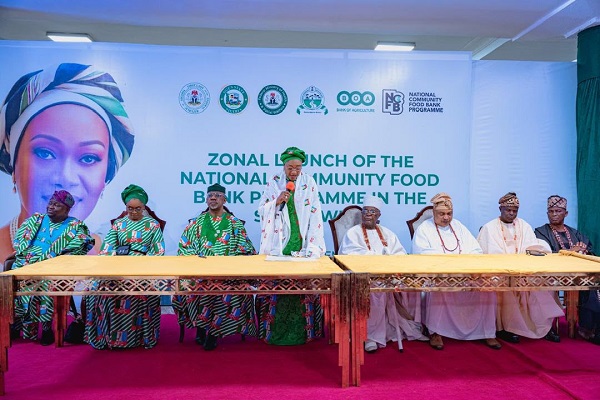
For a family struggling to put nutritious food on the table, hunger is rarely just about food.
It can affect a child’s development, a mother’s health and the wellbeing of an entire household.
This is the reality behind Nigeria’s continuing struggle with food insecurity and malnutrition, particularly among vulnerable families.
It is also the challenge the National Community Food Bank Program is seeking to address.
Nigeria’s First Lady, Senator Oluremi Tinubu, has launched the program in the South-West, expanding an initiative designed to provide vulnerable households with access to nutritious food and support efforts to reduce malnutrition across the country. The program is particularly focused on children below six years, pregnant women and lactating mothers.
In Ogun State, three community food banks have been established in Sagamu, Yewa North and Abeokuta South Local Government Areas as part of the South-West rollout.
But the significance of the initiative goes beyond the opening of three facilities.
It raises a bigger question:
Can bringing food and nutrition support closer to communities create a more effective and sustainable response to hunger?
Bringing Support Closer to Vulnerable Families
Food insecurity can be especially difficult for families who already face limited access to healthcare, income and social support.
For a household living on a tight budget, nutritious food may become one of the first things sacrificed when prices rise or income falls.
For young children, however, the consequences can be much more serious.
This is why the National Community Food Bank Programme is specifically focused on groups considered particularly vulnerable to the effects of food insecurity.
The programme is intended to make nutritious food available to disadvantaged households while supporting broader efforts to improve nutrition and address malnutrition.
The approach is also deliberately community-based.
The First Lady has called on state governments to establish food banks close to primary healthcare centres, creating a closer link between nutrition support and existing community health systems.
That connection is important.
Food insecurity is not simply a question of whether food exists.
It is also about whether vulnerable people can access the right food at the right time and in the places where support is most needed.
Why the Community Approach Matters
A national programme can have ambitious targets, but its impact is ultimately experienced at community level.
That is where families live.
That is where health workers interact with mothers and children.
That is where local leaders understand which households are most vulnerable.
And that is where support can either reach the people who need it or fall short.
The National Community Food Bank Programme is being implemented through a partnership involving the Office of the First Lady, the Federal Ministry of Health and Social Welfare, the National Primary Health Care Development Agency and the Bank of Agriculture.
The wider programme has already been rolled out across several geopolitical zones, including Borno for the North-East, Jigawa for the North-West and Kogi for the North-Central region, with further launches expected in the South-South and South-East.
This gradual expansion reflects an attempt to create a national system while allowing the intervention to operate through communities and existing institutions.
More Than a Food Distribution Programme
One detail is particularly important to understanding the programme.
The First Lady clarified that the community food banks are not food hubs for general commercial distribution.
They are intended for disadvantaged people, with the services and support provided free of charge.
That distinction matters because the purpose is not simply to increase the movement of food.
It is to direct support towards households that may otherwise struggle to afford adequate nutrition.
In that sense, the program sits within a much broader conversation around social protection and human development.
A child who receives adequate nutrition has a better foundation for growth.
A pregnant woman with access to nutritious food faces fewer barriers to maintaining her health.
A household with access to food support may have more room to cope with other economic pressures.
These effects can extend beyond the immediate food package.
The CSR and Social Impact Connection
From a CSR and social impact perspective, the program provides an important example of how an intervention can be designed around a clearly identified social need.
The need is straightforward:
vulnerable households need better access to nutritious food.
The intervention is also clear:
bring food support closer to communities and connect it with health systems.
But social impact is not measured only by the number of food banks established.
The more important questions come afterwards.
Are vulnerable families actually receiving support?
Are children experiencing better nutritional outcomes?
Are pregnant and lactating women being reached consistently?
Are communities aware of how the food banks work?
Are primary healthcare centres able to connect eligible families to the programme?
And can the facilities continue operating effectively over time?
These questions matter because a social initiative can have a strong launch and still struggle with implementation.
The Sustainability Question
The programme has been described as a sustainable response to food insecurity and hunger.
But sustainability requires more than establishing facilities.
It requires systems that can continue delivering support.
That means reliable food supply chains.
It means adequate resources.
It means effective coordination between federal and state institutions.
It means identifying eligible beneficiaries fairly.
It means community awareness.
And it means monitoring whether the programme is actually improving the conditions it was created to address.
The Bank of Agriculture has said it will strengthen the financial and supply chains supporting the program across the country, pointing to the importance of having systems behind the food banks themselves.
That is an important part of the conversation.
A food bank cannot create lasting impact simply because a building exists.
The system around it has to work.
Beyond Emergency Relief
There is also an opportunity to see the initiative as part of a wider shift in how food insecurity is addressed.
Emergency food support can be vital when families are struggling.
But long-term food security also depends on stronger systems around food production, distribution, affordability, healthcare, livelihoods and nutrition.
A food bank can help meet an immediate need.
But if the goal is to reduce vulnerability over time, it must sit alongside broader efforts that address why households remain unable to access adequate food.
That is where partnerships become important.
Government agencies, state governments, development organisations, communities and private-sector partners all have roles to play.
The National Community Food Bank Programme is therefore not only about what happens inside the food banks.
It is also about whether the institutions around them can work together to create a stronger social safety net.
Measuring What Matters
The rollout across the country will provide an opportunity to see whether a community-based model can deliver meaningful results at scale.
But the strongest measure of success will not be the number of launches.
It will be the number of vulnerable families reached and the difference the support makes in their lives.
Can fewer children go without nutritious meals?
Can vulnerable mothers access food support before nutritional challenges become more severe?
Can communities become better equipped to identify and respond to households at risk?
Can the programme remain accessible after the attention surrounding its launch fades?
Those are the measures that will determine whether the initiative becomes more than a promising intervention.
The Bigger Picture
Nigeria’s food insecurity challenge is too complex for a single program to solve.
But that does not make targeted interventions less important.
A community food bank cannot replace functioning food systems, affordable food, strong livelihoods or effective social protection.
What it can do is provide a practical line of support for families who need help now, while contributing to a larger national effort to improve nutrition and reduce vulnerability.
That is where the real significance of the National Community Food Bank Program lies.
It is not simply about putting food in a facility.
It is about making sure that, when a vulnerable family needs support, that support is closer, accessible and connected to the systems that can help them.
As the program expands into more parts of Nigeria, its success will ultimately depend on what happens beyond the launch ceremonies.
Because in social impact, the real question is never only how many programs were launched.
It is:
How many lives became better because they existed?
[give_form id="20698"]