csrreporters
Companies pour months of effort into their sustainability reports. They gather environmental data, consult stakeholders, commission specialist writers, and refine their disclosures through round after round of careful internal review. The result is often a detailed, polished document that reflects genuine organisational commitment to transparency, environmental responsibility, and social accountability.
However, in 2026, a growing number of those carefully produced reports are effectively invisible to the systems that now shape corporate reputation, investor perception, and public understanding. Those systems are AI tools. The large language models, search algorithms, and intelligent agents that people across every sector now rely on. These models filter, summarise, and interpret corporate information.
This is not a future problem. It is happening right now, quietly, across every sector and every region. Nevertheless, most sustainability and CSR reporting teams have not yet adjusted their thinking to reflect this new reality. Whether your company believes in the efficacy of AI tools or not, consumers and investors are using these tools.
So, the issue here is not the content of your sustainability report. Often, the content is thorough, accurate, and genuinely reflective of meaningful progress. The issue is the format, specifically, the widespread reliance on PDF-only sustainability reporting. This has created a significant and growing blind spot at the heart of corporate sustainability communication.
That blind spot is actively costing companies something they cannot easily recover: control of their own narrative.
For organisations that have invested real resources in sustainability performance and reporting, this matters enormously. So the conversation needs to expand beyond what a report says. Format has become a strategic issue, and the time to address it is now. According to CSR Reporters’ research, most companies will release their 2025 Sustainability Reports this quarter or next.
Why PDF Is No Longer Enough
For years, the PDF was the gold standard for sustainability reporting. It looked professional and was easy to distribute electronically. It also preserved design, typography, and layout across all devices and printing conditions. Consequently, it became the default format for almost every major sustainability disclosure, from integrated annual reports to standalone ESG documents.
That assumption, however, is now outdated, and the evidence behind this shift is becoming increasingly difficult to dismiss.
A study shared at a recent sustainability reporting webinar that CSR Reporters team members participated in, revealed that digital HTML reports receive three times more visibility than their PDF equivalents. Furthermore, when reports exist only in PDF format, AI systems tend to turn to external sources to fill the informational gaps. Those external sources may be incomplete. They may also be inaccurate. Additionally, they may reflect outdated data, third-party interpretations, or selective citations that do not represent the company’s full story.
That shift in sourcing has enormous implications for corporate communication strategy. When a company publishes only a PDF report, it effectively hands control of its sustainability narrative to whoever AI happens to find first. That could be a third-party ESG rating agency applying its own methodology. Or a news outlet summarising last year’s disclosures, or even a social media post from a critical stakeholder. In other words, the company loses meaningful control over how its sustainability work is perceived and communicated.
When a company publishes only a PDF report, it effectively hands control of its sustainability narrative to whoever AI happens to find first.
Moreover, this is not a minor technical inconvenience that can be addressed at some unspecified future point. For organisations investing significant resources in sustainability performance and reporting, this is a real communication failure. This has real consequences for investor relations, stakeholder trust, and public credibility. Therefore, the conversation around sustainability reporting needs to expand beyond content quality and scope. Format has become just as strategic as substance.
AI Is Now a Gatekeeper of Corporate Reputation
To fully understand why this matters, it helps to understand what AI actually does with sustainability information when it encounters it.
AI tools do not read reports the way human analysts do. They do not start at page one and work methodically through to the conclusion. Instead, they scan, extract, summarise, and synthesise. They act as intelligent filters, concentrating on information that is most accessible, most clearly structured, and most consistently labelled. Sustainability data is very much part of what these systems prioritise, given the growing importance of ESG information to financial markets, regulatory compliance, and public accountability.
As a result, the way your sustainability data is structured has a direct and measurable impact on how your company is ultimately understood across digital channels. This is no longer theoretical. It is the operating reality of 2026.
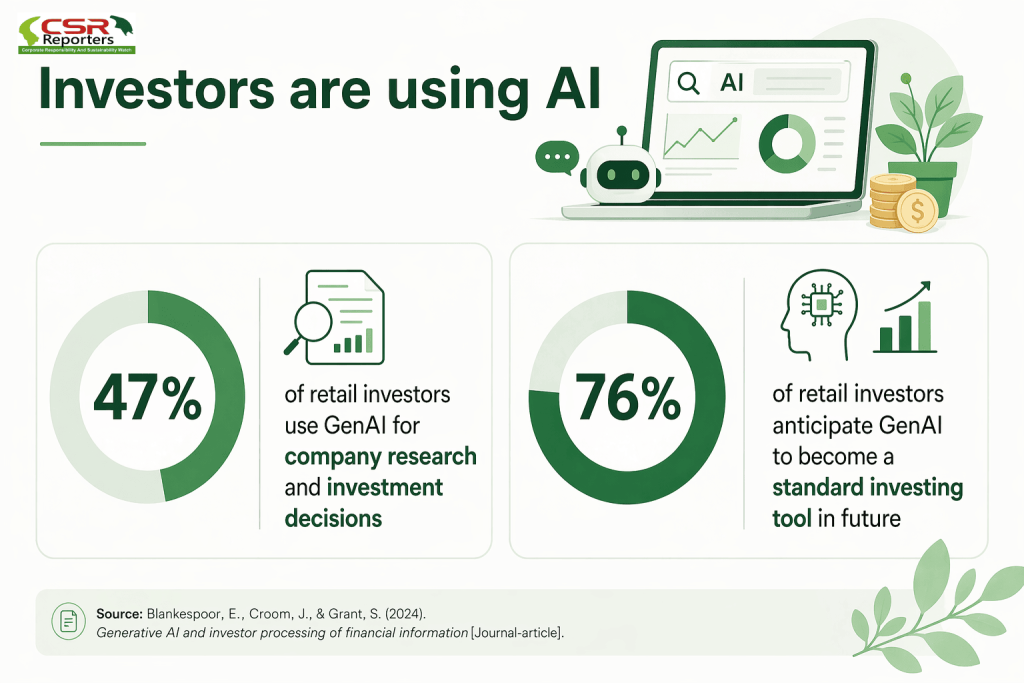
Investors, moreover, are already using AI to scan multiple sustainability reports simultaneously. They are looking for comparable data points, consistent performance narratives, and clear disclosure of material risks and opportunities. If your report is structured in a way that makes that extraction difficult, even your strongest results may go unrecognised or misrepresented. Meanwhile, a competitor with a well-structured digital report gains a clarity advantage that has nothing to do with the actual quality of their sustainability performance. That is a deeply unfair outcome, but it is increasingly a common one.
Consider, additionally, how journalists and analysts now work. AI-assisted research is standard practice in many newsrooms and financial institutions. When a reporter needs to verify a sustainability claim, or when an analyst needs to benchmark a company against its peers, they frequently rely on AI tools to accelerate their process. If your sustainability data is buried in a static PDF, those tools will look elsewhere for the answers they need. And the information they find elsewhere will shape the story that gets told about you.
Investors are using AI to scan multiple sustainability reports simultaneously. They are looking for comparable data points, consistent performance narratives, and clear disclosure of material risks and opportunities.
The question, therefore, is no longer simply whether your report is well designed. The more important and more urgent question is this: can AI understand it clearly, interpret it accurately, and represent it faithfully when explaining your company to the world?
The Structural Difference Between PDF and HTML
So what specifically makes HTML reporting so much more effective for AI readability? The answer comes down to the fundamental difference between a static document and a structured digital resource.
A PDF is essentially a fixed, visual representation of a document. It preserves the appearance of the original layout extremely well. However, it does not communicate meaning to machines in a way they can easily process. Headers may look like headers to a human reader, but a PDF does not inherently signal to a machine that those headers represent meaningful section titles. Data tables may appear clearly formatted visually, but the semantic relationships between data points are often lost or significantly degraded in the conversion to PDF format.
By contrast, an HTML report uses semantic structure. That means the document itself actively communicates meaning to machines through its coding. A heading is tagged as a heading. A list is tagged as a list. Data tables include descriptive headers. Key terms can be consistently labelled and identified across the document. Consequently, AI systems can navigate an HTML report, identify what matters most, extract specific data points, and represent the information far more accurately.
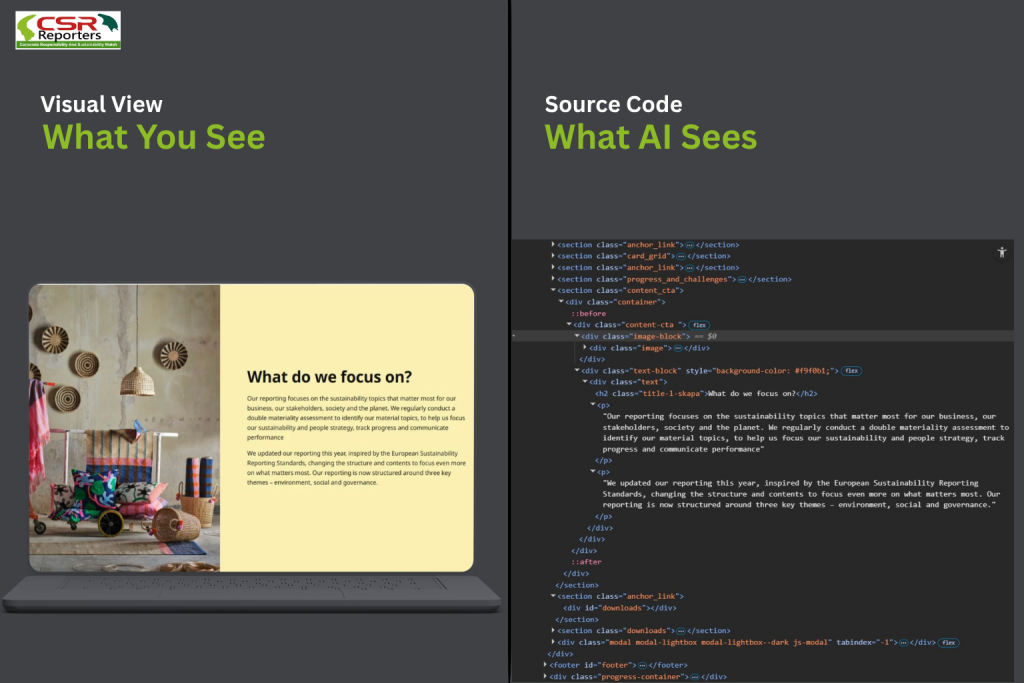
Furthermore, HTML reports live on your company’s website. That means they benefit from search engine visibility, inbound links from other digital sources, and the broader ecosystem of web discoverability. They are, in practical terms, part of the live web, while a PDF exists largely outside of it. Over time, a well-maintained HTML report builds digital authority that a PDF simply cannot accumulate.
Additionally, smaller structural choices add up to significant differences in how AI processes and represents your content. For example, a simple bullet list communicates more to an AI system than the same information presented in a dense paragraph. Clear, descriptive headings signal hierarchy and importance. Consistent labelling of performance metrics across different sections helps AI systems recognise and compare data accurately, rather than treating repeated references as unrelated pieces of information.
None of these changes require a fundamental overhaul of the reporting process. However, they do require a genuine shift in how reporting teams think about the purpose and intended audience of the documents they produce.
Reporting for AI: A New Mindset for Sustainability Teams
Here is the core shift that sustainability and CSR teams need to make. A sustainability report is no longer just a communication tool for human readers. It is also data infrastructure for AI systems, and it needs to function effectively in both capacities simultaneously.
That framing may feel unfamiliar at first. Most reporting teams naturally think about their audience in human terms: investors, employees, regulators, civil society organisations, and community stakeholders. Those audiences still matter enormously, and nothing about this shift changes that.
Nevertheless, AI is now an additional and increasingly significant layer between your report and all of those human audiences. It scans, filters, summarises, and selects. In many practical situations today, it is the first point of contact between your sustainability data and the decision-makers who need it.
Think about it from an investor’s perspective. When an investment analyst asks an AI assistant to compare the sustainability performance of twenty companies within a sector, the AI does not download and read each report from cover to cover. Instead, it identifies the most accessible, best-structured sources of relevant data and builds its summary from there.
Accordingly, companies whose reports are easiest for AI to process will have their stories told most accurately and most completely. The companies whose reports are locked in static PDFs may find that key achievements, nuanced commitments, or critical context simply go unrepresented in that summary.
Therefore, every sustainability team should be asking a fundamental strategic question: when AI explains your company to the world, will it rely on your own reporting, or will it rely on someone else’s interpretation of your work?
That question is not hypothetical. It has direct and practical implications for investor relations, regulatory credibility, media representation, and public trust. The answer depends significantly on the choices that reporting teams make today about format, structure, and digital accessibility. Getting this right is not optional; it is increasingly a condition of being heard.
Companies whose reports are easiest for AI to process will have their stories told most accurately and most completely. The companies whose reports are locked in static PDFs may find that key achievements, nuanced commitments, or critical context simply go unrepresented in that summary.
How to Make Your Sustainability Report AI-Ready
The good news is that making a sustainability report more AI-readable does not require abandoning existing processes or starting from scratch. In fact, many of the most impactful changes are relatively straightforward to implement. This is even within existing reporting workflows and budgets.
- Publish an HTML version of your report on your company website. This is the single most impactful step a reporting team can take. A digital HTML report is highly machine-readable by default. It is visible to search engines, accessible to AI systems, and embedded in the live digital ecosystem. Importantly, it does not replace the PDF version. Instead, it works alongside it. Think of the HTML report as your primary digital channel for sustainability communication and the PDF as a formatted archival reference.
- Use clear semantic headings and subheadings throughout. Structure your report with a logical and consistent hierarchy of descriptive headings. Make sure those headings accurately describe the content that follows them. This helps AI systems navigate the document, understand its organisational structure, and quickly identify the sections most relevant to specific queries from investors, journalists, or regulators.
- Organise key data in structured, clearly labelled formats. Where possible, present performance data in tables, summary lists, or clearly marked sections. Avoid embedding important figures in long narrative paragraphs where they are harder to locate and extract. For instance, a clean summary table of your key performance indicators is significantly more machine-readable than a flowing paragraph that describes the same numbers in narrative form.
- Use intentional bullet points for key information. Bullet lists are a simple but powerful structural tool. They create clear, distinct information units that AI systems can identify, process, and represent effectively. Use them deliberately for key targets, performance summaries, strategic commitments, and defined action items.
- Write clearly and avoid unnecessary jargon. This advice applies equally to human readers and AI systems. What confuses a human reader will also confuse an AI. Ambiguous language, unclear cross-references, and overly complex sentence structures all reduce the accuracy with which AI can represent your content. Plain, direct language benefits every audience, every time.
- Use consistent terminology throughout the document. If you label your scope one emissions reduction target in one section, use exactly the same label when referring to it elsewhere. Consistency helps AI systems connect information across different parts of the report and construct an accurate, coherent picture of your sustainability profile rather than treating related data points as entirely separate pieces of information.
Together, these steps do not transform your reporting into a purely technical exercise. Instead, they create a structure that genuinely works for both the machines that process your data and the humans who ultimately act on it.
The Human-AI Balance: The Nuance Most Teams Miss
Here is where the conversation becomes genuinely interesting, and where most commentary on AI-ready reporting tends to fall short of the full picture.
The principle that what confuses humans also confuses AI is fairly well understood at this point. However, the reverse dimension is equally worth careful consideration. What is perfectly optimised for AI can sometimes feel cold, mechanical, or overly sterile to human readers. A document stripped of narrative voice and human context in pursuit of machine readability may actually undermine engagement with the very audiences whose trust a sustainability report is designed to build.
This creates a real tension that sustainability teams need to navigate thoughtfully and deliberately. On one hand, the move toward structured, semantic, clearly organised content is absolutely the right direction for all the reasons outlined above.
On the other hand, sustainability reports are not simply data files. They are also communication instruments as they carry narrative, values, organisational culture, and human stories. They are frequently read by employees, community members, and civil society groups who respond to tone, voice, and the sense of genuine commitment behind the words.
Therefore, the goal is not to optimise purely for machines at the expense of human readers. Instead, the goal is dual readability: a report that is simultaneously engaging and meaningful for human audiences and clearly interpretable by AI systems.
In practice, you achieve this balance through deliberate layering. Use strong semantic structure, consistent labelling, and clear data formatting to organise your material for machine readability. Then, within that structure, use narrative sections, case studies, leadership perspectives, and community stories to bring the human dimension of your sustainability work to life. The structure serves the machines. The storytelling serves the people. Both are necessary, and neither needs to compromise the other when done well.
Furthermore, this balance is genuinely a quality signal. A report that is well-structured, clearly written, and richly contextualised is a better report by almost any standard. The discipline of writing with AI readability in mind frequently produces improvements that human readers also appreciate. This includes greater clarity, stronger organisation, and more accessible data presentation.
So, rather than viewing AI readability as an additional burden, sustainability teams can approach it as a practical opportunity to raise the overall quality and impact of their reporting.
Narrative Control in an AI-Mediated World
There is one final dimension of this conversation that deserves direct attention, because it goes beyond technical formatting and into the realm of strategic communication leadership.
Your sustainability report is your primary source of record. It is the document your organisation controls fully. It is the place where you define your commitments, describe your progress, acknowledge your challenges honestly, and frame your sustainability journey on your own terms. That control is genuinely valuable, and it needs to be protected actively rather than surrendered by default.
When AI draws on a well-structured HTML report, it draws on that controlled source. Consequently, it is far more likely to represent your story accurately, using your terminology and your framing. Your targets are described the way you intended them. All your achievements are presented in their proper context. Your approach to material issues reflects your own understanding of what matters and why, rather than a secondary interpretation shaped by someone else’s priorities.
However, when AI cannot easily access your report, or when your report is locked in a format that resists effective machine reading, it compensates. It finds other sources.
This means it may encounter your report cited selectively in a third-party analysis. It may find your performance data summarised in a financial database that applies its own rating methodology. It may also encounter critical media coverage or advocacy reports that frame your work very differently from how you would frame it yourself. Each of those secondary sources adds a layer of interpretation and, potentially, a layer of distortion that you cannot control or correct after the fact.
Additionally, consider the speed at which AI tools now summarise and synthesise information. An investor using AI to evaluate companies across a sector does not spend hours manually analysing each report. They ask a question and receive a structured summary within seconds. The accuracy of that summary depends entirely on the quality and accessibility of the underlying data. If your underlying data is difficult to access or poorly structured, the summary will be imprecise. In a competitive investment environment, that imprecision carries real consequences for capital allocation decisions.
Ultimately, publishing a well-structured HTML sustainability report is an act of narrative control. It is a deliberate organisational choice to ensure that when AI explains your company, it uses your words, your data, and your framing. That strategic importance is far greater than most sustainability reporting teams currently recognise, and acknowledging it is the first step toward acting on it.
The Moment to Act Is Now
This is not simply a conversation about file formats. It is a conversation about who gets to define your sustainability story in an AI-mediated world, and whether your organisation has made the structural choices necessary to remain the authoritative source of that story.
Companies that recognise this shift early will gain a meaningful and compounding advantage. Their sustainability data will be more visible, more accessible, and more accurately represented across the digital ecosystem. Their performance narratives will reach investors, analysts, journalists, regulators, and the public with greater fidelity and precision. Furthermore, their HTML reports will continue to build digital authority over time as they accumulate links, citations, and references within the systems that now shape public understanding.
By contrast, organisations that continue to rely exclusively on PDF-only reporting will find that their carefully constructed narratives are increasingly filtered, fragmented, or replaced by secondary interpretations over which they have no meaningful control. That is not a scenario any serious sustainability communicator should be comfortable with.
The transition to AI-readable HTML reporting is not a radical departure from good practice. It is, instead, a natural and necessary evolution of what effective sustainability communication has always demanded: clarity, structure, accessibility, and a genuine commitment to reaching the audiences that matter most. The audience has simply expanded to include machines, and the approach needs to evolve accordingly.
As AI increasingly explains companies to the world, the most important question is no longer whether your sustainability report is comprehensive or beautifully designed. The most important question is whether the systems that now shape perception, investment decisions, and public understanding will find it, read it accurately, and use it to tell your story on your terms.
That answer is largely yours to determine. The format you choose for your next sustainability report will play a far larger role in shaping that answer than most teams currently appreciate. The gap between companies that understand this shift and those that do not is already widening. And the longer that gap is allowed to grow, the harder it becomes to close.
As AI reshapes how investors make decisions, the real question is no longer if but how fast. Stay ahead of the curve with CSR Reporters and get analysis that matters when it matters most.
[give_form id="20698"]