


 CHUKS OLUIGBO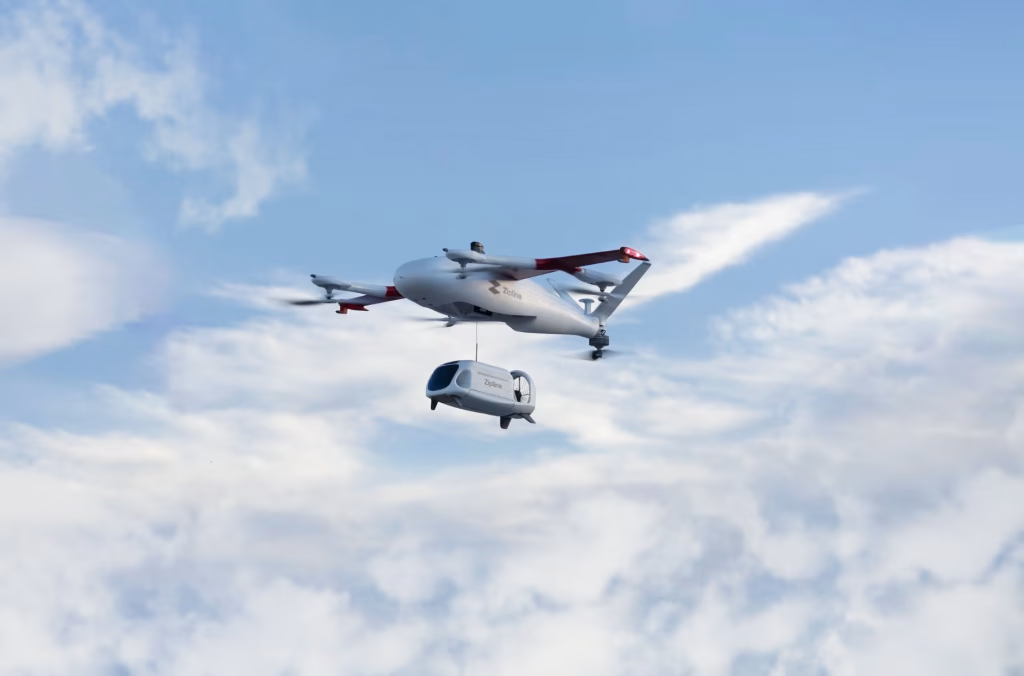
Zipline drone. Source: zipline.com
Zipline’s autonomous logistics network has extended its impact in Africa beyond the public health use case that it’s best known for, delivering measurable results in nutrition systems, agricultural productivity, and household incomes.
Findings from three new studies show a 22 per cent reduction in child fatalities from severe acute malnutrition, a 68 per cent direct return on investment for smallholder pig farmers, and $850 to $1,200 in additional annual household income near Zipline distribution hubs, suggesting that Zipline’s distribution infrastructure is registering impact beyond improved access to health products. Its impact extends to Environmental, Social and Governance.
Zipline, an American-based company, came into being in 2014 pioneering autonomous drone technology to address critical healthcare and logistical challenges worldwide. It operates in multiple countries, including Rwanda, Ghana, Nigeria, Kenya, and Côte d’Ivoire, as well as in the United States and Japan.
What the Studies Show
Three separate studies, in agriculture, nutrition, and economic outcomes, show a 68% return on investment for smallholder farmers, a 22% reduction in childhood deaths from severe malnutrition, and $850-$1,200 in additional income per household per year, respectively.
Agricultural Returns
A peer-reviewed study published in Frontiers in Veterinary Science evaluated the impact of Zipline’s aerial logistics model on pig farming in Rwanda, where drone-delivered pig semen was paired with localized training for community animal health workers across eight rural districts. The programme, run in partnership with the Rwanda Agriculture and Animal Resources Development Board and Feed the Future Rwanda, set out to test whether reliable, temperature-controlled delivery could turn artificial insemination into a viable income source for smallholder pig farmers.
Key results from the study show 17 per cent of the increase in farmers’ income was attributable to Zipline; the programme generated nearly $129,000 more in direct farmer income than it cost to implement, representing a 68 per cent return on investment, and community animal health workers reported a 74.8 per cent rise in artificial insemination success rates, up from 48.8 per cent, after integrating drone logistics.
Nutrition Outcomes
In a separate study that evaluated whether Zipline’s drone delivery of ready-to-use therapeutic food (RUTF) changes outcomes for children with severe acute malnutrition in Rwanda, the researchers compared 299 Zipline-served and non-served facilities over a five-year period.
(RUTF is the standard treatment for severe acute malnutrition in children, but when clinics run out, treatment stops. Zipline delivers RUTF on demand from central stock, so facilities no longer have to predict demand or carry excess inventory.)
Key results at Zipline-served facilities compared to non-served facilities show that in-hospital childhood deaths from severe malnutrition fell 22 per cent; severe acute malnutrition encounters fell across every age group: 22 per cent in children under 2, 42 per cent in ages 2 to 5, and 84 per cent in children older than 5; and severe anemia encounters in children aged 2 to 59 months fell 46 per cent.
In what is considered one of the largest system-wide reductions ever in severe child malnutrition consultations, malnutrition-related hospitalisations rose by 21 per cent, but deaths did not, indicating that Zipline-served facilities were identifying more children, referring them sooner, and sustaining treatment they previously could not complete.
Pedro Kremer, Head of Impact and Research at Zipline, said, “The protocol for treating malnutrition has not changed. What changed was whether supplies were there when clinicians needed them. That is the variable these studies are measuring – and the results are unambiguous.”
Economic Impact
A third study that measured the wider economic footprint of Zipline’s GH3 distribution hub in northern Ghana combined a household survey with a satellite analysis of nighttime light intensity benchmarked against 82 comparable locations across the country. The research question was simple: when a logistics hub built to serve the health system arrives in a community, does the surrounding economy change?
Findings show that households within 2 km of the Zipline GH3 hub gained $850 to $1,200 in additional income per year; household acquisition of liquid assets falls about 27 per cent with every additional 1.5 km from the hub, with a gap of over 30 percentage points between the nearest and farthest communities; and improvements in drinking-water access follow the same proximity pattern, 6 per cent near the hub versus 2 per cent farther out.
Satellite-measured nighttime light intensity, a recognized proxy for local economic activity, is significantly higher near GH3 than at the 82 comparable locations used as benchmarks.
What Zipline Is Saying
The research, according to Caitlin Burton, CEO for Africa and Emerging Markets at Zipline, “shows what communities and governments across Africa have seen firsthand: when essential supplies reliably reach the people who need them, outcomes change”.
“Zipline began by improving access to critical health supplies. Today, the same infrastructure is strengthening nutrition systems, agricultural productivity and local economies,” Burton said.
Why This Matters for Africa
In Africa, where inadequate road networks and limited transportation options hinder movement of medical and other supplies, and challenging terrains pose significant barriers to accessing rural and hard-to-reach areas, Zipline is transforming access to healthcare. From Kenya to Rwanda, Nigeria to Cote d’Iviore, Zipline drones’ ability to transport supplies within 15 to 45 minutes means that delays in delivery of medical supplies (vaccines, medicines, and diagnostic kits) and the challenges of insufficient cold chain facilities and poor temperature control that could worsen preventable illnesses can be eliminated. This can reduce infant and maternal mortality, malnutrition, malaria, and other pressing health challenges.
In Nigeria, Zipline has operations in Kaduna, Cross River and Bayelsa States, serving over 1,300 health facilities and about six million people. In Bayelsa, the drones made over 2,400 deliveries to 210 health facilities between February and June 2023, and in Cross River, from deployment in 2023 to July 2024, they delivered over 1 million vaccine doses to communities and health facilities across nine local government areas. The company plans to build 12 additional distribution centres, expanding its network to 15 facilities nationwide to connect up to 20,000 health facilities and provide access to healthcare commodities for nearly 100 million Nigerians by 2028.
With Zipline’s recent expansion into consumer products and food deliveries, African consumers in local communities, just like their counterparts in urban areas, can access instant delivery of everyday goods, food, and agricultural supplies, thus bridging the urban-rural divide.
It is also good news for small businesses as it facilitates retail and e-commerce deliveries. Local businesses can now operate on-demand inventory models, leading to better services and improved economic outcomes.
This ESG Perspective
The expansion of Zipline’s autonomous drone delivery system in Africa beyond emergency medical supplies to support retail, e-commerce, and animal health has broader positive implications for ESG.
Environmental (E): Being entirely battery-powered, Zipline drones produce zero direct carbon emissions during flight. The drones deliver straight to the recipient from local distribution centres, effectively bypassing congested and poor road networks, accelerating delivery times, lowering overall transport emissions, and cutting supply-chain product waste.
Also, with a delivery method that utilizes a tethered mini-droid to drop the package from a hover, Zipline drones consume less overall energy than if the larger main drone were to descend and land for every delivery.
Social (S): Zipline’s social impact extends beyond expanding social equity and improving health outcomes for tens of millions of people through better healthcare access. It is also visible in job creation. Every Zipline distribution hub in Africa is staffed entirely by local talent, creating jobs and impacting local communities.
Governance (G): Zipline operates in direct partnerships with national governments, businesses and philanthropic organizations, including the Elton John AIDS Foundation, the Gates Foundation, Gavi, Pfizer, and The UPS Foundation, enabling data-driven transparency, improved regulatory frameworks for autonomous tech, and supply chain accountability. This has also helped Zipline and its partner governments to develop a wealth of empirical evidence that advances understanding of how improved supply chain performance increases timely treatment and ultimately saves lives.
What’s Next?
Since its establishment in 2014, Zipline has evolved from an emergency medical drone service to a transformative, multi-sector logistics network currently operating on four continents and serving federal and state health systems, health care institutions, restaurants and retailers.
With more than 130 million commercial autonomous miles safely flown to date, over two million deliveries, and its recent expansion into consumer products and food deliveries, Zipline’s impact is being felt across multiple sectors in different markets.
The company now requires more partnerships with governments and NGOs to further expand its operations into currently inaccessible areas. In Nigeria, one of of its best continental bets, Zipline is pursuing an ambitious federal-scale framework that would allow states to integrate more seamlessly into a national autonomous delivery network.
Scaled responsibly, the technology can mature from just serving localised rural districts into a strategic tool to mitigate global supply chain disruptions and maintain steady economic activity. But there will be need to strengthen regulatory frameworks to ease drone operations across borders.
[give_form id="20698"]