Wilderness Holdings Secures $175 Million in Sustainable Finance to Expand African Operations
 CHUKS OLUIGBO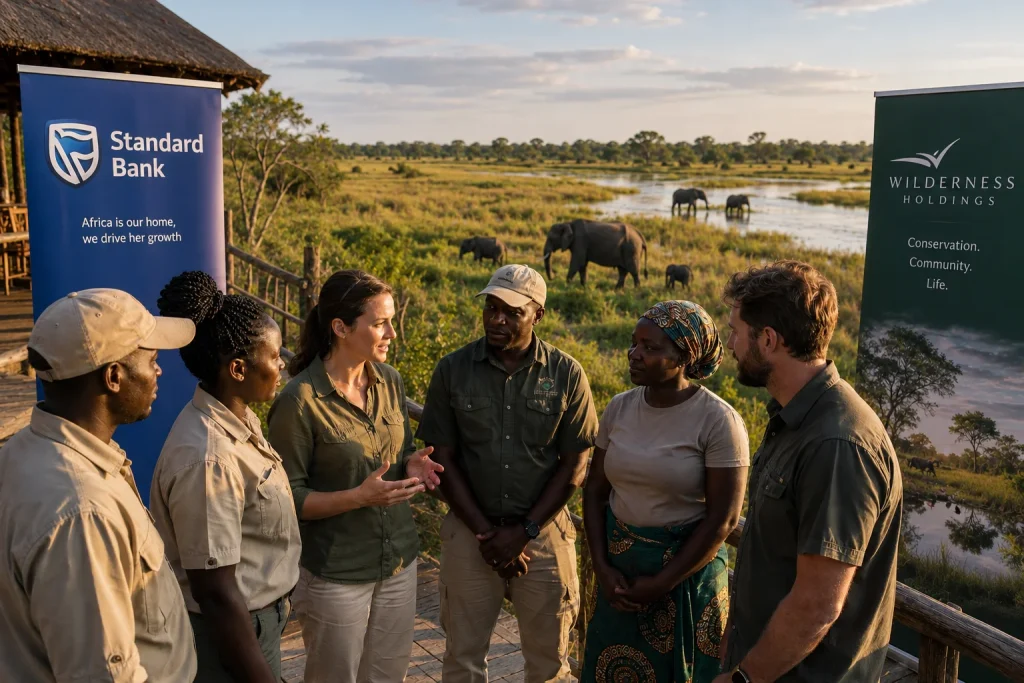
Image credit: ESG Now Digital
In a demonstration of how private capital can be mobilised to support conservation objectives, Standard Bank has arranged a $175 million sustainable financing package for Wilderness Holdings that is expected to provide the conservation and eco-tourism operator with the financial certainty needed to pursue future expansion opportunities while maintaining its conservation mandate.
The transaction, led by Standard Bank as sole mandated lead arranger, underwriter, and sustainability co-ordinator, consists of a $125 million term facility and a $50 million revolving credit facility.
Structured over a five-year period, the funding package is designed to strengthen Wilderness Holdings’ liquidity position, extend debt maturities, and provide greater financial flexibility as the company expands its operations across Africa.
The transaction, which represents one of the more significant sustainable finance deals in the continent’s tourism and conservation sector in recent years, highlights growing investor appetite for businesses that combine environmental stewardship with long-term commercial growth.
A Commitment to Conservation and Biodiversity Protection
Wilderness Holding Limited is a globally recognized conservation and ecotourism group dedicated to promoting and managing responsible and sustainable wildlife tourism in southern Africa.
According to African Financials, the Group operates 45 safari camps and lodges and 10 scheduled overland safaris across eight African countries – Botswana, Congo, Kenya, Namibia, Seychelles, South Africa, Zambia and Zimbabwe – with a combined capacity to host 35,000 guests per year.
The company manages over 2.5 million hectares of protected land through a network of concessions and conservation partnerships spanning some of the continent’s most significant ecosystems, from the Okavango Delta to the Namib Desert, Hwange National Park, Mana Pools National Park, Damaraland, Etosha and Kafue National Park.
ESG Now reports that Wilderness, through its high-value, low-volume tourism model, channels guest revenues into anti-poaching initiatives, habitat restoration programmes, wildlife monitoring, species protection projects and long-term land stewardship agreements. By generating economic value from intact ecosystems rather than resource extraction, the company has positioned conservation as a commercially viable land-use model, linking tourism income directly to biodiversity protection and community development outcomes across Africa.
A Landmark Sustainable Finance Deal
Deputy Head of Debt Financing Solutions at Standard Bank Corporate and Investment Banking, Brydone Graham, said the transaction was concluded after several discussions.
“Having walked a long journey with Wilderness, we are proud to have partnered with them on this landmark sustainable finance deal,” Graham said.
He added that the financing supports a business that demonstrates how conservation, community development, and commercially resilient growth can coexist within a single operating model.
The funding arrangement by Standard Bank incorporates impact reporting mechanisms that will track indicators, including the extent of land under conservation management and the economic value generated through conservation-related activities.
Why It Matters
The Wilderness transaction comes as biodiversity protection and climate resilience rise on the global investment agenda.
Latest data from the Climate Bonds Initiative, as reported by ESG Now, put cumulative issuance of aligned green, social, sustainability, and sustainability-linked debt at over $7 trillion in May 2026, having added almost $6 trillion since 2020 alone. Annual sustainable debt issuance has exceeded $1 trillion for three consecutive years, underscoring the rapid mainstreaming of environmental and social financing instruments across global capital markets.
Green bonds remain the dominant asset class, accounting for more than $4 trillion of cumulative issuance worldwide, according to the Climate Bonds Initiative, while sustainability and social bonds continue to attract strong institutional demand.
But despite the growth of sustainable finance globally, biodiversity and conservation-focused transactions remain a relatively small segment of the market, at just roughly $90 billion to $100 billion in annual direct finance flows, according to OECD. Thus, the Standard Bank financing stands out for both its size and its direct link to conservation outcomes.
A Significant Milestone for Wilderness Holdings’ Long-Term Strategy
The funding is expected to provide Wilderness Holdings with the financial certainty it needs to pursue future expansion opportunities while maintaining its conservation mandate.
Chief Executive Officer, Keith Vincent, described the transaction as a significant milestone for the group’s long-term strategy.
“This transaction represents an important milestone for Wilderness as we continue to scale our conservation and eco-tourism platform across Africa,” Vincent said.
He noted that the financing structure and its sustainability alignment would provide the flexibility and certainty required to support the company’s growth ambitions over the coming years.
[give_form id="20698"]