ROSEMARY IMOBHIO
For decades, Nigeria has been a taker in the global solar story, not a maker. Households and businesses fleeing an unreliable grid have depended almost entirely on imported panels. Most of them shipped in from China.
So the news that Nigeria exported ₦85.79 billion worth of solar panels in the first quarter of 2026, with the United States as its single biggest customer, has landed like a plot twist nobody saw coming. It is a genuinely striking reversal.
Yet the more interesting question is not whether Nigeria is exporting solar panels. It clearly is. The question is whether this marks the start of real industrial capability. Or whether Nigeria is simply catching a wave created by trade tensions between Washington and Beijing. That distinction will decide whether this moment becomes a lasting chapter in Africa’s clean energy transition or a fleeting statistic.
The Numbers Behind Nigeria’s Solar Export Boom
According to the National Bureau of Statistics Foreign Trade Report for the first quarter of 2026, Nigeria exported ₦85.79 billion worth of goods classified as photovoltaic cells assembled into modules or panels. The United States led all buyers with purchases worth ₦34.23 billion, followed by Burkina Faso at ₦20.40 billion. India bought at ₦13.85 billion, and Indonesia at ₦12.71 billion, with Ghana and other markets making up the rest.
That figure is remarkable partly because of what came before it. Nigeria imported ₦435.52 billion worth of solar products in 2025 alone. Meaning the country remains, on balance, a net importer even as it begins exporting.
Meanwhile, the Rural Electrification Agency reports that local manufacturing capacity has climbed from 120 megawatts two years ago to roughly 300 megawatts today. This with an additional 3.7 gigawatts in the pipeline. REA managing director Abba Aliyu disclosed the figures during an April webinar, describing them as evidence of deliberate government policy rather than accident.
Investment has followed the momentum. Nigeria attracted approximately $425 million in 2025 to build eight renewable energy manufacturing facilities. Consequently, the sector now looks less like a handful of assemblers and more like an emerging industrial cluster, at least on paper.
Why the United States Suddenly Needs Suppliers Like Nigeria
Nigeria’s rise as a supplier to America is not happening in isolation. It is tied to a broader restructuring of global solar trade. One driven by Washington’s effort to cut its dependence on China-linked manufacturing.
According to data reviewed by CSR Reporters, Nigeria ranked among the top ten source countries for solar module imports into the United States in the first quarter of 2026. Even as overall American solar imports fell to their lowest quarterly level in almost seven years.
The trigger was a new rule known as the Foreign Entity of Concern restriction. It took effect at the start of 2026 and blocks products linked to designated foreign entities from qualifying for key American clean energy incentives.
In simple terms, Washington tightened the rules on which supply chains count as trustworthy, and China no longer easily qualifies. As a result, importers rushed to bring in panels before the deadline, then pulled back sharply once it arrived. An expert CSR Reporters spoke to, described the shift as driven by a natural rush to ship modules and cells before that deadline. He added that a recovery is likely once the market adjusts.
This is where countries such as Nigeria, Kenya, and Ethiopia gain relevance. US developers are in a search for alternative sources that satisfy the new compliance rules. African assemblers with access to global components suddenly look attractive, regardless of how much of the actual manufacturing happens on their soil.
Is Nigeria Truly Manufacturing These Solar Panels?
This is the question that separates celebration from scrutiny. On the surface, Nigeria’s numbers look impressive. Underneath, the picture is more complicated.
CSR Reporters discovered that solar cell and component imports for local assembly reached 837 megawatts in 2025. More than the cumulative 375 megawatts imported across all previous years combined. In other words, the raw materials flowing into Nigerian factories grew explosively at the same time exports did.
This suggests assembly, not deep manufacturing, is driving the boom. Industry analysts we spoke to describe this candidly. Renewable energy experts note that most Nigerian facilities currently import solar cells, wafers, and other core components from China, then assemble them into finished modules locally.
Now note that this is a legitimate first rung on the industrial ladder. It is how several Asian manufacturing hubs began decades ago. However, it is not the same as producing polysilicon, ingots, or wafers domestically. And that is where the capital-intensive heart of the solar value chain lies.
Some projects point toward deeper localisation. In Jigawa State, there is a planned 100 megawatt facility. It is backed by a joint venture between a Beijing-based firm and a Nigerian energy company. The goal is to be the first plant in the country to manufacture panels locally from start to finish. Backers project production costs could fall by 50 to 60 percent once operational.
Separately, the Rural Electrification Agency, InfraCorp, and Dutch firm Solarge BV have formed a special purpose vehicle. It is aimed at building a one gigawatt panel manufacturing plant. Trade analysts argue that until several such projects mature, Nigeria functions primarily as an assembly hub benefiting from geography and timing. Rather than a fully fledged manufacturing base competing with Asia on technology and cost.
The Green Jobs Opportunity
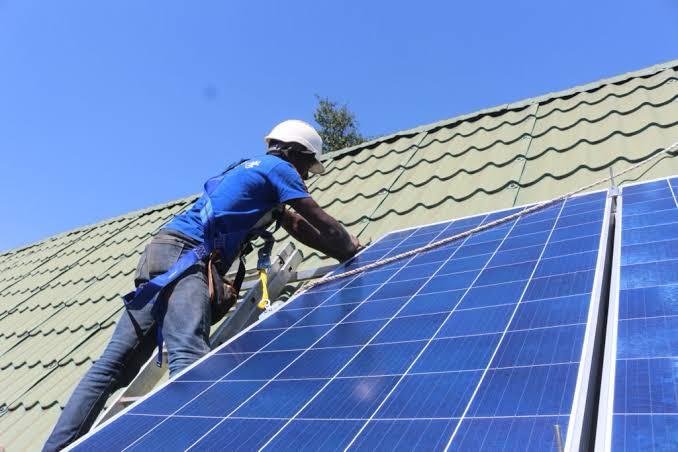
Even assembly-stage manufacturing creates jobs. This matters enormously in a country where youth unemployment remains a persistent crisis. Solar plants require technicians, quality control staff, logistics workers, and engineers, all trainable within a few years rather than a generation.
Manufacturing economists suggest that if Nigeria sustains its current investment pace, thousands of direct and indirect jobs could emerge across assembly lines, installation crews, and maintenance services.
Furthermore, the sector offers a rare opening for women in a historically male-dominated energy industry. Particularly in quality assurance, procurement, and community-facing distribution roles tied to mini-grid rollouts. If training programmes keep pace with factory expansion, Nigeria has a genuine shot at becoming West Africa’s renewable energy employment hub. Provided, of course, investment does not stall once the current export headlines fade.
What Does This Mean for Communities?
Ultimately, none of this matters unless ordinary Nigerians feel the benefit. The country’s grid supplied only about 3,940 megawatts to a population exceeding 220 million people as of March 2026. A shortfall so severe that Nigerians reportedly spend close to $14 billion a year running petrol and diesel generators. In Lagos alone, generator emissions are estimated to match the output of 8.5 million cars annually.
Local manufacturing, if it scales, could meaningfully lower solar costs by cutting shipping expenses and import duties. New regulations are already nudging things forward. The Nigerian Electricity Regulatory Commission’s 2026 Mini-Grid Regulations raised allowable mini-grid capacity from 1 megawatt to as much as 10 megawatts for interconnected systems. While separate Net Billing Regulations now let households and small businesses sell surplus solar power back into the grid.
The REA’s DARES programme, backed by $750 million in public funding, is expected to unlock a further $1.1 billion in private capital. It targets electricity access for 17.5 million Nigerians through 1,350 mini-grids. For rural communities that have never had reliable power, that kind of access can transform small businesses, clinics, and schools almost overnight.
Nigeria’s Bigger Ambition
Nigeria is not hiding its regional ambitions. The government has said expanded mini-grid capacity could support cross-border electricity trade. Especially around border communities, complementing the West African Power Pool’s grid connectivity work.
Notably, countries including Mozambique, Benin Republic, Burkina Faso, Niger, Chad, and Mauritania are studying Nigeria’s regulatory framework for possible adoption. In fact, Mauritius has entered active dialogue with Abuja about replicating the model.
If that interest converts into formal cooperation, Nigeria could position itself as an anchor for regional industrial policy in renewable energy, not merely a national success story. That would align with continental research suggesting Africa’s best path to competitive solar manufacturing lies in cross-border industrial cooperation rather than each country building in isolation.
A New Industrial Chapter, or a Missed One?
Nigeria’s solar export boom is real, and it deserves recognition. Billions of naira in panels are leaving Nigerian ports for American buyers. Buyers who, until recently, would never have considered the country a supplier. Still, the underlying story is one of assembly scaling faster than deep manufacturing, propelled as much by Washington’s trade politics as by Nigerian industrial strategy.
Whether this becomes a genuine turning point depends on what happens next. If Nigeria pushes decisively into cell and wafer production, sustains policy support beyond the current news cycle, and channels new jobs and cheaper power toward the communities that need them most, this could indeed mark the beginning of a new industrial chapter.
However, if local value addition stays shallow while the country simply rides a temporary shift in global supply chains, the moment risks becoming a footnote rather than a foundation. For now, Nigeria has earned its place in the conversation. The next few years will determine whether it earns a lasting seat in the room.
[give_form id="20698"]