


 ROSEMARY IMOBHIO
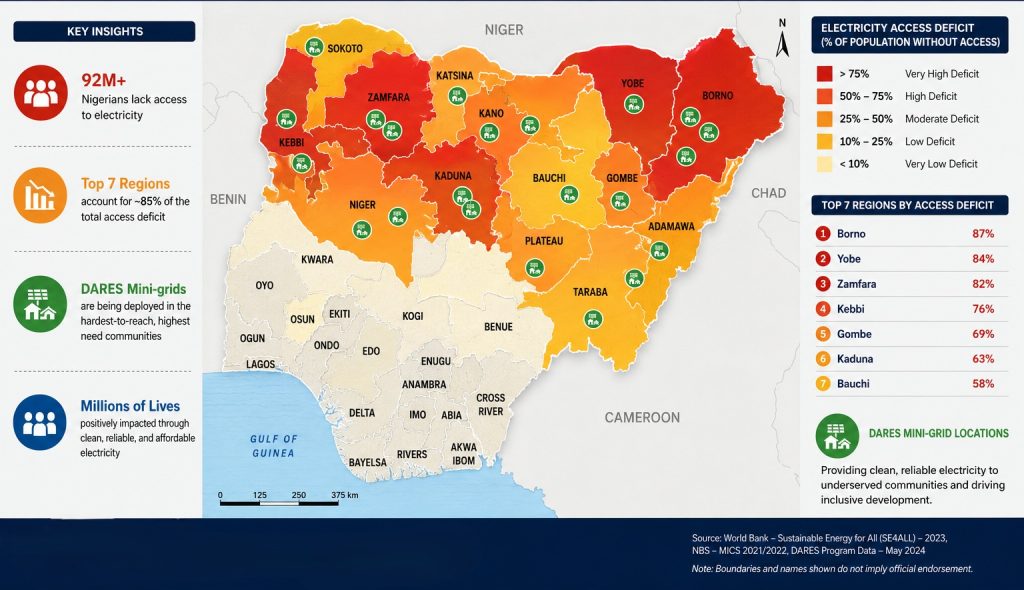
Nigeria has the world’s largest electricity access deficit. As of 2023, approximately 87 million Nigerians still lacked access to electricity, according to ESMAP data compiled by the World Bank. That figure means that despite being Africa’s largest economy, Nigeria trails many far smaller nations in ensuring that citizens and businesses can simply switch on a light. Across rural communities, families burn kerosene, schools struggle after dark, clinics depend on erratic diesel generators, and small businesses lose productive hours every single day. The national grid, despite decades of reform, reaches only about 61 percent of the population, and even connected communities often receive only a few hours of power per day.
Against this backdrop, the Nigerian Electricity Regulatory Commission (NERC) issued the Mini-Grid Regulations 2026 on 10 April 2026. The document, officially designated NERC-R-001-2026, replaces the 2023 framework and provides a comprehensive structure for the development, operation, and oversight of mini-grid electricity systems across the country. Issued under Section 226 of the Electricity Act 2023, the regulations immediately attracted attention from developers, investors, development finance institutions, and corporate sustainability teams.
The regulations matter not just because they address energy access. They matter because they signal a clear policy shift: Nigeria is now treating decentralised power not as a temporary workaround, but as a core pillar of its national electrification strategy. For ESG-conscious investors, sustainability professionals and companies operating in Nigeria, this development creates both opportunity and responsibility.
What Is a Mini-Grid?
A mini-grid, simply put, is a small electricity supply system with its own generation capacity that serves more than one customer. Think of it as a local power station that operates independently of, or in coordination with, the national distribution network. Mini-grids are typically powered by solar panels, small hydropower installations, wind systems, or hybrid solar-diesel setups.
Isolated vs. Interconnected
The 2026 regulations recognise two categories. Isolated mini-grids operate entirely independently of distribution company (DisCo) networks and typically serve communities that the national grid has never reached. Interconnected mini-grids, by contrast, are linked to existing distribution networks and function in coordination with a DisCo. Under the 2026 rules, isolated systems are permitted up to 5 megawatts (MW) per site, while interconnected systems can reach up to 10MW.
These are not niche technologies. Across rural Nigeria, individuals, NGOs, and private companies have increasingly deployed mini-grids to fill the electricity gap. The World Bank-funded Distributed Access through Renewable Energy Scale-up (DARES) programme is actively funding mini-grid deployments, with 391 projects already under grant agreements as of early 2026 and a stated target of improving energy access for 17.5 million Nigerians. Mini-grids, therefore, are central to Nigeria’s energy transition story, not peripheral to it.
Key Changes in the Mini-Grid Regulations 2026
Compared with the 2023 Framework
The 2026 regulations respond directly to practical frustrations that developers and investors encountered under the 2023 framework. The most material change is scale. Under the previous 2023 framework, mini-grids were capped at 1MW, which limited commercial viability and made it difficult to attract institutional capital. The jump to 5MW for isolated systems and 10MW for interconnected ones fundamentally changes the economics of mini-grid investment.
Key Changes at a Glance: 2023 vs. 2026 Mini-Grid Frameworks
| Feature | 2023 Regulations | 2026 Regulations |
| Isolated capacity | Up to 1 MW | Up to 5 MW |
| Interconnected capacity | Not clearly defined | Up to 10 MW |
| Permit processing | Undefined timeline | 30 business days |
| Grid arrival notice | Limited provisions | Minimum 12 months written notice |
| Reporting (>1MW) | Annual reports | Quarterly reports |
| Compensation framework | Basic provisions | Structured; lump sum or instalments |
| Site exclusivity | Limited | Explicit developer rights |
| State-level alignment | Not addressed | Explicitly accommodated |
Streamlined Permitting
The regulations introduce a tiered registration and permitting system. Mini-grids below 100 kilowatts (kW) need only register with NERC, while those above 100kW must obtain a permit. Critically, NERC is now required to process permit applications within 30 business days. This timeline certainty is meaningful. Previously, unclear processing periods created planning uncertainty for developers and complicated financial close with lenders. Today, developers can build project timelines with greater confidence.
Investor Protection and Site Exclusivity
One of the most significant additions is the explicit protection of developer interests. Developers now benefit from site exclusivity rights during the project development phase. This prevents other operators from entering a target community and undercutting an investment that is still being prepared. Furthermore, the regulations introduce a structured compensation framework for the scenario where the national grid eventually arrives at a mini-grid’s service area. Distribution companies must provide at least 12 months’ written notice before extending the grid into areas served by isolated mini-grids.
When the grid does arrive, operators and DisCos must negotiate a transition arrangement. Options include converting to an interconnected mini-grid, transferring assets, continuing operations under a commercial framework, or decommissioning. Where parties cannot reach agreement, NERC steps in to determine the outcome. Compensation, which excludes speculative profits, may be paid as a lump sum or in instalments, and operators may continue operating while transition arrangements are being finalised.
Reporting and Compliance
Transparency requirements have been strengthened. Operators of mini-grids below 1MW must submit annual reports to NERC, while operators of larger systems must file quarterly reports. NERC has also reserved the right to conduct ongoing monitoring and publish sector-wide data, which will improve market visibility and support investment decision-making over time.
Alignment with the Electricity Act 2023 and State Markets
The regulations sit firmly within the broader governance architecture created by the Electricity Act 2023. That legislation introduced state-level electricity markets, which means that many Nigerian states, particularly those without immediate access to the national transmission network, will rely heavily on mini-grids as their primary vehicle for electrification. The 2026 regulations explicitly accommodate state-level regulation, creating a flexible but coherent national framework.
What the Regulation Means for Rural Electrification
The practical implications for underserved communities are significant. With capacity thresholds raised considerably, mini-grid providers can now power more than households. A 3MW to 5MW isolated mini-grid can supply electricity to an entire village cluster while also supporting commercial uses such as cold storage for agriculture, agro-processing, water pumping, and small-scale manufacturing. Previously, the 1MW cap kept many systems in the household and lighting range, limiting broader economic impact.
Consider the effect on healthcare facilities. Clinics that cannot maintain refrigeration for vaccines or run diagnostic equipment are constrained by more than just medical capacity. They are constrained by energy poverty. Similarly, schools that cannot run computers, projectors, or extended evening study hours are limited in their educational delivery. Mini-grids under the 2026 framework are large enough to serve not just homes but entire community anchor institutions.
For SMEs and agricultural businesses, reliable mini-grid power under a commercially structured framework represents an important input cost stabiliser. Rather than depending on expensive diesel generators, businesses in mini-grid communities can access cleaner, lower-cost energy on a tariff basis. Over time, this reduces the cost of production, improves competitiveness, and creates conditions for local economic growth. Given that rural entrepreneurship remains underserved in Nigeria, the downstream effects of this regulation could be substantial.
What It Means for Investors and Businesses
For investors, the core appeal of the 2026 regulations is predictability. Before this framework, mini-grid investment in Nigeria carried a specific combination of risks: uncertain permitting timelines, ambiguous compensation if the grid arrived, unclear exclusivity arrangements, and insufficient scale to attract institutional capital. The new regulations address each of these concerns with reasonable clarity.
Regulatory certainty is the foundation of bankable infrastructure investment. The new framework repositions mini-grids as central to Nigeria’s power strategy. Rather than a stop-gap solution, they support a move towards larger, commercially viable portfolios. One that can blend donor, development finance, and private capital.
That blending is already happening. The IFC launched a $200 million DARES Platform in late 2024. In May 2025, it made its first investment of $5 million into Husk Power Systems Nigeria to expand solar hybrid mini-grids in Northern Nigeria. British International Investment committed alongside a $7.5 million facility through Odyssey Energy Solutions in September 2025 to address procurement financing gaps.
Domestic capital is moving too. In February 2026, the Rural Electrification Agency announced that Lotus Bank had made available a revolving credit facility of 100 billion naira, approximately $65 million, specifically for project developers participating in DARES and related renewable energy initiatives. The 2026 regulations provide the regulatory foundation beneath all of this capital, making the risk-return calculation for future investors clearer than it has ever been.
For renewable energy developers, the expanded capacity limits open larger project pipelines. A developer who previously had to structure multiple small-site projects to achieve scale can now build a single commercially meaningful asset. This reduces overhead, simplifies financing, and improves returns. For local and foreign investors alike, the combination of the new regulatory framework and active development finance programs makes Nigeria’s off-grid market materially more attractive.
The CSR Connection: Energy as Community Investment
For years, corporate community investment in Nigeria has leaned heavily on familiar interventions: constructing school buildings, donating medical equipment, or funding scholarships. While these contributions are genuine and valued, they often produce one-off impact without addressing the structural constraints that keep communities poor. Energy access is one of those structural constraints, and the 2026 mini-grid regulations create a compelling alternative pathway for corporate social responsibility.
Consider a company in the manufacturing sector operating near a rural community that lacks reliable power. Traditionally, the company might fund a borehole or a community hall as part of its CSR programme. Under the new regulatory framework, that same company could partner with a licensed mini-grid developer to bring clean, reliable electricity to that community, with the structured legal protections now available to developers. The company contributes to capital costs or operational subsidies, the developer builds and runs the system, and the community gains lasting infrastructure.
Sector-Specific Opportunities
In telecoms, operators with tower infrastructure across rural Nigeria face ongoing energy costs from diesel generators. Partnering with or co-investing in mini-grid developers near tower sites creates dual benefits: it reduces the company’s own energy costs while expanding community access. Furthermore, it addresses a real community need in a way that is far more durable than conventional CSR gifts.
Oil and gas companies, which operate in some of Nigeria’s most energy-deprived host communities, face growing expectations to demonstrate tangible local development outcomes. A structured mini-grid partnership, documented under the transparent regulatory framework now in place, allows these companies to show meaningful, measurable impact. Banking sector firms, too, can link community electrification to financial inclusion goals, since powered communities are more likely to adopt digital banking and mobile money services.
Mining companies with operations near rural communities similarly carry energy infrastructure in their project areas. Under the 2026 regulations, those assets could be structured as commercial mini-grids serving surrounding communities, creating a legacy benefit that goes beyond the operational period of the mining project itself.
The ESG Connection
Environmental Implications
Nigeria’s power generation mix remains heavily dominated by natural gas. It accounted for over 79 percent of total electricity produced in 2023. Hydropower contributed approximately 20 percent. Other renewable sources, including solar, collectively contributed less than one percent. The 2026 mini-grid regulations, by enabling larger commercial-scale renewable energy projects, create a direct pathway to shifting this mix.
Most mini-grid projects in Nigeria use solar photovoltaic generation with battery storage, sometimes in hybrid combination with small diesel backup. As mini-grid portfolios scale under the new framework, they displace diesel consumption across hundreds of communities. Each displaced generator reduces local air pollution, reduces carbon emissions, and reduces household health risks from fumes. For companies tracking Scope 3 emissions across supply chains or value chains that include rural Nigeria, mini-grid electrification in supplier communities represents a measurable and reportable emissions reduction opportunity.
Social Implications
The social dimension of the 2026 regulations is perhaps the most immediately tangible. Energy access is a recognised enabler of development across virtually every SDG. The regulations specifically target unserved and underserved communities, and the protective framework for communities, including provisions for fair tariffs and consumer protection, means that communities are not simply subject to commercial extraction. Rather, they are recognised stakeholders with rights within the regulatory framework.
For ESG practitioners tracking social impact metrics, mini-grid investments under this framework offer traceability. NERC’s reporting requirements mean that operators must document connections, tariff levels, and operational data. This creates an evidence base that supports social impact measurement at both portfolio and community level. For development finance institutions, impact investors, and corporates with community investment mandates, this is a meaningful improvement over previous frameworks where impact data was often incomplete.
Governance Implications
The governance dimension is often overlooked in discussions of energy access, but it matters enormously for ESG credibility. The 2026 regulations establish clear accountability structures. NERC processes permits within defined timelines. DisCos must provide advance notice before grid extension. Compensation frameworks are structured and subject to NERC approval. Operators must report regularly. Disputes have a defined resolution pathway. These features embed governance quality into the regulatory architecture of mini-grid investment.
For responsible investors applying ESG screens, this matters because it reduces the risk of governance failures that have sometimes plagued infrastructure investment in developing markets. The regulation’s alignment with the Electricity Act 2023 also places mini-grid governance within a coherent legislative framework, rather than leaving it to regulatory discretion. This gives ESG-focused investors the institutional confidence that the rules are unlikely to change arbitrarily.
Challenges and Areas to Watch
Financing Constraints
Despite improved investor protections, financing remains a real challenge. The upfront capital costs of mini-grid development, before any performance-based grants are disbursed, continue to strain smaller developers. Even with instruments such as the Lotus Bank facility and the IFC DARES Platform in place, the gap between project commitment and actual disbursement creates cash flow risk. Smaller Nigerian renewable energy companies may struggle to participate unless financing mechanisms continue to evolve.
DisCo Cooperation
The relationship between mini-grid operators and Distribution Companies is a persistent source of tension in Nigeria’s power sector. DisCos have sometimes been reluctant partners in electrification efforts, partly because of their own financial difficulties and partly because of concerns about competition. The 2026 regulations attempt to structure this relationship through tripartite agreements and defined coordination mechanisms, but cooperation depends on implementation, not just rules. CNBC Africa noted in April 2026 that fresh NERC data showed 70 percent of Nigeria’s installed power generation capacity sat idle throughout March 2026, a reminder that structural challenges across the power sector remain very much unresolved.
Affordability and Willingness to Pay
Tariff affordability in rural communities is a genuine constraint. Mini-grids must set tariffs high enough to cover capital recovery and operations, yet low enough for community members to actually pay. The 2026 regulations require fair tariffs and consumer protection, but they do not solve the fundamental economics of low-income communities. Subsidy mechanisms, productive use programs, and careful community engagement all remain necessary alongside the new regulatory framework.
Regulatory Enforcement
Clear regulations are only as effective as their enforcement. Nigeria’s regulatory history includes frameworks that were sound on paper but inconsistently applied in practice. The quality of NERC’s implementation over the next 12 to 24 months will be the real test of whether the 2026 regulations deliver on their promise. Experts CSR Reporters spoke to noted that a key signal to watch is how quickly NERC processes the first permits under the new regime and whether environmental compliance frameworks translate into faster financial close.
Infrastructure Limitations
Finally, even well-funded mini-grid projects face logistical challenges in some parts of Nigeria. Road access, supply chain gaps for equipment, skilled labour shortages, and community land tenure issues can all delay deployment. The regulation provides the framework; it does not automatically resolve the on-the-ground implementation challenges that developers encounter daily.
A Framework Whose Moment Has Come
The Mini-Grid Regulations 2026 represent a genuine policy leap. By raising capacity thresholds from 1MW to 5MW for isolated systems and 10MW for interconnected ones, by protecting investors against grid arrival risk, by mandating transparency through structured reporting, and by aligning with the Electricity Act 2023, NERC has built a framework that is measurably more investable than anything Nigeria has had before.
For sustainability professionals, ESG practitioners, and impact investors, the regulations signal that Nigeria’s off-grid energy sector has moved beyond the early-adopter phase. The blend of development finance, domestic bank credit, international investment platforms, and corporate CSR partnerships that is already forming around DARES and related initiatives now has a regulatory floor beneath it. That is a material change.
Ultimately, the measure of this regulation will not be the elegance of its drafting. It will be the number of Nigerian communities that gain access to reliable, affordable, clean electricity because investors, developers, and companies were confident enough to commit capital under its protection. If NERC implements it well, and if the broader stakeholder community engages seriously with the opportunities it creates, the 2026 Mini-Grid Regulations could become one of the most consequential sustainability policy instruments that Nigeria has ever issued.
The grid that left 87 million people behind did not do so overnight. Fixing it will take time, capital, courage, and regulation that works. This regulation, at least, is a start.
[give_form id="20698"]


1 thought on “Policy Explainer: NERC Mini-Grid Regulations 2026 and Energy Poverty”