ONYINYECHI NWAIGBA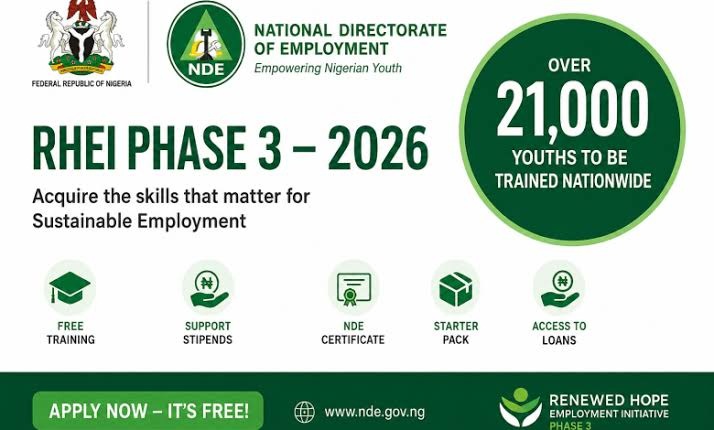
The National Directorate of Employment (NDE) has opened applications for the third phase of its Renewed Hope Employment Initiative (RHEI), offering unemployed and underemployed Nigerians an opportunity to acquire practical skills, improve their employability and build sustainable livelihoods.
The nationwide programme is expected to train 21,824 beneficiaries across the 36 states and the Federal Capital Territory (FCT) through a combination of vocational, entrepreneurial, agricultural, digital and public works training. The initiative is part of the Federal Government’s broader strategy to tackle unemployment, promote self-reliance and strengthen human capital development through skills acquisition.
About the Renewed Hope Employment Initiative
The Renewed Hope Employment Initiative is implemented by the National Directorate of Employment to provide market-driven skills that enable Nigerians to secure employment, establish businesses or expand existing enterprises.
Rather than focusing solely on job placement, the programme seeks to equip participants with practical competencies that respond to local economic needs while encouraging entrepreneurship and economic resilience.
According to the NDE, the initiative is designed to bridge the gap between skills development and income generation by combining technical training with entrepreneurship support and post-training opportunities.
Programme Objectives
The initiative seeks to:
- Reduce unemployment and underemployment across Nigeria.
- Equip Nigerians with practical, industry-relevant skills.
- Promote entrepreneurship and self-employment.
- Support rural economic development through agriculture-based training.
- Enhance productivity among small businesses.
- Improve access to sustainable livelihood opportunities.
Who Can Apply?
Applications are open to Nigerians who:
- Are unemployed or underemployed.
- Are between 18 and 50 years of age.
- Possess a valid means of identification.
- Have a valid National Identification Number (NIN).
- Have a Bank Verification Number (BVN).
- Can provide valid bank account details.
- Are willing to participate fully in the training programme.
- Are ready to attend training at their designated centre.
The programme welcomes a broad range of applicants, including:
- Graduates
- School leavers
- Artisans
- Farmers
- Women
- Persons with disabilities
- Informal sector workers
- Individuals seeking new vocational or entrepreneurial skills
Benefits of the Programme
Successful applicants are expected to benefit from several forms of support, including:
- Fully funded technical and vocational training.
- Practical, hands-on instruction delivered by experienced trainers.
- Entrepreneurship development support.
- National Directorate of Employment certificate upon successful completion.
- Starter packs for selected trades.
- Access to business support initiatives and, where applicable, low-interest financing opportunities.
- Improved employability and opportunities for self-employment.
Programme Categories
Training will be delivered through four major intervention programmes.
1. Vocational Skills Development (VSD)
The Vocational Skills Development Programme focuses on practical trades and technical occupations that are in demand within local communities.
Participants may receive training in areas such as:
- Digital skills
- Fashion and garment making
- Electrical installation
- Welding and fabrication
- Carpentry
- Catering
- Hairdressing and beauty services
- ICT-related skills
- Community-based vocational training
- Special vocational training for persons with disabilities and internally displaced persons.
2. Small Scale Enterprises (SSE)
This component is designed for aspiring entrepreneurs and small business owners.
It includes programmes such as:
- Start Your Own Business (SYOB)
- Basic Business Training
- Enterprise and Finance Counselling
- Micro Enterprise Enhancement Scheme
- Matured People’s Programme.
3. Rural Employment Promotion (REP)
The REP programme promotes agricultural entrepreneurship and rural livelihoods through training in:
- Sustainable agriculture
- Fish farming
- Livestock production
- Organic farming
- Crop processing
- Food processing
- Feed formulation
- Agribusiness development.
4. Special Public Works (SPW)
This programme focuses on employment opportunities that support public infrastructure and environmental sustainability.
Training areas include:
- Solar energy installation
- Environmental beautification
- Graduate Attachment Programme
- Graduate Coaching Scheme
- Other community-based employment initiatives.
Pre-Enrolment Assessment
Following registration, applicants will undergo a compulsory pre-enrolment assessment before final selection.
The assessment will include:
- Identity verification.
- Verification of NIN and BVN.
- Age verification.
- Confirmation of state of residence.
- Validation of bank account information.
- Passport photograph verification.
- Allocation to the nearest training centre.
Applicants are advised to ensure that every detail submitted during registration is accurate, as inconsistencies may affect their eligibility.
Documents Required
Applicants should have the following available before beginning the application:
- National Identification Number (NIN)
- Bank Verification Number (BVN)
- Valid means of identification
- Functional email address
- Active mobile phone number
- Passport photograph
- Bank account details.
How to Apply
Interested applicants can complete their application HERE by following these steps:
- Visit the official application portal.
- Create an account using a valid email address.
- Complete identity verification using your NIN.
- Fill in your personal information.
- Select your preferred programme, scheme and skill area.
- Review your application carefully.
- Submit the completed application.
- Download or print the acknowledgement slip for future reference.
- Await notification regarding the pre-enrolment assessment and subsequent stages of the selection process.
Application Deadline
As of the time of publication, the National Directorate of Employment has not announced a closing date for applications.
Prospective applicants are therefore encouraged to submit their applications as early as possible to avoid last-minute challenges and potential portal congestion.
Enquiries and Support
Applicants experiencing technical difficulties or requiring additional information are advised to:
- Use the contact or support section on the official application portal.
- Visit the nearest National Directorate of Employment state office.
- Follow official NDE communication channels for updates regarding screening, training schedules and beneficiary selection.
Why the Programme Matters
Nigeria continues to face significant unemployment and underemployment challenges, particularly among young people. Skills development programmes such as the Renewed Hope Employment Initiative are increasingly being positioned as a pathway to economic inclusion by helping participants acquire practical skills that respond to labour market needs.
Beyond improving employability, the programme is expected to encourage entrepreneurship, strengthen local industries and contribute to broader economic development through job creation and small business growth.
With more than 21,000 training opportunities available under the latest phase, the initiative represents one of the Federal Government’s major investments in workforce development and enterprise promotion.
[give_form id="20698"]