Four Nigerian Universities Secure ₦235 Million to Commercialise Student Engineering Innovations
 ONYINYECHI NWAIGBA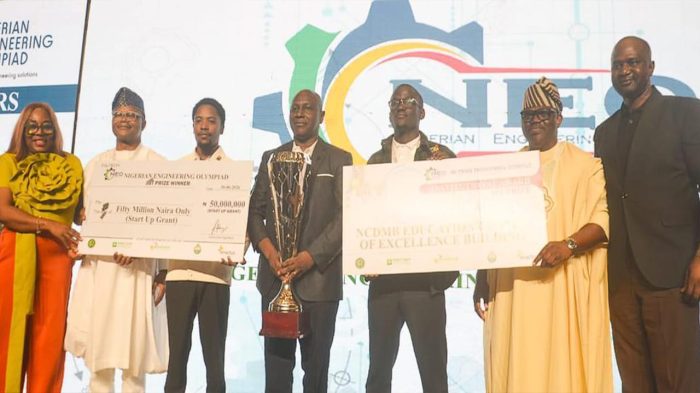
Four Nigerian universities have secured a combined ₦235 million in funding and institutional support after emerging as winners of the maiden Nigerian Engineering Olympiad (NEO), a national competition designed to transform student-led engineering ideas into commercially viable solutions.
The winning institutions Modibbo Adama University (MAU), Yola; the University of Ibadan (UI); the University of Jos (UniJos); and the University of Nigeria, Nsukka (UNN)—were recognised for developing engineering innovations that address some of Nigeria’s most pressing challenges, including insecurity, healthcare, agriculture and energy.
Beyond the cash prizes, the competition provides mentorship, business development support, industry partnerships and commercialisation opportunities to help the innovations move from university laboratories to the marketplace.
The initiative reflects a growing recognition that Nigeria’s universities can play a much bigger role in solving national problems when research is supported with funding, industry collaboration and pathways to commercialisation.
The Winning Innovations
Modibbo Adama University Takes the Top Prize
Modibbo Adama University emerged as the overall winner with Ubuntu Sapphire, a community-powered security alert system designed to improve emergency response, particularly in rural and peri-urban communities where internet connectivity is limited.
The innovation enables households to send rapid alerts to neighbours and emergency responders through affordable communication devices, strengthening community security and improving response times during emergencies.
The university received ₦50 million in seed funding to commercialise the innovation, while its Faculty of Engineering will benefit from the construction of a Centre of Excellence Building, providing additional infrastructure to strengthen engineering research and innovation.
University of Ibadan’s Health Innovation
The University of Ibadan finished second with Aurora Birth, a health technology innovation developed to reduce neonatal deaths caused by birth asphyxia, particularly in low-resource healthcare settings.
Birth asphyxia remains one of the leading causes of newborn mortality in many developing countries. By providing a practical solution tailored to resource-constrained environments, the innovation has the potential to improve maternal and child healthcare outcomes while supporting Nigeria’s broader public health objectives.
The student team received ₦30 million in commercialisation funding, while the university’s Faculty of Engineering was awarded an additional ₦75 million grant to strengthen engineering education and research.
University of Jos Develops AI Solution for Farmers
The University of Jos secured third place with Sentra, a solar-powered artificial intelligence device capable of detecting crop diseases, pest infestations and soil nutrient deficiencies before visible symptoms appear.
The technology is expected to help farmers make quicker decisions, reduce crop losses and improve agricultural productivity.
As climate change and food insecurity continue to challenge agricultural production, innovations like Sentra demonstrate how engineering and artificial intelligence can support more resilient farming systems.
The team received ₦20 million in seed funding to continue product development and commercialisation.
University of Nigeria, Nsukka Wins with Clean Energy Innovation
The University of Nigeria, Nsukka, finished fourth with Flameless, a modular energy solution that converts associated gas into electricity for homes, businesses and communities.
Associated gas is often flared during oil production, contributing to environmental pollution and greenhouse gas emissions. By converting the gas into usable electricity, the innovation offers a cleaner approach to energy generation while supporting improved access to power.
The student team received ₦10 million, while the university’s Faculty of Engineering was awarded a ₦50 million grant to strengthen engineering research and capacity development.
More Than a Competition
Organisers say the Nigerian Engineering Olympiad was created to bridge the long-standing gap between academic research and commercial innovation.
Although Nigerian universities produce thousands of engineering projects every year, only a small number receive the funding, mentorship and industry support needed to become market-ready products.
The Olympiad seeks to change that by providing promising student innovators with access to prototype funding, technical experts, investors, manufacturers and business mentors who can help transform research into commercially viable enterprises.
A Highly Competitive Process
The maiden edition attracted 984 students from 80 tertiary institutions, resulting in 375 applications from engineering teams across Nigeria.
Following a rigorous selection process involving more than 200 judges and industry professionals, 30 teams—five from each of the country’s six geopolitical zones—received ₦3 million each to develop working prototypes.
The shortlisted teams then advanced through regional competitions before 12 finalists participated in an intensive innovation boot camp in Lagos, where they received training in business development, product refinement, pitching and commercialisation.
The programme eventually produced the four winning teams announced at the grand finale.
Backing Innovation Beyond the Classroom
The Nigerian Engineering Olympiad is sponsored by the Nigerian Content Development and Monitoring Board (NCDMB), with Renaissance Africa Energy Company and First Exploration & Petroleum Development Company serving as funding partners. Enactus Nigeria implemented the programme, while engineering professionals, entrepreneurs and industry leaders provided mentorship throughout the competition.
Speaking during the event, representatives of the organisers described investment in young engineers as an investment in Nigeria’s future, noting that innovation and indigenous technology development remain essential to national competitiveness.
Officials also stressed that supporting student innovators is critical to building local manufacturing capacity, creating jobs and reducing dependence on imported technologies.
From Prototype to Marketplace
One of the biggest challenges facing innovation in Nigeria is the inability to move promising ideas beyond the prototype stage.
Many university research projects end as academic papers or laboratory demonstrations because of limited funding, weak industry collaboration and the absence of commercialisation pathways.
To address this gap, organisers announced that the winning teams will receive ongoing mentorship, access to investors, manufacturing support and business development services aimed at preparing their products for the market.
In addition, the National Agency for Science and Engineering Infrastructure (NASENI) said the top-performing teams would be admitted into its Innovation Hub, where they will receive further technical and business support to accelerate commercialisation.
Looking Ahead
Organisers have disclosed plans to expand the impact of the Olympiad over the next three years by supporting the development of more than 150 engineering prototypes and nurturing numerous technology start-ups capable of contributing to Nigeria’s industrial transformation.
Funding support for future editions is also expected to increase, with prototype grants for shortlisted teams set to rise from ₦3 million to ₦5 million, providing additional resources for student innovators to refine their technologies.
Why It Matters
The success of the maiden Nigerian Engineering Olympiad highlights the growing importance of investing in youth-led innovation as a driver of sustainable development.
From healthcare and agriculture to energy and community security, the winning projects demonstrate how locally developed technologies can address real societal challenges while creating opportunities for entrepreneurship, job creation and industrial growth.
For Nigeria, initiatives that connect universities with industry, investors and government institutions offer a pathway to unlocking the country’s innovation potential. Rather than allowing promising research to remain within academic institutions, programmes like the Nigerian Engineering Olympiad provide young innovators with the support needed to transform ideas into products, businesses and lasting social impact.
[give_form id="20698"]